By now you have several tools for limits: reading a graph, building a table, the limit laws, factoring and rationalizing. A real question does not say which one to use. This page gives you a plan. One substitution, read carefully, tells you which tool comes next.
Substitute first
Start every limit by putting into the expression. This is fast, and it is often the whole job. The limit laws say that for a polynomial, or a quotient of polynomials whose denominator is not 0 at , the limit equals the value:
Worked example 1. Find .
Substitute: the denominator is , not 0. So the limit is the value.
Read the result
Substitution can come out three ways. Each one sends you somewhere different.
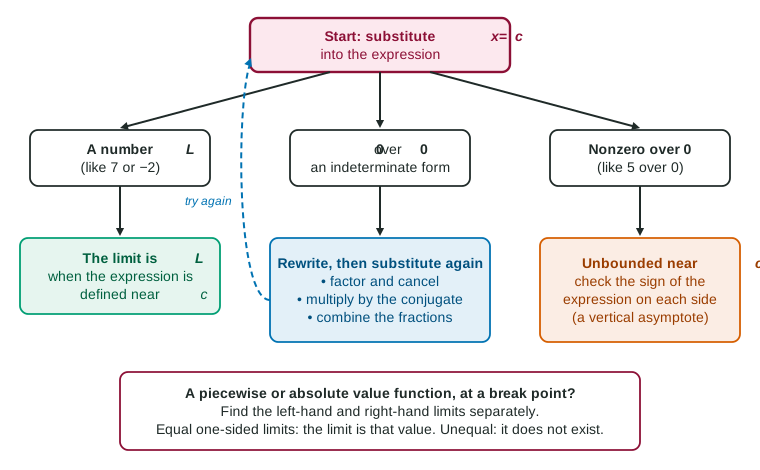
| Substituting gives | What it means | What to do |
|---|---|---|
| a number, like | the expression is defined near | that number is the limit |
| top and bottom share a zero factor | rewrite, then substitute again | |
| nonzero over 0, like | the bottom shrinks, the top does not | the function is unbounded; check each side's sign |
One more case sits beside the table. If the function changes formula at (a piecewise function, or an absolute value), the two sides follow different rules. Then find the left-hand and right-hand limits separately and compare them.
Zero over zero: rewrite
is called an indeterminate form. It is not a number and it is not an answer. It says the numerator and the denominator both reach 0 at , which usually means they share a factor that is 0 there. Remove that factor and the rest of the expression tells you the limit. Three moves cover almost every case.
Factor and cancel when you see polynomials.
Worked example 2. Find .
Substitute: . Rewrite.
Factor the top:
A limit never looks at itself, so the two expressions have the same limit:
Multiply by the conjugate when a square root sits next to a subtraction.
Worked example 3. Find .
Substitute: . Multiply top and bottom by the conjugate :
Now substitute: .
Combine fractions when small fractions sit inside a big one.
Worked example 4. Find .
Substitute: . Put the top over one denominator: . Then
Substitute: .
Keep the limit symbol on every line until the final substitution. The rewritten expression equals the original only for , and the limit symbol is what makes that enough. Never write : the 5 comes from the rewritten expression, not from .
Nonzero over zero: unbounded
Suppose substitution gives . Near the numerator stays close to 6 while the denominator gets as small as you like. Dividing 6 by a tiny number gives a huge number. So the function is unbounded near , and the limit does not exist. No rewriting changes this, because there is no common zero factor to cancel.
The sign on each side tells the shape. For near 3: just left of 3, is a tiny negative number, so is a huge negative number. Just right of 3, is a huge positive number. The graph has a vertical asymptote at . A later topic gives this behavior its own notation.
Break points: one side at a time
For a piecewise function, use the formula that applies on each side. For an absolute value, remember when and when , so it is a piecewise function in disguise.
Worked example 5. Let for and for . Find .
From the left, use : . From the right, use : .
The one-sided limits are equal, so . Had they differed, the limit would not exist.
A checklist
- Substitute .
- A number? That is the limit.
- ? Factor, use a conjugate, or combine fractions. Then substitute again.
- Nonzero over 0? The function is unbounded near ; the limit does not exist. Check the sign on each side.
- A formula change at ? Find both one-sided limits and compare.
- Still stuck, or no formula at all? Use a graph or a table of values.