So far you have estimated limits by looking: at a graph, at a table. Now you will find them exactly, with rules. The good news is that the rules are the ones you would guess. Limits respect ordinary arithmetic. If you know where and are heading, you know where , and many other combinations are heading. For most functions in this course, the rules boil down to one step: substitute.
The limit laws
Suppose and , and both of these limits exist. Then:
| Law | In symbols | Condition |
|---|---|---|
| Sum and difference | ||
| Constant multiple | ||
| Product | ||
| Quotient | ||
| Power | a positive integer | |
| Root | for even roots |
Two simple limits start everything off: for a constant , and . Both are obvious from their graphs, a flat line and the line .
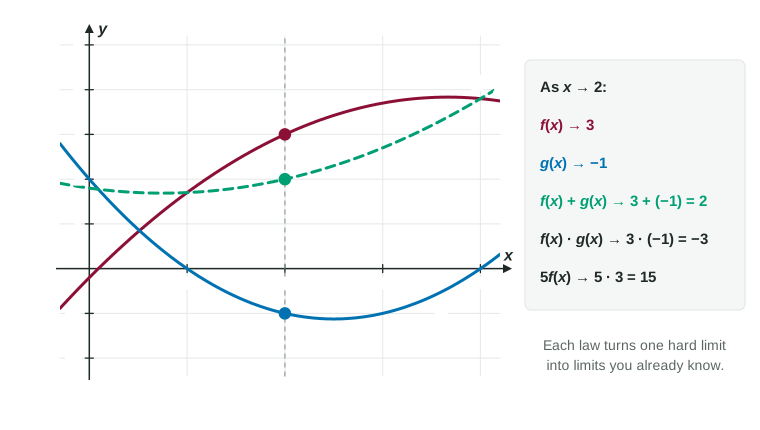
Worked example 1. Given and , find .
Numerator: , by the constant multiple, power and difference laws.
Denominator: , which is not 0, so the quotient law applies.
So the limit is .
Direct substitution
Every polynomial is built from constants and using sums, products and constant multiples. The laws therefore give, for any polynomial , The same holds for a rational function as long as , and for roots of these where the expression is defined. Finding a limit by evaluating at is called direct substitution. It is the first thing to try on every limit.
Worked example 2. Find .
This is a rational function, and the denominator at is . Substitute:
Why does this not contradict the idea that a limit ignores ? It doesn't. For these well-behaved functions the limit and the value simply happen to agree. The laws prove they agree; the value is not being used as the definition.
When the laws are silent
The laws come with conditions, and the conditions are where exam questions live.
- Denominator heading to 0, numerator not. For , the top heads to 3 and the bottom to 0. Numbers near 3 divided by numbers near 0 are huge in size, so there is no finite limit. Writing is never a value; say it in words.
- Both top and bottom heading to 0. For , substitution gives a zero in both places, which tells you nothing yet. The limit might be any number, or might not exist. Topic 1.6 shows the algebra that settles it.
- One of the limits does not exist. The laws need both limits to exist. If they do not, the laws do not apply, but the combination might still have a limit. Two jumps can cancel each other in a sum.
Worked example 3. jumps at : it heads to 2 from the left and 0 from the right. heads to 1 from the left and 3 from the right. Find and .
Neither nor has a limit at 1, so use one side at a time.
Sum: from the left ; from the right . So
Product: from the left ; from the right . They differ, so does not exist.
One-sided limits from formulas
The laws work for one-sided limits too. For a piecewise function, each one-sided limit uses the formula for that side.
Worked example 4. Let
Left:
Both are 8, so .
Limits of compositions
For , work from the inside out. First find . If is continuous at (its graph is unbroken there), then heads to :
For example,