Limit Laws
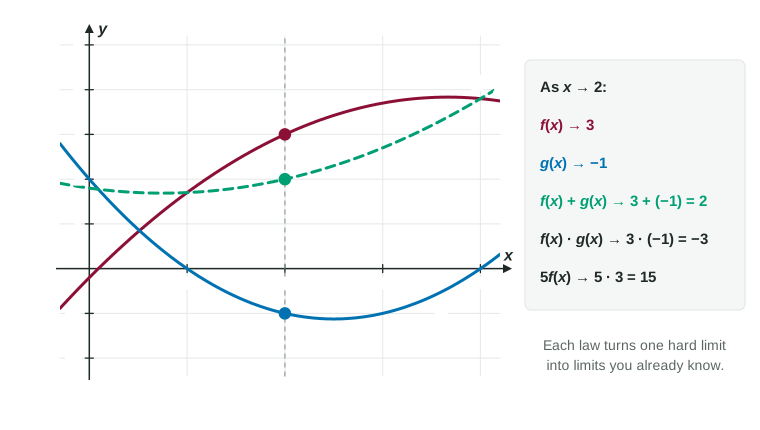
The limit laws let you split a limit over sums, differences, constant multiples, products, quotients (with a nonzero denominator limit), powers, roots and compositions.
Part 1 · Hook
Why this matters
Part 2 · Before you start
What this builds on
Part 3 · Prerequisite check
Quick check before you start
1. If and , then is
- it does not exist
Show the answer
Equal one-sided limits give the limit.
- Correct: :
- it does not exist:
- :
- :
2. Let and . What is ?
Show the answer
and .
- Correct: :
- :
- :
- :
Part 4 · See it
See it first
Part 5 · Step by step
How it works, step by step
- and both existthe limit of , and is , and
- The denominator's limit is not 0the limit of is
- Polynomials and rational functions are built from x and constants with these operationstheir limits come from substitution, as long as the denominator is not 0 at
- A denominator heads to 0the quotient law is silent: a nonzero top means no finite limit; a top also heading to 0 needs the algebra of Topic 1.6
Part 6 · Key ideas
Key ideas
- Sum, difference, constant multiple, product: if both limits exist, combine them the same way.
. - Quotient:
only when . - Powers and roots: , and when .
- Direct substitution: for a polynomial, or a rational function with a nonzero denominator at , the limit is the value at .
- For a composite, find the inside limit first: if and is continuous at , then .
- For a piecewise function, use each side's formula for its one-sided limit.
Part 7 · Misconception
A common mistake
The wrong idea: If neither nor exists, then does not exist.
What actually happens: The laws need both limits to exist; when they do not, the laws are silent, not negative. Check the sum one side at a time: two jumps can cancel, as with and at , where the sum's limit is 3.
Part 8 · Check yourself
Check yourself
Exam-style questions. Anything you miss goes into your review queue.
Graph
The graphs of and
1. What is ?
- It does not exist, because neither nor exists.
Show the answer
Work one side at a time. From the left, and , so . From the right, and , so the sum . Both sides give 3, so the limit is 3, even though and each jump.
- Correct: : Left: . Right: . Both 3.
- It does not exist, because neither nor exists.: The sum law needs both limits to exist, so it cannot be used here; but the sum can still have a limit. Check each side of the sum directly.
- : 5 mixes sides: 's left-hand limit 2 plus 's right-hand limit 3. Each one-sided limit of the sum uses the same side for both functions.
- : 2 is the left-hand limit of alone; the question asks about the sum .
2. What is ?
- It does not exist.
- , from
Show the answer
From the left, . From the right, . The one-sided limits differ, so the limit does not exist.
- Correct: It does not exist.: Left 2, right 0.
- , from : 2 is only the left-hand limit of the product.
- : 0 is only the right-hand limit (and ).
- : 3 is the limit of the sum, not the product.
3. Read the needed values from the graphs and use the quotient law to find .
No calculator. Type the exact value (a fraction, π, e or a root is fine).
Show the answer
Near both graphs are unbroken lines: and . Since , the quotient law gives .
- Answer: ≈ 0.250
4. Use the graphs to evaluate the limit of the composite function, .
Show the answer
As , . Near an input of 2, is the unbroken line , so .
- Correct: : Inside first: ; then near 2 gives 1.
- : 2 is the inside limit, . Then apply .
- : That is , not the composite near .
- : That is from the right; the input to is near 2, not 1.
5. Find .
No calculator. Type the exact value (a fraction, π, e or a root is fine).
Show the answer
A rational function whose denominator is not 0 at : substitute. Numerator ; denominator . Limit: .
- Answer: -2
6. Which limit can be found by direct substitution?
Show the answer
A rational function can be evaluated by substitution where its denominator is not 0. At the denominator is 4, so the limit is .
- Correct: : Denominator 4 at : substitute.
- : At the denominator is 0, so substitution gives no value; Topic 1.6 handles this.
- : At the denominator is 0.
- : is not defined for near 1.
7. What can you conclude about ?
- It is not a finite number: the top approaches 3 and the bottom approaches 0.
- It equals 0, because the bottom approaches 0 and the quotient shrinks with it.
- It equals 3, the limit of the top.
- It equals .
Show the answer
The quotient law fails because the denominator's limit is 0. With the top near 3 and the bottom near 0, the quotient grows without bound in size, so it has no finite limit.
- Correct: It is not a finite number: the top approaches 3 and the bottom approaches 0.: Nonzero over a number near 0: unbounded.
- It equals 0, because the bottom approaches 0 and the quotient shrinks with it.: A small denominator makes a quotient large.
- It equals 3, the limit of the top.: The denominator still matters.
- It equals .: is not a number; that is not a limit value.
Part 9 · Summary
Summary
Part 10 · Up next
What comes next
Part 11 · Connections