What a Limit Is and How to Write It
lim as x → a, f(x) = L says that f(x) closes in on L as x approaches a from both sides.
Part 1 · Hook
Why this matters
Part 2 · Before you start
What this builds on
Part 3 · Prerequisite check
Quick check before you start
1. The average speed of a stone over is . What does it close in on as shrinks toward 0?
Show the answer
shrinks toward 0, leaving 32.
- Correct: :
- :
- :
- :
2. On a graph, an open circle at means
- the point is not on the graph
- the graph crosses the -axis at 2
Show the answer
An open circle marks a point left out of the graph.
- Correct: the point is not on the graph:
- :
- :
- the graph crosses the -axis at 2:
Part 4 · See it
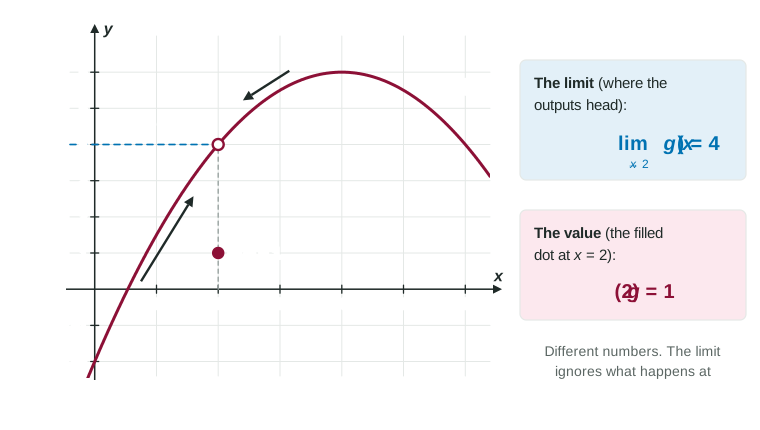
See it first
Part 5 · Step by step
How it works, step by step
- Let get close to from both sides, but never equal watch where the outputs go
- If the outputs close in on a single number we write : the limit of as approaches is
- The definition never uses itselfthe limit can differ from , or exist when is not defined
- A limit can be read from a graph, a table or a formulathe next four topics teach each way
Part 6 · Key ideas
Key ideas
- means: as gets close to (from both sides, ), gets close to , as close as we like.
- The limit at and the value are different questions. A hole can have a limit and no value; a filled dot off the curve gives a value that is not the limit.
- Read the notation from the bottom up: the input heads to , the output heads to .
- Write "lim" with its arrow on every line until the line where you substitute and get a number; then drop it.
Part 7 · Misconception
A common mistake
The wrong idea: is just , the value of the function at .
What actually happens: The limit describes where heads for inputs near , never at . It equals for many functions, but not when the graph has a hole or a dot off the curve, and it can exist when does not.
Part 8 · Check yourself
Check yourself
Exam-style questions. Anything you miss goes into your review queue.
Graph
The graph of
1. What is ?
Show the answer
As gets close to 1 from either side, the heights of the graph get close to 1, the height of the open circle. The filled dot at is the value , which the limit ignores.
- Correct: : The curve heads to height 1 from both sides.
- : 3 is , the value at . A limit is about where the heights head as approaches 1.
- : No part of the graph near heads to 2.
- : The graph near stays at heights near 1, not 0.
2. What is ?
- is not defined
Show the answer
is the height of the filled dot above : 3.
- Correct: : The filled dot is at .
- : The open circle at is not on the graph; 1 is the limit, not the value.
- is not defined: There is a filled dot at , so is defined.
- : No point of the graph is at .
3. What is ?
Show the answer
Near the graph is an ordinary unbroken curve through , so the heights close in on 3. Here the limit and the value agree.
- Correct: : The curve passes through with no gap.
- : 1 is the limit at , not at .
- : 5.5 is the height at .
- : Read the height above : it is 3.
4. Which statement about is true?
Show the answer
At the limit is 1 but the value is 3, so they are not equal.
- Correct: : 1 and 3 differ.
: The limit is 1 and . - : At both the limit and the value are 3.
- : Near the curve is at height about 5.5, not 3.
5. Which sentence reads correctly?
- As approaches 4, approaches 7.
- As approaches 7, approaches 4.
- .
- As approaches 4, approaches 7.
Show the answer
The number under "lim" is where the input goes (); the number after the equals sign is where the output goes (7).
- Correct: As approaches 4, approaches 7.: Input heads to 4, output heads to 7.
- As approaches 7, approaches 4.: The input and output numbers are swapped.
- .: A limit statement says nothing certain about the value at .
- As approaches 4, approaches 7.: The roles of and are swapped.
6. A student says: ", so ." Is the student right?
- Not necessarily: could be a different number or not defined at all.
- Yes: a limit is the value of the function at the point.
- No: if the limit is 5, then is some other number.
- Yes: whenever a limit exists, the function is defined there.
Show the answer
The limit is about inputs near 2, never at 2. might be 5, might be another number, or might not exist. The graph of in this topic, with limit 1 and value 3 at , is an example.
- Correct: Not necessarily: could be a different number or not defined at all.: The limit ignores itself.
- Yes: a limit is the value of the function at the point.: The limit and the value are different ideas; they agree only for some functions.
- No: if the limit is 5, then is some other number.: They can be equal; for many functions they are.
- Yes: whenever a limit exists, the function is defined there.: A function with a hole has a limit at the hole but no value there.
7. A function has , and as approaches 3 from either side, the values close in on 6. Which is correct?
- and
- and
- and
- and
Show the answer
The limit is where the values head (6); the value at 3 is what actually gives there (8).
- Correct: and : Limit 6 from the trend, value 8 at the point.
- and : The two numbers are swapped.
- and : The value at the point does not set the limit.
- and : The input target is 3, not 6.
Part 9 · Summary
Summary
Part 10 · Up next
What comes next
Part 11 · Connections