Reading Limits from a Graph
Read a graph's limit one side at a time.
Part 1 · Hook
Why this matters
Part 2 · Before you start
What this builds on
Part 3 · Prerequisite check
Quick check before you start
1. What does mean?
- As approaches 2, approaches 6
- As approaches 6, approaches 2
Show the answer
Input heads to 2, outputs head to 6; the value is not involved.
- Correct: As approaches 2, approaches 6:
- :
- As approaches 6, approaches 2:
- :
2. A graph has a filled dot at and an open circle at . What is ?
- not defined
Show the answer
The filled dot is on the graph.
- Correct: :
- :
- not defined:
- :
Part 4 · See it
See it first
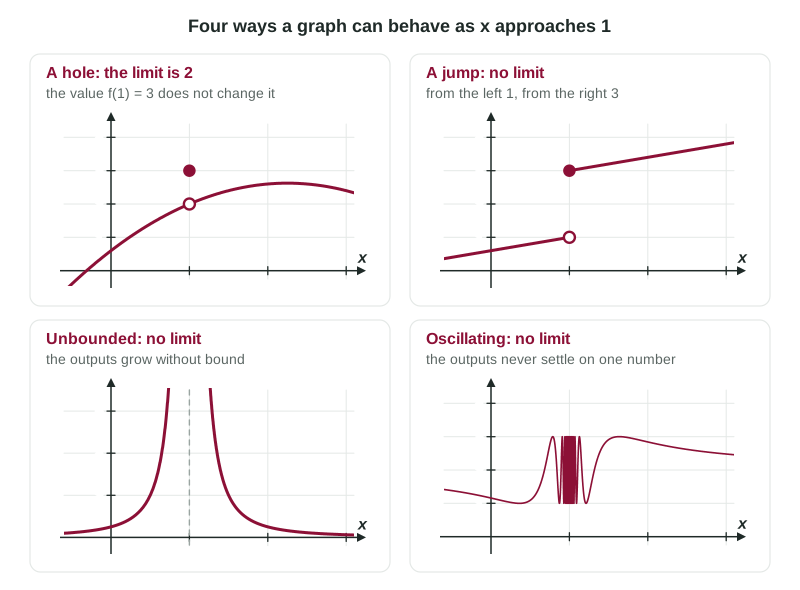
Part 5 · Step by step
How it works, step by step
- Slide toward from the left onlythe heights give the left-hand limit,
- Slide toward from the right onlythe heights give the right-hand limit,
- Both one-sided limits exist and are equalthe two-sided limit exists and equals that number
- The sides disagree, the outputs are unbounded, or they oscillatethe limit does not exist
Part 6 · Key ideas
Key ideas
- uses only ; uses only . Follow the graph's heights on that side to the edge at .
- exactly when both one-sided limits equal .
- A limit fails to exist when the one-sided limits differ (a jump), when the outputs grow without bound, or when they oscillate.
- Filled and open dots tell you ; they never decide the limit.
- A justification names both one-sided limits: "From the left ; from the right ; since , the limit does not exist."
Part 7 · Misconception
A common mistake
The wrong idea: If is not defined, then does not exist.
What actually happens: A missing value never decides a limit. A hole has a limit (the height it sits at) and no value. Decide existence only from the two one-sided limits.
Part 8 · Check yourself
Check yourself
Exam-style questions. Anything you miss goes into your review queue.
Graph
The graph of
1. Reading each side of the graph, what is ?
- The limit does not exist.
Show the answer
From the left, the line heads to height 3; from the right, the curve also heads to height 3. Both one-sided limits are 3, so the limit is 3. The dot at is , which does not affect the limit.
- Correct: : Left and right both head to 3.
- : 1 is , the filled dot. A limit does not use the value at the point.
- : is the input being approached.
- The limit does not exist.: Both sides head to the same height, 3, so the limit exists.
2. What is ?
- The limit does not exist.
Show the answer
For just to the right of 1, the graph is the rising line, whose heights head to 0, the open circle at .
- Correct: : From the right, the line heads to the open circle at height 0.
- : is where the curve on the left ends, so it is the limit from the left.
- : 1 is the -value, not a height.
- The limit does not exist.: A one-sided limit only needs one side to settle, and the right side heads to 0.
3. Which statement about is correct?
- It does not exist, because
and . - It equals , because .
- It equals , halfway between the two sides.
- It does not exist, because is not defined.
Show the answer
A two-sided limit needs both one-sided limits to be equal. From the left the heights head to ; from the right, to 0. They differ, so the limit does not exist.
- Correct: It does not exist, because
and .: Names both one-sided limits and why they rule out a limit. - It equals , because .: is a value; it does not make the right side agree.
- It equals , halfway between the two sides.: There is no averaging: when the sides disagree there is no limit.
- It does not exist, because is not defined.: is defined: the filled point . The reason is the unequal sides.
4. Which statement about is true?
Show the answer
From the left of 1, the curve heads to , and the filled point at the end of that curve says . They match.
- Correct:
: Both equal . : From the right the heights head to 0, but . : The limit at is 3, but . - : From the left of , the line heads to 3, not to the dot at 1.
5. Find .
No calculator. Type the exact value (a fraction, π, e or a root is fine).
Show the answer
From the left, the line's heights head to 3. The value is the filled dot, 1. Sum: .
- Answer: 4
6. Near , the graph of a function wiggles up and down between heights and infinitely many times, faster and faster as gets closer to 0. What is ?
- It does not exist, because the outputs oscillate and settle on no single number.
- , the height halfway between and .
- , the highest height the graph reaches.
- It does not exist, because the outputs grow without bound.
Show the answer
However close gets to 0, the outputs keep taking every value from to 1. They never settle near one number, so there is no limit.
- Correct: It does not exist, because the outputs oscillate and settle on no single number.: Oscillating outputs settle on nothing.
- , the height halfway between and .: The outputs pass through 0 but never stay close to it.
- , the highest height the graph reaches.: The graph keeps coming back down from 1.
- It does not exist, because the outputs grow without bound.: The outputs stay between and 1; they are bounded. The cause is oscillation.
7. Which condition guarantees that ?
- and
- and
Show the answer
A two-sided limit exists and equals exactly when both one-sided limits exist and equal .
- Correct: and : Both sides equal 5: that is the definition's test.
- : The value at says nothing about nearby outputs.
- : One side is not enough; the right side could head elsewhere.
- and : The right side is still unknown, and the value does not help.
Part 9 · Summary
Summary
Part 10 · Up next
What comes next
Part 11 · Connections