Limits at Infinity and Horizontal Asymptotes
A limit at infinity describes where f(x) heads as x → ∞ or x → −∞ ; a finite one gives a horizontal asymptote.
Part 1 · Hook
Why this matters
Part 2 · Before you start
What this builds on
Part 3 · Prerequisite check
Quick check before you start
1. For large , which term of matters most?
- They matter equally
Show the answer
The highest power grows fastest.
- Correct: :
- :
- :
- They matter equally:
2. What is ?
Show the answer
One over a tiny positive number grows without bound.
- Correct: :
- :
- :
- :
3. equals
Show the answer
A negative exponent means a reciprocal.
- Correct: :
- :
- :
- :
Part 4 · See it
See it first
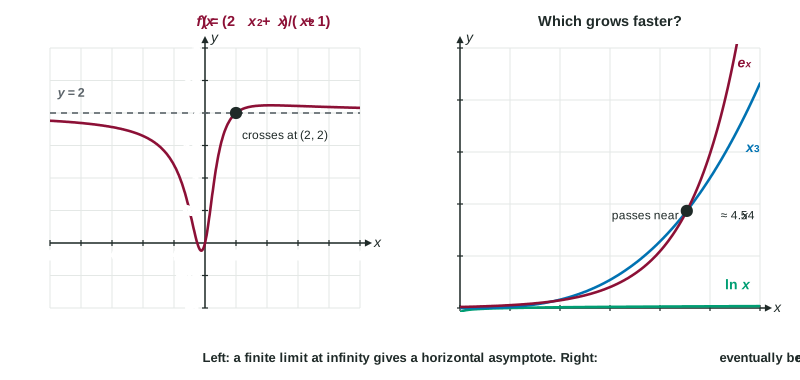
Part 5 · Step by step
How it works, step by step
- grows without boundterms like , and shrink to 0
- You divide the top and bottom of a quotient by the dominant termevery other term becomes one of those shrinking terms, and the limit can be read off
- or is finite is a horizontal asymptote; the graph levels off there (and may cross it in the middle)
- Two functions both grow without boundthe faster one dominates: as , loses to any power (), and loses to
Part 6 · Key ideas
Key ideas
- means approaches as grows without bound. A finite limit at or gives a horizontal asymptote .
- For a rational function, divide by the highest power of in the denominator. Equal degrees: ratio of leading coefficients. Bottom higher: 0. Top higher: no horizontal asymptote.
- . As , , which can flip the sign of the answer.
- Dominant terms: in the long run loses to every positive power, and beats every power.
- Vertical asymptote: . Horizontal asymptote: . Do not mix them up.
Part 7 · Misconception
A common mistake
The wrong idea: A graph never crosses its horizontal asymptote, and the limit at is the same as at .
What actually happens: A horizontal asymptote only describes the far ends: crosses at . And the two ends can differ: approaches 4 on the right and on the left.
Part 8 · Check yourself
Check yourself
Exam-style questions. Anything you miss goes into your review queue.
Table
Four rational functions
| Function | Formula |
|---|---|
1. Divide by the highest power of to find .
No calculator. Type the exact value (a fraction, π, e or a root is fine).
Show the answer
Divide every term by :
- Answer: ≈ 1.500
2. Which function has the horizontal asymptote ?
Show the answer
In the denominator has the higher degree. Dividing by :
- Correct: : Degree 1 over degree 2: the denominator dominates, so the quotient approaches 0.
- : Equal degrees give .
- : The numerator has the higher degree, so is unbounded.
- : Equal degrees give .
Graph
The graph of
3. Why is rather than ?
- For , is negative, so the quotient changes sign
- The constant 1 under the root becomes when is negative
- Limits at are the negatives of limits at
- For , , so
Show the answer
. When is negative, , so for large negative ,
- For , is negative, so the quotient changes sign: A square root is never negative; it is the numerator that is negative.
- The constant 1 under the root becomes when is negative: The 1 stays 1; it just becomes small next to .
- Limits at are the negatives of limits at : Not in general: above has the same limit in both directions.
- Correct: For , , so : The root is , which equals for negative , while the numerator is negative.
4. How many horizontal asymptotes does the graph of have?
- Two: and
- One:
- One:
- Zero, since is defined everywhere
Show the answer
A horizontal asymptote comes from a finite limit at or at . Here they differ, 4 and , so there are two.
- Correct: Two: and : Each direction gives its own finite limit.
- One: : The left side levels off at , a second asymptote.
- One: : , but asymptotes describe behavior far out, not at the origin.
- Zero, since is defined everywhere: Being defined everywhere does not stop a graph from leveling off.
5. Find .
Show the answer
An exponential with base greater than 1 eventually grows faster than any power of . So dominates and the quotient approaches 0.
- : is larger only for moderate ; in the long run wins.
- : The two do not grow at the same rate.
- Correct: : passes (near ) and then leaves it far behind.
- : The exponent 3 does not appear in the limit.
6. Can a graph cross its own horizontal asymptote? Consider
- No: a graph stays off its asymptote
- Yes: , yet as
- No: for each , so it stays above
- Yes, but then is no longer an asymptote
Show the answer
when , so at . A horizontal asymptote describes behavior far out, as , and says nothing about the middle of the graph.
- No: a graph stays off its asymptote: Vertical asymptotes cannot be crossed (the function is unbounded there), but horizontal ones can.
- Correct: Yes: , yet as : : the graph crosses , and still approaches it far out.
- No: for each , so it stays above: , so the graph is sometimes below.
- Yes, but then is no longer an asymptote: The asymptote is defined by the limit at infinity, which is still 2.
Part 9 · Summary
Summary
Part 10 · Up next
What comes next
Part 11 · Connections