Skills Beta
Trigonometry and the Unit Circle
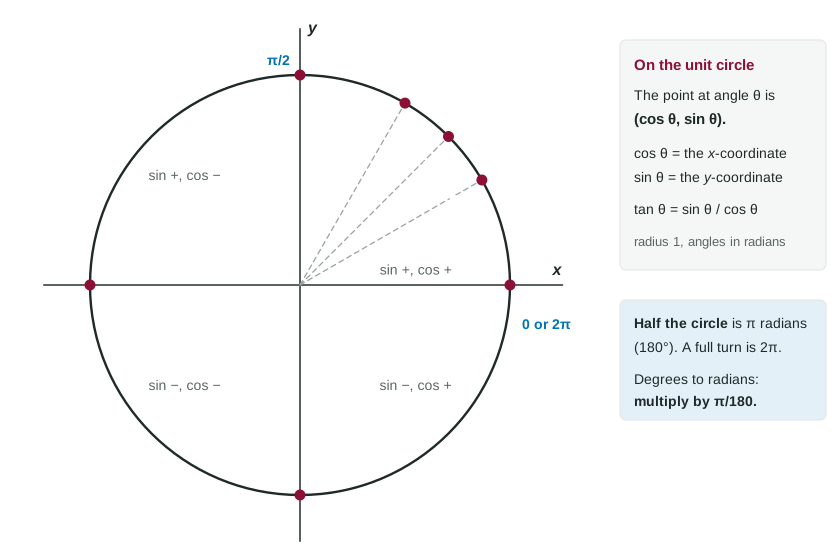
Radians measure angles by arc length on the unit circle, where the point at angle θ is (cos θ, sin θ) .
Practice 1: Implementing Mathematical Processes
Question set for this topic
Part 1 · Hook
Why this matters
Calculus measures angles in
radians, and the six
trig functions show up in every unit: as rates of change, as areas, as models for anything that repeats. Most trig mistakes on the exam are precalculus slips: a wrong sign in a quadrant, a degree-mode calculator,
misread. This page rebuilds trig from one picture, the
unit circle.
Part 2 · Before you start
What this builds on
Part 3 · Prerequisite check
Quick check before you start
1. Which expression is written with an exponent?
Show the answer
A negative exponent is a reciprocal.
- Correct: :
- :
- :
- :
2. The graph of is the graph of moved
- 2 units right
- 2 units left
- 2 units up
- 2 units down
Show the answer
Replacing by shifts right by 2.
- Correct: 2 units right:
- 2 units left:
- 2 units up:
- 2 units down:
Part 5 · Step by step
How it works, step by step
- Measure an angle by the arc it cuts on a circle of radius 1→radians: a half turn is , a full turn
- Walk an angle around the unit circle from →the point reached is , and
- The point lies on →, the Pythagorean identity
- A reference angle in the first quadrant plus the quadrant signs→gives the exact value at any special angle
Part 6 · Key ideas
Key ideas
- Radians: radians . To convert degrees to radians, multiply by . Calculus always uses radians, including on the calculator.
- On the unit circle, the point at angle is : cosine is the -coordinate, sine the -coordinate.
- Know the first-quadrant values at : . Other quadrants use a reference angle and a sign.
- , , . means .
- Pythagorean identity: ; also and .
Part 7 · Misconception
A common mistake
The wrong idea: , and .
What actually happens: Trig functions are not multiplied through: . And means . Test with : , but .
Part 8 · Check yourself
Check yourself
Exam-style questions. Anything you miss goes into your review queue.
1. Find exactly.
No calculator. Type the exact value (a fraction, π, e or a root is fine).
Show the answer
Reference angle , with . In the second quadrant cosine is negative: .
- Answer: ≈ -0.500
2. Find exactly.
No calculator. Type the exact value (a fraction, π, e or a root is fine).
Show the answer
: reference angle , third quadrant, so .
- Answer: ≈ -0.500
3. Find exactly.
No calculator. Type the exact value (a fraction, π, e or a root is fine).
Show the answer
.
4. Which values of in solve ?
- and
- and
- and
- and
Show the answer
. The reference angle with sine is ; sine is negative in quadrants III and IV: and .
- Correct: and : Quadrants III and IV with reference angle .
- and : Those give .
- and : Those give ; the reference angle should be , not .
- and : Those give ; sine at is positive.
5. Which expression equals for every ?
Show the answer
From the Pythagorean identity , subtract from both sides.
- Correct: : .
- : , a different identity.
- : The sign is positive: .
- : The identity involves squares: , not .
6. Which expression equals for every ?
Show the answer
The double-angle identity: . Check at : and .
- Correct: : The double-angle identity.
- : At : , but .
- : That always equals 1, but varies.
- : Missing the factor 2: at it gives , not 1.
7. Use a calculator to find , where the angle is in radians. Give your answer to three decimal places.
Calculator allowed. Give the answer correct to three decimal places.
Show the answer
In radian mode, . Calculus formulas assume radians, so check the mode before every trig calculation.
Part 9 · Summary
Summary
Radians measure angles by arc length on the unit circle, where the point at angle
is
. Exact values come from the first-quadrant special angles plus the quadrant signs. Tangent, secant, cosecant and cotangent are ratios of sine and cosine, and
links them. Keep calculators in radian mode.
Part 10 · Up next
What comes next
Part 11 · Connections
Connections