The Squeeze Theorem
If g(x) ≤ f(x) ≤ h(x) near c and g and h have the same limit L at c , then f has limit L too.
Part 1 · Hook
Why this matters
Part 2 · Before you start
What this builds on
Part 3 · Prerequisite check
Quick check before you start
1. For every real , the values of lie
- between and
- between and
- between and
- anywhere on the number line
Show the answer
On the unit circle, is a -coordinate, so .
- Correct: between and :
- between and :
- between and :
- anywhere on the number line:
2. If , then is
- not known
Show the answer
By the limit laws: 2(3) − 1 = 5.
- Correct: :
- :
- :
- not known:
3. Which is ?
- It does not exist
Show the answer
Cancel : the expression is for , which approaches 2.
- Correct: :
- :
- :
- It does not exist:
Part 4 · See it
See it first
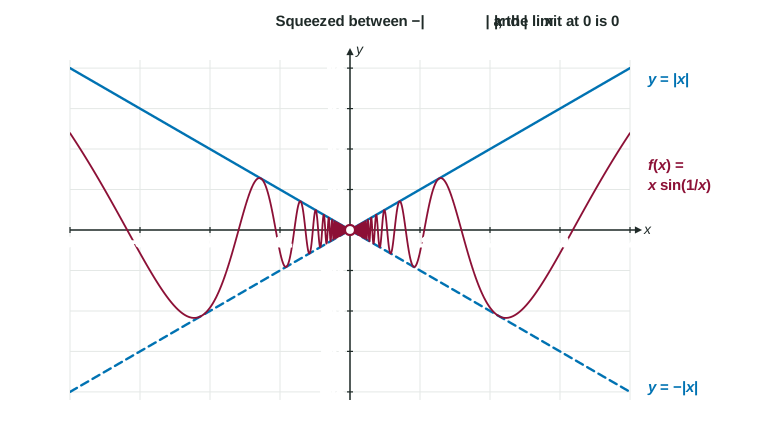
Part 5 · Step by step
How it works, step by step
Part 6 · Key ideas
Key ideas
- Squeeze theorem: a function trapped between two functions with the same limit at also has limit at .
- Both bounds must approach the same value. Bounds with different limits give no conclusion.
- Build bounds from and , multiplied by a factor that is not negative (use , not ).
- The special limit
comes from the squeeze. Match the inside: . - A justification states the inequality, shows the two bounds have the same limit, and names the squeeze theorem.
Part 7 · Misconception
A common mistake
The wrong idea: , so the squeeze theorem shows has a limit at 0.
What actually happens: The bounds and have different limits, so the squeeze theorem says nothing. In fact oscillates and has no limit at 0. Multiply by and the bounds both approach 0; then the squeeze works.
Part 8 · Check yourself
Check yourself
Exam-style questions. Anything you miss goes into your review queue.
Graph
Three functions near
1. The graph shows and , with for every . Find .
No calculator. Type the exact value (a fraction, π, e or a root is fine).
Show the answer
and . Since near 2, the squeeze theorem gives .
- Answer: 3
2. Which pair of facts is exactly what the squeeze theorem needs to conclude ?
- near 2, and both and have limit 3 there
- , and lies between and at
- , and wiggles faster and faster as nears 2
- near 2, and has limit 3 as approaches 2
Show the answer
The theorem has two parts: the inequality for near 2 (not at 2), and equal limits for the two bounds. Then has limit too.
- Correct: near 2, and both and have limit 3 there: These are the two conditions: is trapped, and the trap closes at the single value 3.
- , and lies between and at : does not exist here, and the theorem never uses the value at the point.
- , and wiggles faster and faster as nears 2: Wiggling is not a condition, and equal values at 2 are not the same as equal limits.
- near 2, and has limit 3 as approaches 2: must be trapped between the bounds, and both bounds need limit 3; one bound is not enough.
3. Suppose the upper bound were instead of , still with near 2. What does the squeeze theorem say about ?
- The limit is 3.5, halfway between the limits of the bounds
- Nothing: the bounds approach different values, 3 and 4
- The limit is 4, the larger of the two bounds
- The limit does not exist, since the bounds differ
Show the answer
The squeeze theorem applies only when both bounds have the same limit. With limits 3 and 4 it gives no conclusion; might have a limit, or might not.
- The limit is 3.5, halfway between the limits of the bounds: Nothing in the theorem averages the bounds.
- Correct: Nothing: the bounds approach different values, 3 and 4: Unequal bound limits leave a gap from 3 to 4, so is not pinned to one value.
- The limit is 4, the larger of the two bounds: The upper bound does not decide the limit by itself.
- The limit does not exist, since the bounds differ: Unequal bounds do not prove the limit fails to exist; the theorem simply gives no answer.
4. Find .
No calculator. Type the exact value (a fraction, π, e or a root is fine).
Show the answer
- Answer: 5
5. To squeeze as , which pair of bounds is valid on both sides of 0?
- and
- and
- and
- and
Show the answer
, so for all . Both bounds approach 0, so the limit is 0.
- and : For , multiplying by flips the inequalities, so fails there.
- Correct: and : Multiplying by keeps the direction, and both bounds go to 0.
- and : These are true bounds, but their limits are and , which are not equal.
- and : The function is negative for many , so 0 is not a lower bound.
6. A student writes: ", so by the squeeze theorem exists and is between and ." What is wrong?
- Nothing; the limit exists and is , the midpoint of the two bounds and
- The inequality is false near 0, since can be larger than 1 there
- The theorem requires the function to be defined at , and is not defined at 0
- The bounds and have different limits, so the theorem says nothing; this limit does not exist
Show the answer
The squeeze theorem needs the two bounds to share a limit. Here they are the constants and . In fact swings between and infinitely often near 0, so the limit does not exist.
- Nothing; the limit exists and is , the midpoint of the two bounds and : Being bounded does not make a limit exist, and the theorem never averages bounds.
- The inequality is false near 0, since can be larger than 1 there: Sine never exceeds 1, so the inequality is true; it just does not help.
- The theorem requires the function to be defined at , and is not defined at 0: The theorem never needs the value at the point.
- Correct: The bounds and have different limits, so the theorem says nothing; this limit does not exist: Unequal bounds give no conclusion, and the oscillation shows the limit does not exist.
Part 9 · Summary
Summary
Part 10 · Up next
What comes next
Part 11 · Connections