A function takes an input and produces an output. Very often, though, the question runs the other way: the thermometer reads 70 °F, so what time is it? The sine of an angle is 0.8, so what is the angle? Running a function backward is the job of an inverse function. Unit 3 asks how fast an inverse changes, and the answer comes straight out of one picture on this page.
What an inverse does
If sends to , its inverse sends back to : Doing one and then the other gets you back where you started: and .
From a table, read an inverse backward: find the output in the output row and read the input above it. If , then .
One warning, repeated because it costs so many points: is not . The here means "undo," not "reciprocal." If you mean the reciprocal, write or .
When an inverse exists
An inverse must send each output back to exactly one input. So needs to be one-to-one: no two inputs share an output. On a graph, that is the horizontal line test: every horizontal line meets the graph at most once. Functions that only increase, or only decrease, are one-to-one.
fails, since . The fix is to restrict the domain. On , is one-to-one and its inverse is . That is why is 3 and not .
Finding a formula
To find , write the equation (inputs and outputs swapped) and solve for .
Worked example 1. Find the inverse of .
Swap: . Clear the fraction: , so .
Collect the terms: , so , and
Check with a number: , and
The graph of an inverse
Every point on the graph of becomes the point on the graph of . Swapping coordinates is a reflection across the line .
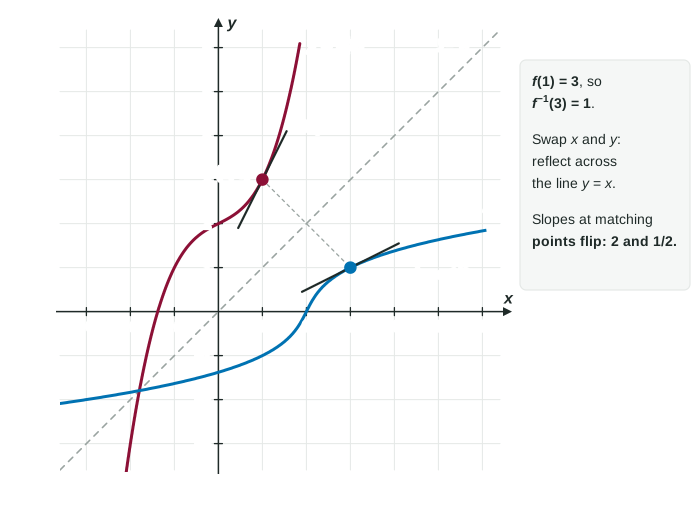
Look at the slopes in the figure. Reflecting swaps the roles of rise and run, so a line of slope 2 through reflects to a line of slope through . In general, at matching points the slopes of and are reciprocals. You can see it in a table too: if rises 3 while moves 1, then rises 1 while its input moves 3.
Worked example 2. , and the graph of has slope 4 at . Describe there.
The graph of passes through , so .
Its slope at is . Topic 3.3 turns exactly this into a formula.
Inverse trig functions
Sine, cosine and tangent repeat forever, so none of them is one-to-one. Each gets an inverse by restricting to one stretch where it is one-to-one and covers all its outputs:
| Inverse | Input | Output (an angle) | Example |
|---|---|---|---|
| every real number |
They are also written , and , with the same warning: is not .
Worked example 3. Find .
It is tempting to say the functions cancel and answer . But arcsine only returns angles between and .
Work inside out: , and .