Inverse Functions
An inverse function runs a one-to-one function backward: f⁻¹(b) = a exactly when f(a) = b .
Part 1 · Hook
Why this matters
Part 2 · Before you start
What this builds on
Part 3 · Prerequisite check
Quick check before you start
1. If and , what is ?
Show the answer
g first, then f.
- Correct: :
- :
- :
- :
2. What is ?
Show the answer
A first-quadrant special value.
- Correct: :
- :
- :
- :
Part 4 · See it
See it first
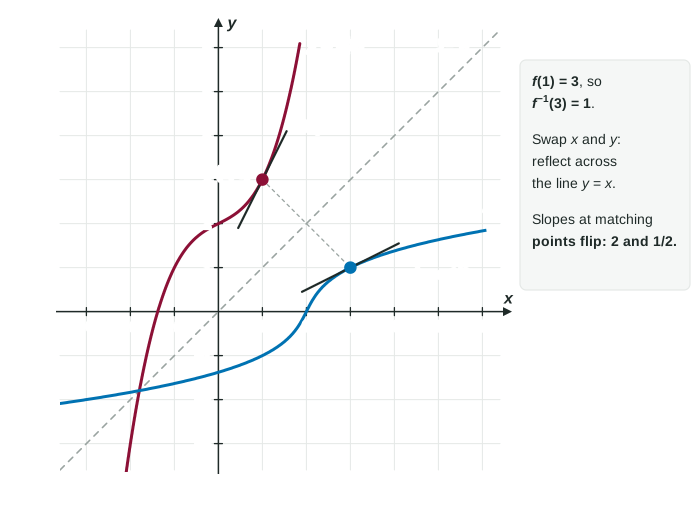
Part 5 · Step by step
How it works, step by step
- sends each input to an output , and no two inputs share an output (one-to-one)the inverse function sends back to : exactly when
- Swapping inputs and outputsswaps the coordinates of every point, reflecting the graph across
- Swapping coordinates swaps rise and runslopes at matching points are reciprocals
- Sine, cosine and tangent repeat, so they are not one-to-onetheir inverses use restricted ranges: arcsine and arctangent give angles from −π/2 to π/2, arccosine from 0 to π
Part 6 · Key ideas
Key ideas
- means . So and on the right domains.
- is not . The means "undo", not "reciprocal".
- Only a one-to-one function (each output from one input; passes the horizontal line test) has an inverse. Restrict the domain if needed.
- To find a formula: write and solve for .
- and return angles in ; returns angles in .
Part 7 · Misconception
A common mistake
The wrong idea: , and .
What actually happens: undoes : if then . The reciprocal is a different function. is ; is .
Part 8 · Check yourself
Check yourself
Exam-style questions. Anything you miss goes into your review queue.
Table
An increasing function
| 0 | 1 | 2 | 3 | 4 | |
|---|---|---|---|---|---|
| 3 | 5 | 6 | 9 | 11 |
1. Find .
No calculator. Type the exact value (a fraction, π, e or a root is fine).
Show the answer
, so . Read the table from the output row back to the input row.
- Answer: 3
2. The average rate of change of on is 3. Find the average rate of change of on .
No calculator. Type the exact value (a fraction, π, e or a root is fine).
Show the answer
and , so the rate is , the reciprocal of 's rate of 3 on .
- Answer: ≈ 0.333
3. Which statement about is true?
- is not defined.
Show the answer
, so . The superscript means "inverse", not "reciprocal".
- Correct: : read backward.
- : is the inverse function; is a reciprocal, a different thing.
- : That reads the table forward. The inverse goes from output to input.
- is not defined.: 3 is an output of (at ), so exists.
4. Let . Find .
Type an expression for .
Show the answer
Write and solve for : , so , so and . Check: and .
- Answer:
5. Find exactly.
No calculator. Type the exact value (a fraction, π, e or a root is fine).
Show the answer
Arccosine gives an angle in . , so .
- Answer: ≈ 2.094
6. Find exactly.
No calculator. Type the exact value (a fraction, π, e or a root is fine).
Show the answer
Inside first: . Then . The two functions do not cancel here, because is outside arcsine's range.
- Answer: ≈ 0.524
7. The point is on the graph of a one-to-one function , and the slope of the graph of there is 4. Which is true about the graph of ?
- It passes through , with slope there.
- It passes through , with slope 4 there.
- It passes through , with slope there.
- It passes through , with slope there.
Show the answer
Reflecting across swaps coordinates, so becomes , and swaps rise and run, so slope 4 becomes .
- Correct: It passes through , with slope there.: Swap the point and flip the slope.
- It passes through , with slope 4 there.: The reflection swaps rise and run, so the slope flips to its reciprocal.
- It passes through , with slope there.: The point must be swapped too.
- It passes through , with slope there.: Reflection across swaps coordinates; it does not negate them.
Part 9 · Summary
Summary
Part 10 · Up next
What comes next
Part 11 · Connections