An inverse function undoes a function: if , then . Often we have no formula for at all. The function is one-to-one, but solving for is hard. Still, we can find the slope of its inverse at any point, using only and its derivative.
The picture: reflection swaps rise and run
The graph of is the graph of reflected in the line . Every point of becomes the point of . Reflection also carries tangent lines along. Take a tangent line to at with slope : it rises units for every 1 unit it runs. After the reflection, the roles of rise and run swap, so the reflected line rises 1 unit for every units it runs. Its slope is .
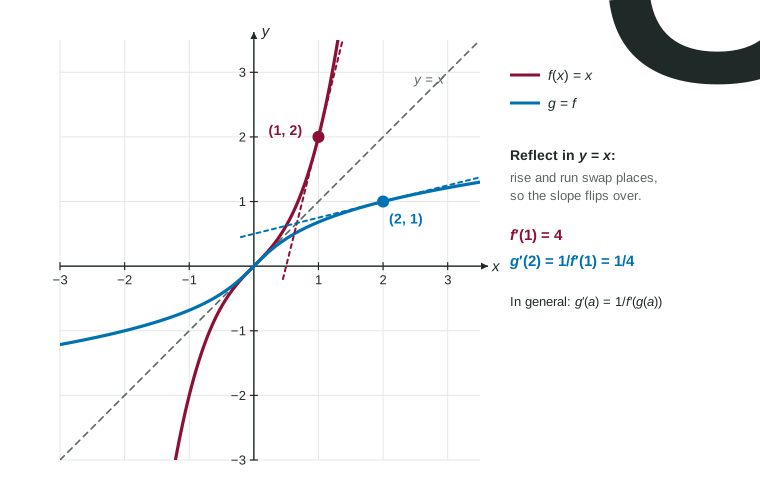
So slopes at matching points are reciprocals. The only care needed is "matching": the slope of at the input goes with the slope of at the input , not at .
The rule
If is the inverse of a differentiable function , and , then
The rule comes straight from the chain rule. Since undoes , for every in the domain of . Differentiate both sides: . Divide by and the rule appears.
Using it: find the matching input first
Worked example 1. Let and . Find .
Step 1, find : which gives ? Try small numbers: . So .
Step 2, the slope of there: , so .
Step 3, take the reciprocal: .
A common slip is to compute . That is the slope of at the wrong point.
On the exam the function often comes as a table. Then step 1 means finding the given number in the row of values and reading the above it.
Worked example 2. A one-to-one function has these values. Find .
The value 7 sits in the row under , so .
Read . Then .
Worked example 3. Let and . Write the line tangent to the graph of at .
, so and the point is .
, so and .
The tangent line is .
When the rule fails
If , the tangent line to at is flat. Its mirror image is a vertical line, which has no slope, so is not differentiable at . The formula agrees: has no value. For example, has , and its inverse has a vertical tangent line at the origin.
A check you can always do
When you do know a formula for the inverse, the rule must agree with differentiating it directly. Take for , so . The rule gives
Slips that cost points
| Slip | Wrong | Right |
|---|---|---|
| Reading at the given number | , since | |
| Forgetting the reciprocal | ||
| Reciprocal of a value | or | the reciprocal of a slope, |
| Point of the wrong graph | tangent to through | through |