The derivative of a function is a new function. Nothing stops us from differentiating it again. The result, the second derivative , tells how fast the rate of change is itself changing. It is the key to motion problems in the next unit and to the shape of graphs after that, so it is worth getting the mechanics and the meaning right now.
Notation
All of these mean the same second derivative:
Read as "d two y, d x squared". The 2s sit where they do because the operation is applied twice to . It is not , the square of the slope, and not the derivative of . Higher derivatives follow the same pattern: for the third, then , and in general , with the number in brackets so it is not mistaken for a power.
Computing higher derivatives
Differentiate, then differentiate the result. Every rule still applies at every step.
Worked example 1. Find and for .
, then , then , and .
A polynomial of degree has : every derivative lowers the degree by one.
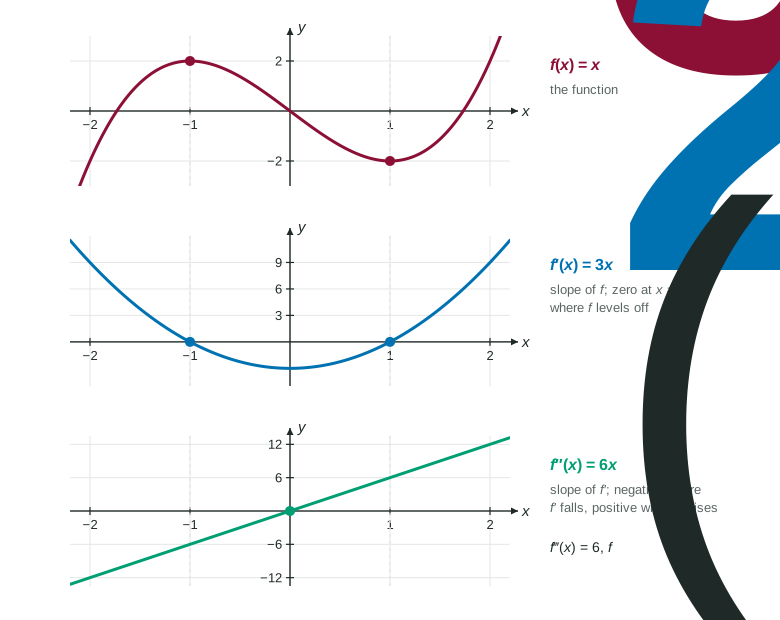
Look at the figure from bottom to top. Where is negative (), the graph of is falling. Where is positive, is rising. And where is 0, at , the graph of levels off. Each function describes the slope of the one above it.
Worked example 2. Find for .
First derivative, by the chain rule: .
This is a product of and , so the second derivative needs the product rule (and the chain rule again inside it):
The most common slip is to differentiate only one factor of .
Patterns are worth spotting. For : , , , and every two derivatives multiply by . For , each derivative multiplies by , so
Reading from a graph of
When the exam shows the graph of , the second derivative is the slope of that graph, not its height. If the graph of is a line segment from to , then
| On the graph of | What it tells |
|---|---|
| height at | , the slope of |
| slope at | |
| graph rising | |
| graph falling | |
| sharp corner | does not exist there |
Second derivatives of implicit curves
For a curve given implicitly, differentiate the expression for again, remembering that still depends on . Then substitute the expression for wherever it appears.
Worked example 3. For , find at .
First: , so . At , .
Second, by the quotient rule:
At with :
In general, substituting and using gives
Slips that cost points
- Writing or for the second derivative.
- Forgetting that a first derivative such as is a product.
- Treating as a constant when differentiating for an implicit curve.
- Reading the height of a graph of when the question asks for .