The sum rule says the derivative of a sum is the sum of the derivatives. It is tempting to guess that the derivative of a product is the product of the derivatives. It is not, and that guess is one of the most common errors in the whole course. This page shows why, gives the correct rule, and practices it on formulas, tables and graphs.
Why the guess fails
Try the simplest product: . Its derivative is . The product of the derivatives is . Those are different, so "multiply the derivatives" cannot be the rule. Something else must be going on.
A picture: a growing rectangle
Think of as the area of a rectangle with width and height . When increases a little, the width grows by and the height by .
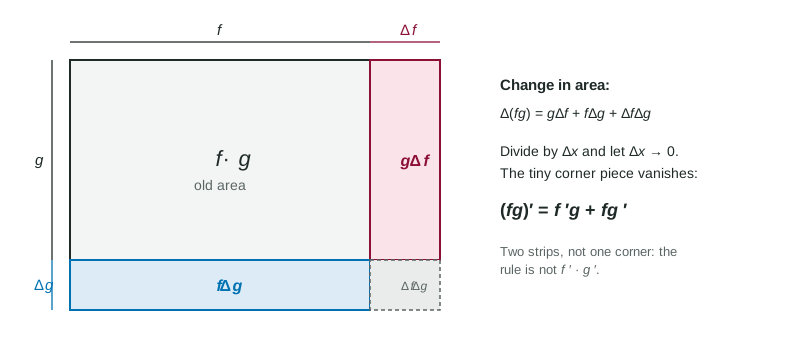
The area gains three pieces: a strip along one side, a strip along the other, and a small corner :
Divide by and let . The first two pieces become and . The corner becomes : it is a small change times another small change, and it vanishes. What is left is the rule.
The product rule
If and are differentiable at ,
Say it as a sentence: the derivative of the first times the second, plus the first times the derivative of the second. Each factor takes a turn being differentiated while the other stays as it is. The order of the two terms does not matter, because they are added.
Check it on : . It agrees with the power rule.
Worked example 1. Differentiate .
First , derivative . Second , derivative .
The wrong answer multiplies the two derivatives; it is missing both of the real terms.
Worked example 2. Differentiate and write the tangent line at .
At : and , so the tangent line is .
When not to use it
If one factor is a constant, the product rule still works, but the constant multiple rule is faster: . And if a product simplifies easily, simplify first: , so the derivative is . The product rule is for products that do not collapse, like or .
Products from a table or a graph
The rule works at a single input, which is how the exam usually asks it:
It uses four numbers: two values and two derivatives. Reading the wrong column is the usual slip.
Worked example 3. A table gives , , , . Find for .
Not , and not .
With a graph made of line segments, read each value from the graph and each derivative as the slope of the segment. At a corner of either graph, check the slope from each side; if the product's one-sided slopes differ, the product has no derivative there.
Three factors
For three factors, differentiate one at a time and add the three results:
Worked example 4. Differentiate .
Differentiate : . Differentiate : . Differentiate : .
Summary of the traps
| Wrong | Right |
|---|---|
| one term only, | both terms, added |
| two terms for three factors | three terms |
| given as | values and derivatives in their places |
The next topic handles the other operation that the basic rules cannot: division.