The power rule handles one power of at a time. Real functions are built from several: , or . This page gives the rules that take derivatives through constants, constant factors, sums and differences. With them and the power rule, every polynomial can be differentiated in one pass.
The constant rule
A constant function, , has a level graph. A level line has slope 0 everywhere, so
The same idea explains what happens when you add a constant to a function. Adding 3 lifts the whole graph 3 units without tilting it, so every tangent line keeps its slope.
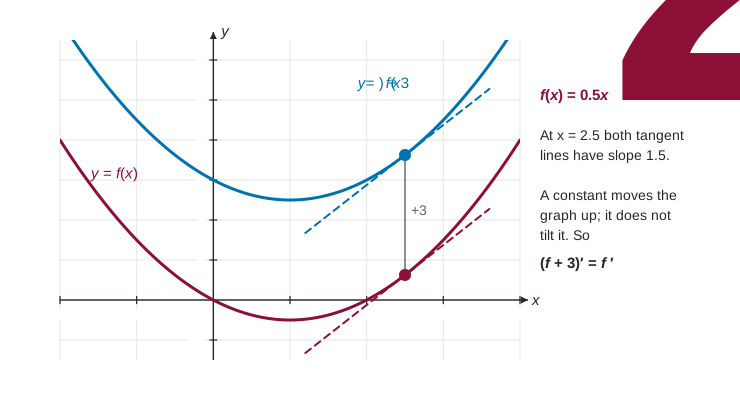
Watch for constants that look like variables: , and are numbers, and their derivatives are 0.
The constant multiple rule
Multiply a function by 4 and every height is multiplied by 4. Over the same run, every rise is 4 times as big, so every slope is 4 times as big:
A constant factor rides along. So
Keep the two constant rules apart. A constant term (added) disappears; a constant factor (multiplied) stays:
| Function | The constant is a | Derivative |
|---|---|---|
| term | ||
| factor | ||
| the whole function | ||
| factor |
The sum and difference rules
If and change together, the change in is the change in plus the change in . Divide by the same and take the limit, and the rates add:
Two pumps adding 30 and 45 liters a minute fill a pool at 75 liters a minute. If one drains at 20 while the other fills at 45, the level changes at .
Polynomials, term by term
A polynomial is a sum of constant multiples of powers of , so the rules take it apart one term at a time.
Worked example 1. Differentiate and find where its tangent line is level.
Term by term: ; ; ; .
So .
Level tangent line:
Worked example 2. Differentiate .
Rewrite every term as a constant times a power:
Differentiate:
Signs need care: times is .
Expand or divide first
The rules cover sums and constant multiples. They say nothing yet about products, quotients or powers of whole expressions, so turn those into sums first when the algebra is easy:
- , so its derivative is . Writing treats as if it were , which it is not.
- for , so its derivative is . Differentiating top and bottom separately gives , which is wrong.
Rules for products and quotients that cannot be simplified come in topics 2.8 and 2.9.
Rules on tables of values
The rules work at a single input too. If , then . You need only the derivative values at , not formulas.
Worked example 3. A table gives , , , . Write the line tangent to at .
Height: . Use the value columns.
Slope:
Line: . Mixing up the columns (values for the slope, or derivatives for the height) is the slip to avoid.
Common mistakes
- Keeping a constant term: is , not .
- Dropping a constant factor: is , not .
- Losing a sign inside a difference: distribute the minus over the whole derivative of the second term.