Unit 2 · Topic 2.6 Beta

Constant, Sum, Difference and Constant Multiple Rules

Constants added to a function disappear when you differentiate; constant factors stay.

Practice 1: Implementing Mathematical Processes

Question set for this topic

Part 1 · Hook

Why this matters

Two pumps fill a pool, one adding 30 liters a minute and the other 45. Together they add 75 liters a minute: rates add. Triple the first pump's output and its rate triples. These everyday facts are the sum and constant multiple rules, and with the power rule they differentiate every polynomial.

Part 2 · Before you start

What this builds on

Part 3 · Prerequisite check

Quick check before you start

1. ddx(x4)\frac{d}{dx}\left( x^4 \right) is

  1. 4x34x^3
  2. 4x44x^4
  3. x3x^3
  4. 3x43x^4
Show the answer

Power rule: bring down 4 and lower the exponent to 3.

  • Correct: 4x34x^3:
  • 4x44x^4:
  • x3x^3:
  • 3x43x^4:

2. ddx(x)\frac{d}{dx}\left( \sqrt{x} \right) is

  1. 12x\frac{1}{2\sqrt{x}}
  2. x2\frac{\sqrt{x}}{2}
  3. 2x2\sqrt{x}
  4. 12x3/2\frac{1}{2}x^{3/2}
Show the answer

x1/2x^{1/2} becomes 12x−1/2\frac{1}{2}x^{-1/2}.

  • Correct: 12x\frac{1}{2\sqrt{x}}:
  • x2\frac{\sqrt{x}}{2}:
  • 2x2\sqrt{x}:
  • 12x3/2\frac{1}{2}x^{3/2}:

Part 4 · See it

See it first

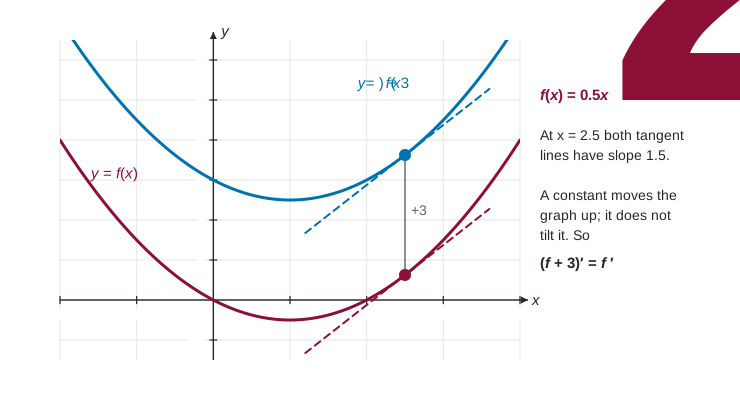
The parabola y = f(x) = 0.5x squared minus x, and the same curve shifted up 3 units, y = f(x) + 3. At x = 2.5 each curve has a dashed tangent line; the two tangent lines are parallel, both with slope 1.5. Adding a constant changes heights but no slopes.
Adding 3 lifts the graph of ff without tilting it: at every xx, ff and f+3f + 3 have parallel tangent lines, so (f+3)′=f′(f + 3)' = f'. LevlPrep original diagram.

Part 5 · Step by step

How it works, step by step

  1. A constant function has a flat graphits derivative is 0: ddx(c)=0\frac{d}{dx}(c) = 0
  2. Multiplying ff by kk stretches every rise by kk while runs stay the sameevery slope is multiplied by kk: (kf)′=kf′(kf)' = kf'
  3. The change in f+gf + g is the change in ff plus the change in ggrates add: (f+g)′=f′+g′(f + g)' = f' + g', and (f−g)′=f′−g′(f - g)' = f' - g'
  4. A polynomial is a sum of constant multiples of powers of xxdifferentiate it term by term with the power rule

Part 6 · Key ideas

Key ideas

  • Constant rule: ddx(c)=0\frac{d}{dx}(c) = 0. Adding a constant shifts a graph up or down and changes no slope.
  • Constant multiple rule: ddx(kf(x))=kf′(x)\frac{d}{dx}\left( kf(x) \right) = kf'(x).
  • Sum and difference rules: ddx(f(x)±g(x))\frac{d}{dx}\left( f(x) \pm g(x) \right)=f′(x)±g′(x)= f'(x) \pm g'(x).
  • Together with the power rule: ddx(4x3−5x+2)\frac{d}{dx}\left( 4x^3 - 5x + 2 \right)=12x2−5= 12x^2 - 5.
  • These rules work on values too: if h=3f−2gh = 3f - 2g, then h′(2)=3f′(2)−2g′(2)h'(2) = 3f'(2) - 2g'(2).

Part 7 · Misconception

A common mistake

The wrong idea: ddx(3x2+7)=6x+7\frac{d}{dx}\left( 3x^2 + 7 \right) = 6x + 7.

What actually happens: The 7 is a constant term, and the derivative of a constant is 0: adding 7 lifts the graph without changing any slope. So the derivative is 6x6x. A constant factor stays (ddx(7x)=7\frac{d}{dx}(7x) = 7); a constant term disappears.

Part 8 · Check yourself

Check yourself

Exam-style questions. Anything you miss goes into your review queue.

Graph

The graph of f(x)=x3−6x2+9x+1f(x) = x^3 - 6x^2 + 9x + 1

1234−2−11234567xyf(1, 5)(3, 1)

1. Find f′(x)f'(x) for f(x)=x3−6x2+9x+1f(x) = x^3 - 6x^2 + 9x + 1.

Type an expression for f′(x)=f'(x) =.

Show the answer

Term by term: 3x2−6(2x)3x^2 - 6(2x)+9(1)+ 9(1)+0+ 0=3x2−12x= 3x^2 - 12x+9+ 9.

  • Answer: f′(x)=f'(x) = 3x2−12x+93x^{2} - 12x + 9

2. Find f′(2)f'(2).

No calculator. Type the exact value (a fraction, π, e or a root is fine).

Show the answer

f′(2)f'(2)=3(2)2−12(2)= 3(2)^2 - 12(2)+9+ 9=12−24= 12 - 24+9+ 9=−3= -3. The graph falls at x=2x = 2.

  • Answer: -3

3. At which values of xx is the line tangent to the graph of ff level (slope 0)?

  1. x=1x = 1 and x=3x = 3
  2. x=0x = 0 and x=4x = 4
  3. x=2x = 2
  4. x=−1x = -1 and x=−3x = -3
Show the answer

f′(x)f'(x)=3x2−12x= 3x^2 - 12x+9+ 9=3(x−1)(x−3)= 3(x - 1)(x - 3)=0= 0 at x=1x = 1 and x=3x = 3, the high and low points of the graph.

  • Correct: x=1x = 1 and x=3x = 3: Where 3(x−1)(x−3)=03(x - 1)(x - 3) = 0.
  • x=0x = 0 and x=4x = 4: At x=0x = 0 and x=4x = 4 the slopes are 9 and 9, not 0.
  • x=2x = 2: f′(2)=−3f'(2) = -3: the graph is falling there.
  • x=−1x = -1 and x=−3x = -3: Sign slip when factoring: (x−1)(x−3)(x - 1)(x - 3) is 0 at x=1x = 1 and x=3x = 3.

4. Which is an equation of the line tangent to the graph of ff at x=0x = 0?

  1. y=1+9xy = 1 + 9x
  2. y=9+xy = 9 + x
  3. y=1−9xy = 1 - 9x
  4. y=9xy = 9x
Show the answer

f(0)=1f(0) = 1 and f′(0)=9f'(0) = 9, so y=1+9(x−0)y = 1 + 9(x - 0).

  • Correct: y=1+9xy = 1 + 9x: Height 1, slope 9.
  • y=9+xy = 9 + x: The height and the slope are swapped.
  • y=1−9xy = 1 - 9x: f′(0)=+9f'(0) = +9; the graph rises at x=0x = 0.
  • y=9xy = 9x: The line must pass through (0,f(0))=(0,1)(0, f(0)) = (0, 1).

5. What is ddx(π2)\frac{d}{dx}\left( \pi^2 \right)?

  1. 00
  2. 2π2\pi
  3. π2\pi^2
  4. 2πx2\pi x
Show the answer

π2≈9.87\pi^2 \approx 9.87 is a constant. Its graph is a level line, so its derivative is 0.

  • Correct: 00: A constant has derivative 0.
  • 2π2\pi: That runs the power rule on π\pi, but π\pi is a number, not the variable xx.
  • π2\pi^2: That is the function itself, not its slope.
  • 2πx2\pi x: The variable is xx, and π2\pi^2 does not contain it.

6. A student writes ddx(3x2+7)=6x+7\frac{d}{dx}\left( 3x^2 + 7 \right) = 6x + 7. What is the correct derivative?

  1. 6x6x
  2. 6x+76x + 7
  3. 3x+73x + 7
  4. 6x+16x + 1
Show the answer

The constant term 7 has derivative 0. Adding 7 lifts the graph without changing a slope.

  • Correct: 6x6x: Power rule on 3x23x^2, constant rule on 7.
  • 6x+76x + 7: A constant term disappears; only constant factors stay.
  • 3x+73x + 7: The 2 comes down: 3⋅2x=6x3 \cdot 2x = 6x.
  • 6x+16x + 1: The derivative of a constant is 0, not 1.

Part 9 · Summary

Summary

Constants added to a function disappear when you differentiate; constant factors stay. Derivatives of sums and differences are sums and differences of derivatives. With the power rule, these rules differentiate any polynomial term by term, and they work on tables of values as well as formulas.

Part 10 · Up next

What comes next

Part 11 · Connections

Connections