Polynomials are only the beginning. Waves, growth and decay are described by sine, cosine, the exponential and the natural logarithm . Their derivatives are short and worth memorizing, and each one makes sense from a picture. This page gives all four, shows where they come from, and uses them to evaluate limits that are derivatives in disguise.
Sine and cosine
Look at the graph of and track its slope. At it rises with slope 1. At , the top of the wave, its tangent line is level: slope 0. At it falls with slope . At , the bottom, the slope is 0 again, and at it is back to 1. The list is exactly the list of heights of at those inputs.
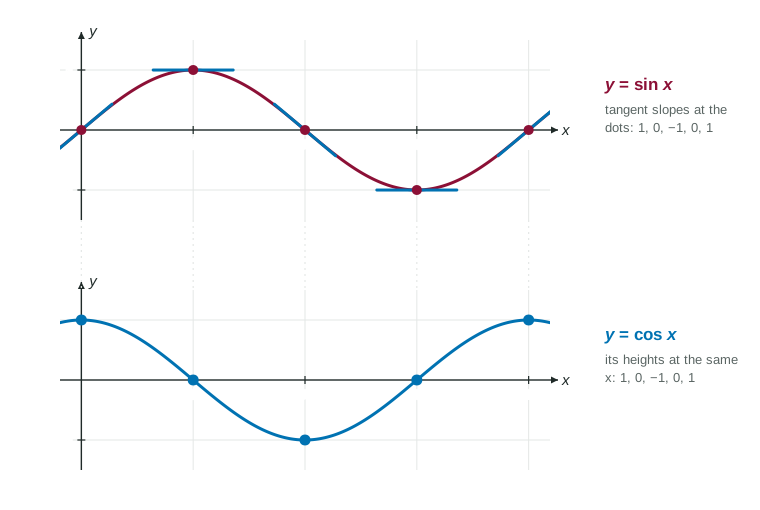
That match holds at every :
The minus sign for cosine is easy to check: just right of , the graph of starts to fall, so its slope is negative, while is positive there.
Why is the slope of at 0 exactly 1? The difference quotient at 0 is
The exponential
Every exponential graph has a slope equal to a fixed multiple of its height. For one special base, the slope at is exactly 1, and then the slope at every point equals the height. That base is , and so
The function is its own derivative. At the slope is 1; at the height is 3 and so is the slope. Do not use the power rule here: in the variable is the exponent, so is wrong.
The natural logarithm
For ,
The graph of is steep near 0 and flattens as grows, matching : large for small , small for large , and always positive, because always increases. Unit 3 shows why this formula follows from the one for .
| A check from the graph | ||
|---|---|---|
| slope 1 at 0, level at | ||
| level at 0, slope at | ||
| slope 1 at 0, slope equals height | ||
| , for | slope 1 at , flattening out |
Worked example 1. Differentiate
Term by term, with the constant multiple and sum rules:
At :
The step to watch is the double negative: becomes .
Worked example 2. Write the line tangent to at .
Point: , so . Slope: .
Line: , which simplifies to . It passes through the origin.
Limits that are derivatives
Now that you know these derivatives, you can evaluate some limits instantly by reading them as derivatives at a point. This is the limit as a derivative idea, and it appears on the exam every year. The method:
- Match the shape or .
- Name and . Check that the subtracted number really is .
- The limit is . Evaluate it with a derivative rule.
Worked example 3. Evaluate .
Shape: , , and is indeed .
So the limit is
Worked example 4. Evaluate .
The subtracted value is hidden: , so the numerator is . That is the shape with and .
The limit is .
Substituting in these limits gives , which never settles anything. Recognizing the derivative does.
Common mistakes
- Sign on cosine: , not .
- Power rule on : the answer is .
- Degrees: the trigonometric formulas need radians, on paper and on the calculator.
- Answering instead of when a limit is a derivative.