Unit 1 asked whether change can happen at an instant and built the tool to answer it: the limit. This page puts that tool to work. You will measure change over an interval, shrink the interval, and let a limit finish the job. Everything in Unit 2 grows out of the one formula you meet here.
Average rate of change: a change over a change
Suppose a delivery drone is 14 meters above the street at seconds and 47 meters up at seconds. It climbed meters in seconds, so on average it climbed meters per second. That number is an average rate of change.
For any function on an interval :
Three habits keep this right every time:
- Subtract in the same order on top and bottom. Later value minus earlier value, over later time minus earlier time.
- Divide by the change in input. The difference is how much changed; it is not yet a rate.
- Name the units. The units are output units per input unit: meters per second, gallons per minute, dollars per item.
An average describes a whole interval. The drone might have climbed fast at first and slowly later; 8.25 meters per second hides that. It also does not tell you how high the drone was. A sentence that interprets an average rate names the quantity, its units and the interval: "Between and seconds, the drone's altitude increased by an average of 8.25 meters per second."
Worked example 1. The volume of water in a tank is gallons after minutes, with and . Find the average rate of change of on and interpret it.
Change in volume:
Average rate: gallons per minute.
Meaning: between and minutes, the volume of water decreased by an average of 5 gallons per minute. The negative sign means the tank was losing water.
The picture: a secant line
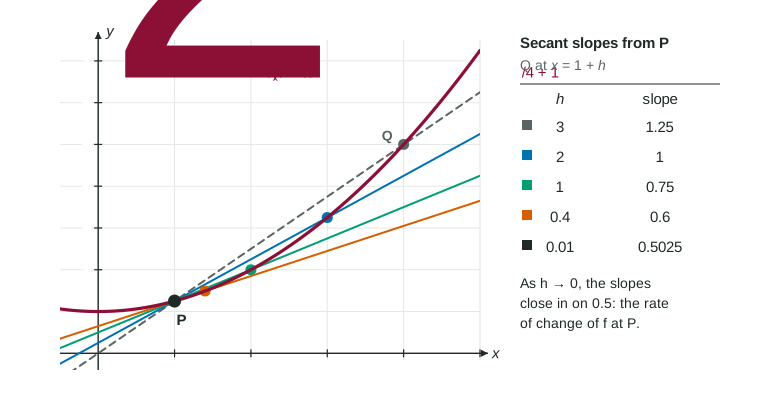
Plot the two points and on the graph of and draw the line through them. That line is a secant line. Its slope is rise over run, , which is exactly the average rate of change. So every average rate you compute is the slope of a secant line, and every secant slope you read from a graph is an average rate.
Shrinking the interval: the difference quotient
To learn how fast changes at one input , look at shorter and shorter intervals that start at . Write the far end as , where is the width of the interval. The average rate on that interval is the difference quotient:
The number can be positive (an interval to the right of ) or negative (an interval to the left). Look at the figure: for and , the secant slopes for are . As shrinks, the second point slides toward and the secant lines pivot toward one line. Their slopes close in on a single number.
The instantaneous rate of change is a limit
You cannot simply put into the difference quotient: that gives , an indeterminate form. Instead, take the limit. The instantaneous rate of change of at is
when that limit exists. The method is the limit algebra of Unit 1: expand, simplify until the factor cancels, then let .
Worked example 2. Find the instantaneous rate of change of at .
Values: and
Difference:
Quotient, for :
Limit:
Worked example 3. A cart rolls so that it has traveled meters after seconds. How fast is it moving at ?
Difference quotient:
For the average is 20.5 meters per second; for it is 20.05. The limit is
Average versus instantaneous
| Average rate of change | Instantaneous rate of change | |
|---|---|---|
| Describes | an interval | one input |
| Formula | ||
| On the graph | slope of a secant line | the limit of secant slopes |
| Needs | two values of | a limit |
| Units | output per input | output per input |
Both rates have the same units. The difference is what they describe: a stretch of time, or one moment.
Common mistakes
- A value over a time is not a rate. The drone's altitude at divided by 5 ignores where it started. A rate always compares two changes.
- Substituting too early. That gives , which says only that more algebra is needed.
- Losing the middle term. .
- Treating an average as an instant. An average on is not the rate at .
The next topic gives the instantaneous rate its own name and notation, and turns it into a whole new function.