Average and Instantaneous Rates of Change
An average rate of change is a change in output over a change in input, the slope of a secant line.
Part 1 · Hook
Why this matters
Part 2 · Before you start
What this builds on
Part 3 · Prerequisite check
Quick check before you start
1. What is ?
- It does not exist
Show the answer
The expression is continuous in , so substitute .
- Correct: :
- :
- :
- It does not exist:
2. For , simplifies to
Show the answer
Factor from the numerator and cancel it: .
- Correct: :
- :
- :
- :
3. A quantity changes from 20 to 50 while time goes from 3 hours to 9 hours. Its average rate of change is
- 5 per hour
- 30 per hour
- 10 per hour
- 6 per hour
Show the answer
Change in quantity over change in time: per hour.
- Correct: 5 per hour:
- 30 per hour:
- 10 per hour:
- 6 per hour:
Part 4 · See it
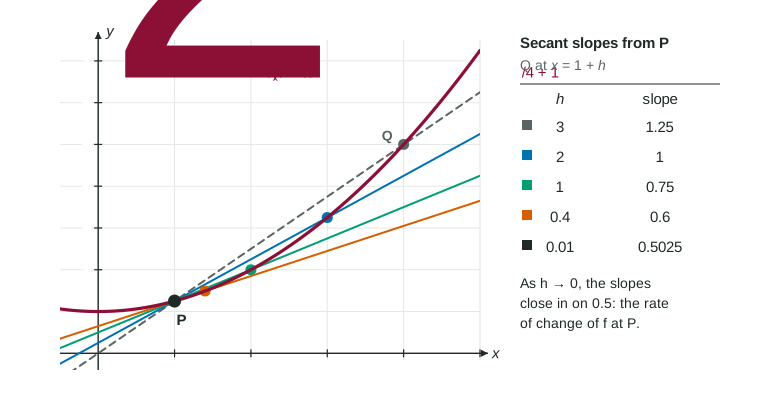
See it first
Part 5 · Step by step
How it works, step by step
- Two points on a graph, at and give a secant line whose slope is the average rate of change
- The second point is written the average rate becomes the difference quotient
- shrinks toward 0the interval shrinks to the single instant and the secant lines pivot toward one limiting line
- The limit existsits value is the instantaneous rate of change of at
Part 6 · Key ideas
Key ideas
- The average rate of change of on is : the change in output over the change in input, with units of output per input.
- A secant line joins two points of a graph. Its slope is the average rate of change between them.
- The difference quotient is the average rate on the interval from to ; can be negative.
- The instantaneous rate of change at is , when that limit exists. Simplify the quotient first; substituting at the start gives .
Part 7 · Misconception
A common mistake
The wrong idea: To find how fast something is changing at , divide its value by 5.
What actually happens: A rate of change compares two changes: a change in the quantity over a change in time. is a value over a time, not a change over a change. Use for an average rate, and a limit of such quotients for the rate at one instant.
Part 8 · Check yourself
Check yourself
Exam-style questions. Anything you miss goes into your review queue.
Table
A drone climbing after takeoff
| (seconds) | 0 | 2 | 5 | 6 | 9 |
|---|---|---|---|---|---|
| (meters) | 6 | 14 | 41 | 47 | 62 |
1. Find the average rate of change of the drone's altitude from to seconds. Include units.
No calculator. Type the exact value (a fraction, π, e or a root is fine), then its unit.
Show the answer
- Answer: ≈ 8.250 meters per second
2. Which sentence correctly interprets
- Between and seconds, the altitude rose 8.25 meters per second on average.
- At seconds, the drone was rising at exactly 8.25 meters per second.
- The drone climbed a total of 8.25 meters between and seconds.
- Between and seconds, the drone was 8.25 meters above the street.
Show the answer
An average rate describes a whole interval: the total climb, 33 meters, spread over 4 seconds.
- Correct: Between and seconds, the altitude rose 8.25 meters per second on average.: It names the interval, the units and the word "average".
- At seconds, the drone was rising at exactly 8.25 meters per second.: An average over an interval says nothing exact about one instant, even the midpoint; the climb may have been uneven.
- The drone climbed a total of 8.25 meters between and seconds.: The total climb was meters; 8.25 is that climb per second.
- Between and seconds, the drone was 8.25 meters above the street.: 8.25 is measured in meters per second, a rate, not an altitude in meters.
3. Over which interval of the table was the average rate of change of greatest?
Show the answer
Average rates: : ; : ; : ; : meters per second. The greatest is 9, on .
- Correct: : The climb of 27 meters over 3 seconds gives 9 meters per second, the largest.
- : The altitude is highest here, but the climb is only 15 meters in 3 seconds, 5 meters per second.
- : The climb is 8 meters in 2 seconds, 4 meters per second.
- : The climb is 6 meters in 1 second, 6 meters per second: a short interval is not a fast one.
4. A student says the drone was rising at meters per second at . What is wrong with this reasoning?
- It divides an altitude by a time instead of dividing a change in altitude by a change in time.
- It should divide by 6 seconds, the next time in the table.
- Nothing; an altitude divided by its time is the rate at that time.
- It should use , the last altitude, because more data gives a better rate.
Show the answer
A rate of change compares two changes. The drone started 6 meters up, so even the average from is meters per second, not 8.2.
- Correct: It divides an altitude by a time instead of dividing a change in altitude by a change in time.: Value over time ignores where the altitude started; rates use differences.
- It should divide by 6 seconds, the next time in the table.: Dividing by a different time still divides a value, not a change.
- Nothing; an altitude divided by its time is the rate at that time.: is not a rate of change; it would be the average from only if the drone started at altitude 0.
- It should use , the last altitude, because more data gives a better rate.: Data far from describes other moments; a rate at needs times close to 5.
5. Let . Simplify for . Type an expression in .
Type an expression for .
Show the answer
- Answer:
6. For , find the instantaneous rate of change of at .
No calculator. Type the exact value (a fraction, π, e or a root is fine).
Show the answer
- Answer: 7
7. What is the average rate of change of on ?
Show the answer
- Correct: : The change divided by 3.
- : That is the change in ; divide by the change in , 3.
- : The sign: falls from 1 to , so the rate is negative.
- : That is
, run over rise, upside down.
Part 9 · Summary
Summary
Part 10 · Up next
What comes next
Part 11 · Connections