Many quantities are ratios: miles per gallon, concentration, average cost per item. When both the top and the bottom of a fraction change, how fast does the fraction change? The product rule turns out to hold the answer. This page derives the quotient rule from it, shows how to use it without sign slips, and shows when a quick rewrite makes it unnecessary.
The guess that fails, again
As with products, dividing the derivatives does not work. Take , which is just for , with derivative 1. The quotient of the derivatives is . Wrong.
Deriving the rule from the product rule
Let . Then , a product. Assuming is differentiable, the product rule gives
Solve for : . Replace with and multiply the top and bottom by :
The quotient rule
If and are differentiable at and ,
A rhyme many students use: "low d-high minus high d-low, over low squared." "Low" is the denominator, "high" is the numerator, and "d" means "the derivative of". Two things make this rule different from the product rule: the numerator is a difference, so its order matters, and the bottom is squared.
| Product rule | Quotient rule | |
|---|---|---|
| Formula | ||
| Middle sign | plus | minus |
| Order matters? | no | yes: first |
| Denominator | none |
Worked example 1. Differentiate .
High , d-high . Low , d-low .
Check with the graph: the numerator is 0 at , where the graph turns, and , where the graph rises through the origin.
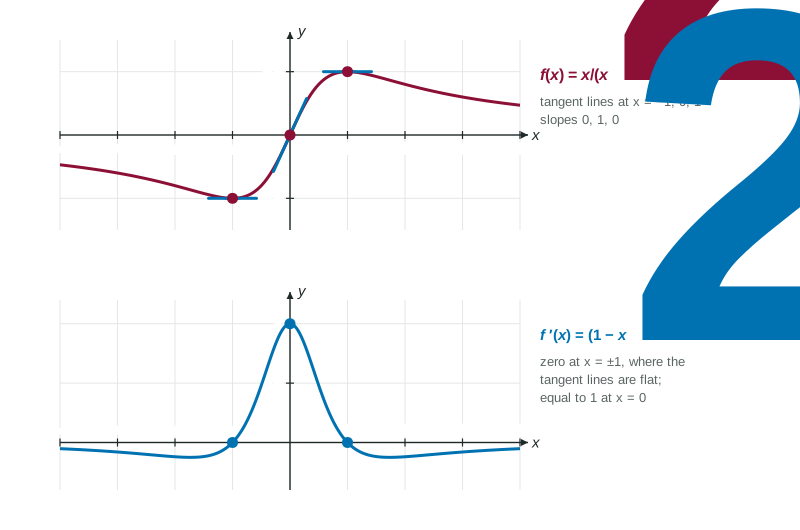
Worked example 2. Differentiate for .
If you had written on top, every slope would have the wrong sign.
From a table
Worked example 3. A table gives , , , . Find for , then the tangent line.
Height: . Tangent line: .
Notice the double negative: . Write every substituted value in parentheses so signs cannot hide.
A constant on top
When the numerator is a constant , its derivative is 0 and the rule shortens to
For example,
Rewrite when you can
When the denominator is a single term, divide first. , so its derivative is , with no quotient rule needed. The quotient rule gives the same answer,
Common mistakes
- Reversing the numerator: gives the negative of the answer.
- Forgetting to square the denominator.
- Dividing the derivatives: is not the derivative of .
- Simplifying more than needed. A correct, unsimplified answer earns full credit; a simplification error can lose it.
With the quotient rule, the next topic finds the derivatives of the remaining trigonometric functions.