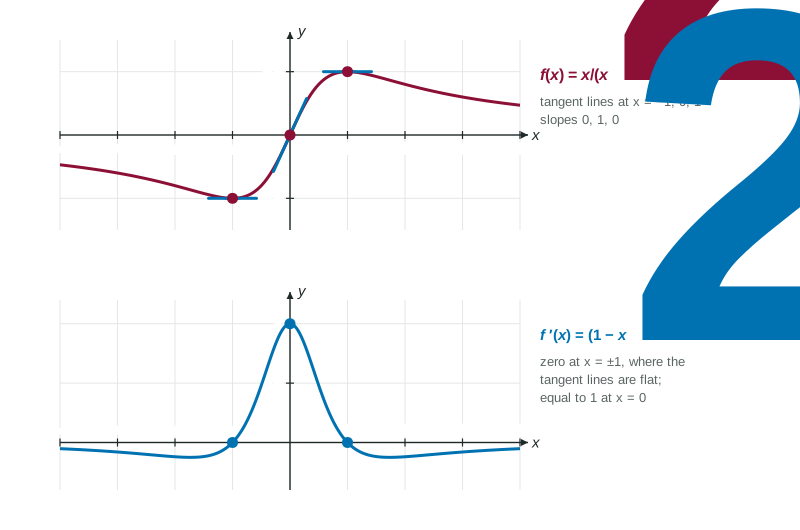
Unit 2 · Topic 2.9 Beta
The Quotient Rule
The derivative of f/g is (f′g − fg′)/g² , derived from the product rule by writing f = f/g ⋅g .
Practice 1: Implementing Mathematical Processes
Question set for this topic
Part 1 · Hook
Why this matters
Fuel economy is distance divided by fuel; a medicine's concentration is the amount of drug divided by the volume of blood it spreads through. When the top and the bottom of a fraction both change, the fraction changes in a way neither part shows alone. The quotient rule gives that rate.
Part 2 · Before you start
What this builds on
Part 3 · Prerequisite check
Quick check before you start
1. is
Show the answer
The product rule: each factor takes a turn being differentiated, and the terms add.
- Correct: :
- :
- :
- :
2. is
Show the answer
Power rule on ; the constant has derivative 0.
- Correct: :
- :
- :
- :
Part 5 · Step by step
How it works, step by step
- Write as →the product rule gives
- Solve for and replace with →
- The numerator is a difference→the order matters: derivative of the top times the bottom comes first
- The denominator is a single power of →rewriting as a sum of powers is often faster than the quotient rule
Part 6 · Key ideas
Key ideas
- The quotient rule: , where .
- Memory aid: "low d-high minus high d-low, over low squared."
- The order in the numerator matters: swapping it flips the sign of the answer.
- The derivative of a quotient is NOT the quotient of the derivatives.
- For , divide first: , then use the power rule.
Part 7 · Misconception
A common mistake
The wrong idea: , or .
What actually happens: The numerator starts with the derivative of the top: . Reversing it gives the negative of the right answer. And ignores how each part's size affects the other: has derivative 1, but .
Part 8 · Check yourself
Check yourself
Exam-style questions. Anything you miss goes into your review queue.
Table
Values of two functions and their derivatives
The functions
and
have derivatives for all
.
Selected values of , , and | | | | |
|---|
| 2 | 4 | 1 | 2 | |
|---|
| 5 | | 6 | 3 | 2 |
|---|
1. Let . Find .
No calculator. Type the exact value (a fraction, π, e or a root is fine).
Show the answer
.
- Answer: ≈ 3.500
2. Let . Find .
No calculator. Type the exact value (a fraction, π, e or a root is fine).
Show the answer
.
3. Let . Find .
No calculator. Type the exact value (a fraction, π, e or a root is fine).
Show the answer
.
- Answer: ≈ -0.778
4. Which is an equation of the line tangent to the graph of at ?
Show the answer
and .
- Correct: : Height 2, slope .
- : The slope's sign comes from a reversed numerator.
- : The height and the slope are swapped.
- : Slope is , not the quotient rule.
5. A student writes . What is the error?
- The denominator should be .
- The numerator should be .
- The answer should be , the derivatives of the top and bottom.
- There is no error.
Show the answer
The quotient rule divides by the square of the bottom: the derivative is .
- Correct: The denominator should be .: The bottom is squared.
- The numerator should be .: The student's numerator order is right: derivative of the top comes first.
- The answer should be , the derivatives of the top and bottom.: The quotient of the derivatives is not the derivative of the quotient.
- There is no error.: The missing square changes the answer at every except where .
6. Which formula is the quotient rule for ?
Show the answer
Low d-high minus high d-low, over low squared.
- Correct: : Derivative of the top times the bottom first; the bottom squared.
- : The numerator is reversed, which flips the sign.
- : The denominator is the bottom squared, not the top.
- : A quotient has a minus sign in the numerator; the plus belongs to the product rule.
Part 9 · Summary
Summary
The derivative of
is
, derived from the product rule by writing
. Keep the numerator in order and square the denominator. When the denominator is a single term, dividing first and using the power rule is often simpler.
Part 10 · Up next
What comes next
Part 11 · Connections
Connections