Unit 2 · Topic 2.10 Beta

Derivatives of tan, cot, sec and csc

Write tangent, cotangent, secant and cosecant in terms of sine and cosine, apply the quotient rule, and simplify with sin² x + cos² x = 1 .

Practice 1: Implementing Mathematical Processes

Question set for this topic

Part 1 · Hook

Why this matters

A surveyor tilts a sight toward a mountaintop, and the height she reads grows with the tangent of the angle. Near flat angles the height barely changes; near straight up it explodes. How fast it changes is the derivative of tan⁡x\tan x, and the quotient rule finds it, along with the other three trigonometric derivatives, from sine and cosine alone.

Part 2 · Before you start

What this builds on

Part 3 · Prerequisite check

Quick check before you start

1. ddx(f(x)g(x))\frac{d}{dx}\left( \frac{f(x)}{g(x)} \right) is

  1. f′(x)g(x)−f(x)g′(x)(g(x))2\frac{f'(x)g(x) - f(x)g'(x)}{\left( g(x) \right)^2}
  2. f′(x)g′(x)\frac{f'(x)}{g'(x)}
  3. f(x)g′(x)−f′(x)g(x)(g(x))2\frac{f(x)g'(x) - f'(x)g(x)}{\left( g(x) \right)^2}
  4. f′(x)g(x)+f(x)g′(x)f'(x)g(x) + f(x)g'(x)
Show the answer

Low d-high minus high d-low, over low squared.

  • Correct: f′(x)g(x)−f(x)g′(x)(g(x))2\frac{f'(x)g(x) - f(x)g'(x)}{\left( g(x) \right)^2}:
  • f′(x)g′(x)\frac{f'(x)}{g'(x)}:
  • f(x)g′(x)−f′(x)g(x)(g(x))2\frac{f(x)g'(x) - f'(x)g(x)}{\left( g(x) \right)^2}:
  • f′(x)g(x)+f(x)g′(x)f'(x)g(x) + f(x)g'(x):

2. sin2⁡x+cos2⁡x\sin^2 x + \cos^2 x equals

  1. 11
  2. 00
  3. 2sin⁡xcos⁡x2\sin x\cos x
  4. tan2⁡x\tan^2 x
Show the answer

The Pythagorean identity, from the unit circle.

  • Correct: 11:
  • 00:
  • 2sin⁡xcos⁡x2\sin x\cos x:
  • tan2⁡x\tan^2 x:

3. ddx(cos⁡x)\frac{d}{dx}(\cos x) is

  1. −sin⁡x-\sin x
  2. sin⁡x\sin x
  3. cos⁡x\cos x
  4. −cos⁡x-\cos x
Show the answer

Cosine falls where sine is positive.

  • Correct: −sin⁡x-\sin x:
  • sin⁡x\sin x:
  • cos⁡x\cos x:
  • −cos⁡x-\cos x:

Part 4 · See it

See it first

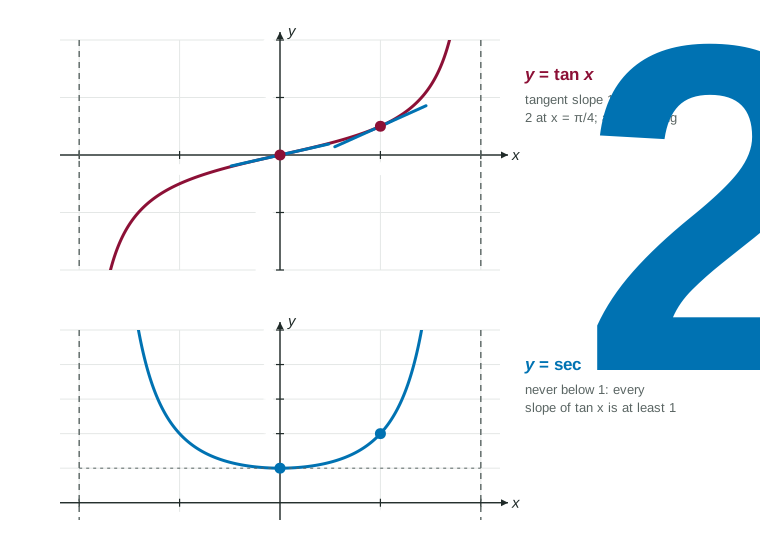
Top: y = tan x between its vertical asymptotes at x = minus pi/2 and pi/2 (dashed), with tangent lines at x = 0 (slope 1) and x = pi/4 (slope 2). Bottom, on the same scale: y = sec squared x, which is 1 at x = 0, 2 at x = pi/4, never less than 1, and grows without bound near the asymptotes.
The graph of tan⁡x\tan x (top) has slope 1 at x=0x = 0 and 2 at x=π4x = \frac{\pi}{4}. Its derivative, sec2⁡x\sec^2 x (bottom), is never below 1. LevlPrep original diagram.

Part 5 · Step by step

How it works, step by step

  1. tan⁡x=sin⁡xcos⁡x\tan x = \frac{\sin x}{\cos x}the quotient rule gives cos⁡xcos⁡x−sin⁡x(−sin⁡x)cos2⁡x\frac{\cos x \cos x - \sin x(-\sin x)}{\cos^2 x}
  2. The numerator is cos2⁡x+sin2⁡x=1\cos^2 x + \sin^2 x = 1ddx(tan⁡x)\frac{d}{dx}(\tan x)=1cos2⁡x= \frac{1}{\cos^2 x}=sec2⁡x= \sec^2 x
  3. sec⁡x=1cos⁡x\sec x = \frac{1}{\cos x} and csc⁡x=1sin⁡x\csc x = \frac{1}{\sin x}the quotient rule with a constant top gives sec⁡xtan⁡x\sec x\tan x and −csc⁡xcot⁡x-\csc x\cot x
  4. Each "co-" function is built from cosine where its partner uses sineits derivative carries a minus sign: −csc2⁡x-\csc^2 x, −csc⁡xcot⁡x-\csc x\cot x

Part 6 · Key ideas

Key ideas

  • ddx(tan⁡x)=sec2⁡x\frac{d}{dx}(\tan x) = \sec^2 x and ddx(cot⁡x)=−csc2⁡x\frac{d}{dx}(\cot x) = -\csc^2 x.
  • ddx(sec⁡x)\frac{d}{dx}(\sec x)=sec⁡xtan⁡x= \sec x\tan x and ddx(csc⁡x)\frac{d}{dx}(\csc x)=−csc⁡xcot⁡x= -\csc x\cot x.
  • Every one comes from writing the function with sin⁡x\sin x and cos⁡x\cos x, using the quotient rule and the identity sin2⁡x+cos2⁡x=1\sin^2 x + \cos^2 x = 1.
  • The three "co-" functions (cosine, cotangent, cosecant) have derivatives with a minus sign.
  • All of these hold in radians, wherever the function is defined.

Part 7 · Misconception

A common mistake

The wrong idea: ddx(sec⁡x)=tan2⁡x\frac{d}{dx}(\sec x) = \tan^2 x, or ddx(cot⁡x)=csc2⁡x\frac{d}{dx}(\cot x) = \csc^2 x.

What actually happens: Rebuild them instead of guessing: sec⁡x=1cos⁡x\sec x = \frac{1}{\cos x}, so its derivative is 0−1(−sin⁡x)cos2⁡x\frac{0 - 1(-\sin x)}{\cos^2 x}=sin⁡xcos2⁡x= \frac{\sin x}{\cos^2 x}=sec⁡xtan⁡x= \sec x\tan x. For cot⁡x=cos⁡xsin⁡x\cot x = \frac{\cos x}{\sin x}, the numerator is −sin2⁡x−cos2⁡x=−1-\sin^2 x - \cos^2 x = -1, so the derivative is −csc2⁡x-\csc^2 x, negative like every "co-" derivative.

Part 8 · Check yourself

Check yourself

Exam-style questions. Anything you miss goes into your review queue.

Graph

The graph of y=tan⁡xy = \tan x on (−π2,π2)\left( -\frac{\pi}{2}, \frac{\pi}{2} \right)

−π/2π/2−4−3−2−11234xyy = tan x(π/4, 1)

1. What is the slope of the graph of y=tan⁡xy = \tan x at x=π4x = \frac{\pi}{4}?

No calculator. Type the exact value (a fraction, π, e or a root is fine).

Show the answer

sec2⁡π4\sec^2 \frac{\pi}{4}=1cos2⁡π4= \frac{1}{\cos^2 \frac{\pi}{4}}=11/2= \frac{1}{1/2}=2= 2.

  • Answer: 2

2. Which is an equation of the line tangent to y=tan⁡xy = \tan x at x=π4x = \frac{\pi}{4}?

  1. y=1+2(x−π4)y = 1 + 2\left( x - \frac{\pi}{4} \right)
  2. y=2+(x−π4)y = 2 + \left( x - \frac{\pi}{4} \right)
  3. y=1+2(x−π4)y = 1 + \sqrt{2}\left( x - \frac{\pi}{4} \right)
  4. y=1+2(x+π4)y = 1 + 2\left( x + \frac{\pi}{4} \right)
Show the answer

Point (π4,1)\left( \frac{\pi}{4}, 1 \right), slope sec2⁡π4=2\sec^2 \frac{\pi}{4} = 2.

  • Correct: y=1+2(x−π4)y = 1 + 2\left( x - \frac{\pi}{4} \right): Height 1, slope 2.
  • y=2+(x−π4)y = 2 + \left( x - \frac{\pi}{4} \right): The height and the slope are swapped.
  • y=1+2(x−π4)y = 1 + \sqrt{2}\left( x - \frac{\pi}{4} \right): Slope 2\sqrt{2} is sec⁡π4\sec \frac{\pi}{4}, not squared.
  • y=1+2(x+π4)y = 1 + 2\left( x + \frac{\pi}{4} \right): Point-slope form uses x−π4x - \frac{\pi}{4}.

3. Why is every slope of the graph of y=tan⁡xy = \tan x on (−π2,π2)\left( -\frac{\pi}{2}, \frac{\pi}{2} \right) at least 1?

  1. The slope is sec2⁡x=1cos2⁡x\sec^2 x = \frac{1}{\cos^2 x}, and 0<cos2⁡x≤10 < \cos^2 x \le 1 there.
  2. The slope is tan⁡x\tan x, which is at least 1.
  3. The graph passes through the origin with slope 1, and slopes stay the same.
  4. The slope is sec⁡x\sec x, which is at least 1 on this interval.
Show the answer

Dividing 1 by a number between 0 and 1 gives a number of at least 1, with equality at x=0x = 0.

  • Correct: The slope is sec2⁡x=1cos2⁡x\sec^2 x = \frac{1}{\cos^2 x}, and 0<cos2⁡x≤10 < \cos^2 x \le 1 there.: cos2⁡x\cos^2 x is at most 1, so its reciprocal is at least 1.
  • The slope is tan⁡x\tan x, which is at least 1.: tan⁡x\tan x is the height, and it is negative for x<0x < 0.
  • The graph passes through the origin with slope 1, and slopes stay the same.: The slope changes: it is 1 at 0 and 2 at π4\frac{\pi}{4}.
  • The slope is sec⁡x\sec x, which is at least 1 on this interval.: The derivative is sec2⁡x\sec^2 x, not sec⁡x\sec x.

4. Which line is tangent to y=tan⁡xy = \tan x at the origin?

  1. y=xy = x
  2. y=0y = 0
  3. y=1+xy = 1 + x
  4. x=0x = 0
Show the answer

Slope sec2⁡0=1\sec^2 0 = 1 through (0,0)(0, 0).

  • Correct: y=xy = x: Slope 1 through the origin.
  • y=0y = 0: The graph rises through the origin; it is not level there.
  • y=1+xy = 1 + x: The line must pass through (0,tan⁡0)=(0,0)(0, \tan 0) = (0, 0).
  • x=0x = 0: A vertical line would need an infinite slope; sec2⁡0=1\sec^2 0 = 1.

5. Use the quotient rule to find ddx(sin⁡xcos⁡x)\frac{d}{dx}\left( \frac{\sin x}{\cos x} \right).

Type an expression for ddx(sin⁡xcos⁡x)=\frac{d}{dx}\left( \frac{\sin x}{\cos x} \right) =.

Show the answer

cos⁡xcos⁡x−sin⁡x(−sin⁡x)cos2⁡x\frac{\cos x\cos x - \sin x(-\sin x)}{\cos^2 x}=cos2⁡x+sin2⁡xcos2⁡x= \frac{\cos^2 x + \sin^2 x}{\cos^2 x}=1cos2⁡x= \frac{1}{\cos^2 x}=sec2⁡x= \sec^2 x.

  • Answer: ddx(sin⁡xcos⁡x)=\frac{d}{dx}\left( \frac{\sin x}{\cos x} \right) = (sec⁡(x))2(\sec(x))^{2}

6. Deriving ddx(tan⁡x)=sec2⁡x\frac{d}{dx}(\tan x) = \sec^2 x with the quotient rule, which identity simplifies the numerator?

  1. sin2⁡x+cos2⁡x=1\sin^2 x + \cos^2 x = 1
  2. tan⁡x=sin⁡xcos⁡x\tan x = \frac{\sin x}{\cos x}
  3. sin⁡(2x)=2sin⁡xcos⁡x\sin(2x) = 2\sin x\cos x
  4. sec⁡x=1cos⁡x\sec x = \frac{1}{\cos x}
Show the answer

The numerator is cos2⁡x+sin2⁡x\cos^2 x + \sin^2 x, which is 1.

  • Correct: sin2⁡x+cos2⁡x=1\sin^2 x + \cos^2 x = 1: The Pythagorean identity collapses the numerator to 1.
  • tan⁡x=sin⁡xcos⁡x\tan x = \frac{\sin x}{\cos x}: That identity sets up the quotient; it does not simplify the numerator.
  • sin⁡(2x)=2sin⁡xcos⁡x\sin(2x) = 2\sin x\cos x: No 2sin⁡xcos⁡x2\sin x\cos x appears in the numerator.
  • sec⁡x=1cos⁡x\sec x = \frac{1}{\cos x}: That identity rewrites the final answer; the numerator needs the Pythagorean identity.

Part 9 · Summary

Summary

Write tangent, cotangent, secant and cosecant in terms of sine and cosine, apply the quotient rule, and simplify with sin2⁡x+cos2⁡x=1\sin^2 x + \cos^2 x = 1. The results: (tan⁡x)′=sec2⁡x(\tan x)' = \sec^2 x, (cot⁡x)′=−csc2⁡x(\cot x)' = -\csc^2 x, (sec⁡x)′=sec⁡xtan⁡x(\sec x)' = \sec x\tan x, (csc⁡x)′=−csc⁡xcot⁡x(\csc x)' = -\csc x\cot x. The "co-" functions get the minus signs.
Part 10 · Up next

What comes next

Part 11 · Connections

Connections