The Chain Rule
For a composite function f(g(x)) , differentiate the outside function at the unchanged inside, then multiply by the derivative of the inside: d/dx f(g(x)) = f′(g(x))⋅g′(x) .
Part 1 · Hook
Why this matters
Part 2 · Before you start
What this builds on
Part 3 · Prerequisite check
Quick check before you start
1. What is the derivative of ?
Show the answer
The derivative of is .
- Correct: :
- :
- :
- :
2. What is the derivative of ?
Show the answer
The power rule: bring the 5 down and lower the power by one.
- Correct: :
- :
- :
- :
Part 4 · See it
See it first
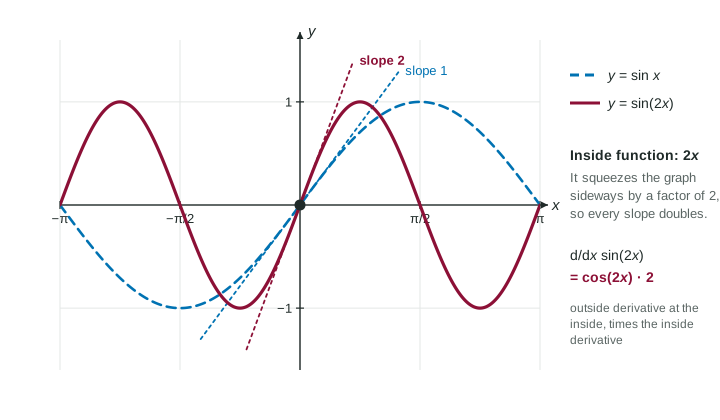
Part 5 · Step by step
How it works, step by step
- A function is built in layers, feeds the inside function , and feeds the outside function
- When changes a little, changes times as muchand changes times as much as its input does
- The two rates multiply, like gears
- In Leibniz form, with
Part 6 · Key ideas
Key ideas
- Spot the layers first: name the outside function and the inside function before you differentiate.
- Differentiate the outside function and leave the inside alone: , not and not .
- Then multiply by the derivative of the inside, . Forgetting this factor is the most common lost point.
- From a table, read at the inside value , then multiply by .
Part 7 · Misconception
A common mistake
The wrong idea: The derivative of is .
What actually happens: That is only the outside derivative. The inside function changes too, at rate , so
Part 8 · Check yourself
Check yourself
Exam-style questions. Anything you miss goes into your review queue.
Table
Values of , , and
| 1 | 3 | 2 | 5 | |
|---|---|---|---|---|
| 2 | 4 | 6 | 3 | |
| 3 | 1 | 4 | 4 | 2 |
| 4 | 2 | 1 | 7 |
1. Let . What is ?
Show the answer
The chain rule: . The outside derivative is read at the inside value , so
- Correct: :
. - : This is : the outside derivative was evaluated at instead of at the inside value .
- : This is alone: the inside derivative was dropped.
- : This multiplies by , the inside value, instead of by its derivative .
2. Let , a composition with on the inside. Use the table to find .
No calculator. Type the exact value (a fraction, π, e or a root is fine).
Show the answer
- Answer: 20
3. Let . What is ?
Show the answer
The outside function is the cube: , so .
- : This is with no inside derivative. The inside function is , and changes the sign.
- Correct: :
. - : This is : the power rule's factor 3 is missing.
- : This is : the power rule lowers the power by one, so the outside derivative is , not .
4. Let . What is ?
Show the answer
. At the inside value is :
- : This is alone: the derivative of the inside function , which is , is missing.
- : This multiplies by 2 instead of by . The inside derivative is evaluated at .
- Correct: : .
- : This is : the outside derivative was read at , not at the inside value .
5. Find for .
Type an expression for .
Show the answer
Outside: , derivative , evaluated at the same inside . Inside derivative: . So .
- Answer:
6. Which of these functions need the chain rule to be differentiated? Select all that apply.
Show the answer
The chain rule is needed when a function is applied to another function: and .
- Correct: : The exponent is an inside function: the derivative is .
- Correct: : The tenth power acts on the inside function .
- : This is a product of and , neither with an inside function: the product rule is enough.
- : This is a quotient of two basic functions: the quotient rule is enough.
Part 9 · Summary
Summary
Part 10 · Up next
What comes next
Part 11 · Connections