Unit 3 · Topic 3.2 Beta

Implicit Differentiation

To differentiate an equation in x and y , apply d/dx to both sides, treating y as a function of x : each y -term gets a factor dy/dx , and products need the product rule.

Practice 1: Implementing Mathematical Processes

Question set for this topic

Part 1 · Hook

Why this matters

Some curves, like a circle or a tilted oval, cannot be written as y equals a single formula in x. Their equations mix x and y together. You can still find the slope at any point without solving for y: differentiate the equation as it stands and let the chain rule do the work.

Part 2 · Before you start

What this builds on

Part 3 · Prerequisite check

Quick check before you start

1. What is ddx(x2+1)3\frac{d}{dx}(x^2 + 1)^3?

  1. 6x(x2+1)26x(x^2 + 1)^2
  2. 3(x2+1)23(x^2 + 1)^2
  3. 3(2x)23(2x)^2
  4. 6x2(x2+1)6x^2(x^2 + 1)
Show the answer

The chain rule: 3(x2+1)2⋅2x3(x^2 + 1)^2 \cdot 2x.

  • Correct: 6x(x2+1)26x(x^2 + 1)^2:
  • 3(x2+1)23(x^2 + 1)^2:
  • 3(2x)23(2x)^2:
  • 6x2(x2+1)6x^2(x^2 + 1):

2. What is ddx(x2sin⁡x)\frac{d}{dx}\left(x^2 \sin x\right)?

  1. 2xsin⁡x+x2cos⁡x2x\sin x + x^2\cos x
  2. 2xcos⁡x2x\cos x
  3. x2cos⁡xx^2\cos x
  4. 2xsin⁡x2x\sin x
Show the answer

The product rule: derivative of the first times the second, plus the first times the derivative of the second.

  • Correct: 2xsin⁡x+x2cos⁡x2x\sin x + x^2\cos x:
  • 2xcos⁡x2x\cos x:
  • x2cos⁡xx^2\cos x:
  • 2xsin⁡x2x\sin x:

Part 4 · See it

See it first

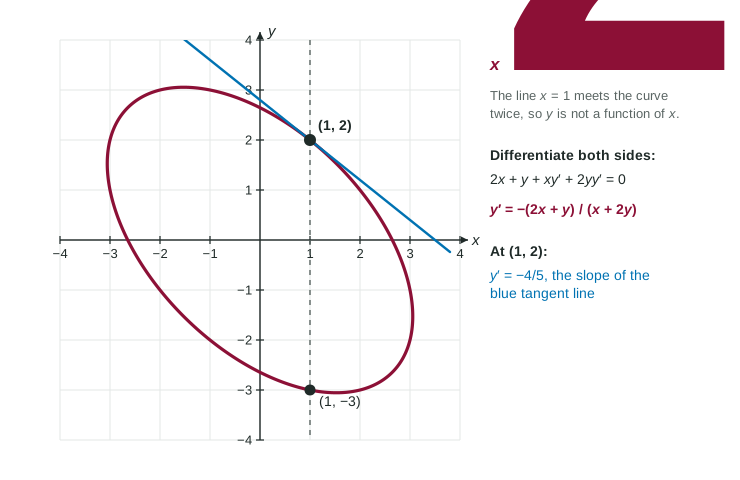
The tilted ellipse x² + xy + y² = 7 in crimson on axes from −4 to 4. A dashed vertical line x = 1 meets it at (1, 2) and (1, −3), so y is not a function of x. A blue tangent line at (1, 2) has slope −4/5.
The curve x2+xy+y2=7x^2 + xy + y^2 = 7 is not the graph of a function, yet near (1,2)(1, 2) it has a tangent line with slope −45-\frac{4}{5}, found by implicit differentiation. LevlPrep original diagram.

Part 5 · Step by step

How it works, step by step

  1. The equation mixes xx and yy, so yy is defined implicitlynear a point, yy still acts like a function of xx
  2. Apply ddx\frac{d}{dx} to both sides of the equationeach term with yy gets a factor dydx\frac{dy}{dx} by the chain rule; products like xyxy need the product rule
  3. Collect the dydx\frac{dy}{dx} terms on one side and factordydx\frac{dy}{dx} equals a fraction that may hold both xx and yy
  4. Substitute the coordinates of a point on the curvethe result is the slope of the tangent line there

Part 6 · Key ideas

Key ideas

  • Every term with yy gets a factor dydx\frac{dy}{dx}: ddxy2=2ydydx\frac{d}{dx}y^2 = 2y\frac{dy}{dx}, ddxsin⁡y=cos⁡ydydx\frac{d}{dx}\sin y = \cos y\frac{dy}{dx}.
  • A product of xx and yy needs the product rule: ddx(xy)=y+xdydx\frac{d}{dx}(xy) = y + x\frac{dy}{dx}.
  • Write the whole equation after differentiating, with =0= 0 or the right side, before you solve for dydx\frac{dy}{dx}.
  • The answer usually holds both xx and yy; a slope needs both coordinates of a point on the curve.

Part 7 · Misconception

A common mistake

The wrong idea: Differentiating x2+y2=25x^2 + y^2 = 25 gives 2x+2y=02x + 2y = 0.

What actually happens: yy depends on xx, so the chain rule gives ddxy2=2ydydx\frac{d}{dx}y^2 = 2y\frac{dy}{dx}: 2x+2ydydx=02x + 2y\frac{dy}{dx} = 0, and dydx=−xy\frac{dy}{dx} = -\frac{x}{y}.

Part 8 · Check yourself

Check yourself

Exam-style questions. Anything you miss goes into your review queue.

Graph

The curve x2+xy+y2=7x^2 + xy + y^2 = 7

−4−3−2−11234−4−3−2−11234xy(1, 2)(-1, 3)

1. For the curve in the graph, find dydx\frac{dy}{dx} in terms of xx and yy.

Type an expression for dydx=\frac{dy}{dx} =.

Show the answer

Apply ddx\frac{d}{dx} to both sides: 2x+(y+xdydx)+2ydydx2x + \left(y + x\frac{dy}{dx}\right) + 2y\frac{dy}{dx}=0= 0. Collect: (x+2y)dydx(x + 2y)\frac{dy}{dx}=−(2x+y)= -(2x + y), so dydx\frac{dy}{dx}=−2x+yx+2y= -\frac{2x + y}{x + 2y}.

  • Answer: dydx=\frac{dy}{dx} = −(2x+y)x+2y\frac{-(2x + y)}{x + 2y}

2. Find the slope of the curve at the point (1,2)(1, 2).

No calculator. Type the exact value (a fraction, π, e or a root is fine).

Show the answer

Substitute after differentiating: dydx\frac{dy}{dx}=−2(1)+21+2(2)= -\frac{2(1) + 2}{1 + 2(2)}=−45= -\frac{4}{5}.

  • Answer: −45\frac{-4}{5} ≈ -0.800

3. Which is an equation of the line tangent to the curve at (−1,3)(-1, 3)?

  1. y−3=−15(x+1)y - 3 = -\frac{1}{5}(x + 1)
  2. y−3=−15(x−1)y - 3 = -\frac{1}{5}(x - 1)
  3. y−3=13(x+1)y - 3 = \frac{1}{3}(x + 1)
  4. y−3=−5(x+1)y - 3 = -5(x + 1)
Show the answer

At (−1,3)(-1, 3): dydx\frac{dy}{dx}=−−2+3−1+6= -\frac{-2 + 3}{-1 + 6}=−15= -\frac{1}{5}. Point-slope form: y−3=−15(x+1)y - 3 = -\frac{1}{5}(x + 1).

  • Correct: y−3=−15(x+1)y - 3 = -\frac{1}{5}(x + 1): The slope is −2(−1)+3−1+2(3)-\frac{2(-1) + 3}{-1 + 2(3)}=−15= -\frac{1}{5} and the line passes through (−1,3)(-1, 3).
  • y−3=−15(x−1)y - 3 = -\frac{1}{5}(x - 1): The slope is right, but the point has x=−1x = -1, so the factor is x−(−1)=x+1x - (-1) = x + 1.
  • y−3=13(x+1)y - 3 = \frac{1}{3}(x + 1): This slope is −xy-\frac{x}{y} at (−1,3)(-1, 3), the slope of a circle; the xyxy term changes it.
  • y−3=−5(x+1)y - 3 = -5(x + 1): This flips the fraction: the slope is −2x+yx+2y-\frac{2x + y}{x + 2y}, numerator 11 and denominator 55.

4. At which points of the curve is dydx=0\frac{dy}{dx} = 0?

  1. Where the curve meets the line x=−2yx = -2y
  2. Where the curve meets the line y=−2xy = -2x
  3. Where the curve meets the line y=2xy = 2x
  4. Where the curve meets the xx-axis
Show the answer

A fraction is 0 when its numerator is 0 and its denominator is not: 2x+y=02x + y = 0, so y=−2xy = -2x. Substituting gives 3x2=73x^2 = 7, two points of the curve.

  • Where the curve meets the line x=−2yx = -2y: On x=−2yx = -2y the denominator x+2yx + 2y is 0, so the slope is undefined there, not 0.
  • Correct: Where the curve meets the line y=−2xy = -2x: dydx=0\frac{dy}{dx} = 0 when the numerator 2x+y2x + y is 0 (and the denominator is not), that is on the line y=−2xy = -2x.
  • Where the curve meets the line y=2xy = 2x: Check a point: on y=2xy = 2x the numerator is 4x4x, which is 0 only at the origin, and the origin is not on the curve.
  • Where the curve meets the xx-axis: At y=0y = 0 the slope is −2xx=−2-\frac{2x}{x} = -2, not 0.

5. If yy is a differentiable function of xx, what is ddx(y4)\frac{d}{dx}\left(y^4\right)?

  1. 4y34y^3
  2. 4x34x^3
  3. 4y3dydx4y^3\frac{dy}{dx}
  4. 4y3dxdy4y^3\frac{dx}{dy}
Show the answer

By the chain rule, ddx(y4)=4y3⋅dydx\frac{d}{dx}\left(y^4\right) = 4y^3 \cdot \frac{dy}{dx}.

  • 4y34y^3: yy changes with xx, so the chain rule adds the factor dydx\frac{dy}{dx}.
  • 4x34x^3: The variable is yy, not xx.
  • Correct: 4y3dydx4y^3\frac{dy}{dx}: Power rule on the outside, times the inside derivative dydx\frac{dy}{dx}.
  • 4y3dxdy4y^3\frac{dx}{dy}: The inside function is yy as a function of xx; its derivative is dydx\frac{dy}{dx}.

6. For the curve x2−2xy+4y2=12x^2 - 2xy + 4y^2 = 12, dydx=y−x4y−x\frac{dy}{dx} = \frac{y - x}{4y - x}. At which point of the curve is dydx\frac{dy}{dx} undefined?

  1. (4,1)(4, 1)
  2. (2,2)(2, 2)
  3. (2,−1)(2, -1)
  4. (0,0)(0, 0)
Show the answer

The slope is undefined where 4y−x=04y - x = 0 and y−x≠0y - x \ne 0, at a point of the curve. With x=4yx = 4y: 16y2−8y2+4y2=1216y^2 - 8y^2 + 4y^2 = 12, so y=±1y = \pm 1; (4,1)(4, 1) is one such point.

  • Correct: (4,1)(4, 1): It is on the curve (16−8+4=1216 - 8 + 4 = 12) and the denominator is 4−4=04 - 4 = 0 while the numerator is −3-3.
  • (2,2)(2, 2): On the curve, but here the numerator is 0 and the denominator is 6, so the slope is 0.
  • (2,−1)(2, -1): On the curve, with slope −3−6=12\frac{-3}{-6} = \frac{1}{2}.
  • (0,0)(0, 0): Both parts of the fraction are 0, but (0,0)(0, 0) is not on the curve: 0≠120 \ne 12.

Part 9 · Summary

Summary

To differentiate an equation in xx and yy, apply ddx\frac{d}{dx} to both sides, treating yy as a function of xx: each yy-term gets a factor dydx\frac{dy}{dx}, and products need the product rule. Collect the dydx\frac{dy}{dx} terms, factor, and solve. Substitute a point of the curve to get a slope.

Part 10 · Up next

What comes next

Part 11 · Connections

Connections