So far every function came as a formula in . Many curves do not. The circle and the tilted oval mix and in one equation, and solving for is either messy or gives two formulas. Implicit differentiation finds the slope at a point straight from the equation, with no solving for first.
Explicit and implicit
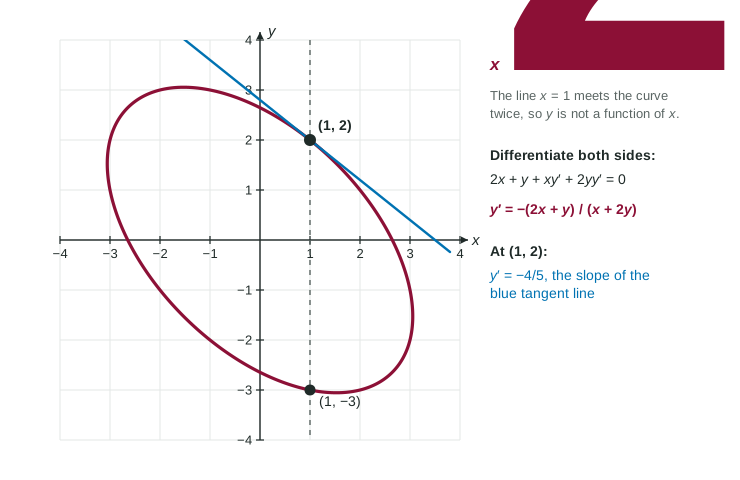
A function is given explicitly when stands alone: . It is given implicitly when an equation links and , such as . The whole circle fails the vertical line test, so it is not the graph of one function. But zoom in near the point and you see a small arc that does pass the test. On that arc, is a function of , even if we never write its formula, and its slope is what we want.
The key step: the chain rule on
Treat as an unknown function of . Then a term like is a composite function: the inside is , the outside is the square. By the chain rule,
The factor is the derivative of the inside function. It appears every time you differentiate a term that holds , and never for a term that holds only :
| Term | Derivative with respect to | Why |
|---|---|---|
| only : no extra factor | ||
| chain rule, inside | ||
| chain rule, inside | ||
| chain rule, inside | ||
| product rule; the factor gives | ||
| a constant |
The routine
- Apply to both sides of the equation and write the new equation in full, with its right side (often ).
- Move every term that holds to one side and everything else to the other.
- Factor out and divide.
- For a slope at a point, substitute both coordinates after differentiating.
Worked example 1. Find the slope of the circle at .
Differentiate both sides: .
Solve: .
At : . Check with the picture: at the upper right of the circle the curve falls as grows, so a negative slope makes sense.
Worked example 2. Find for , and the slope at .
Check the point first: , so is on the curve.
Differentiate both sides, using the product rule on :
Collect:
At :
Worked example 3. Find for .
Differentiate: . Both terms on the left hold , so both get .
Factor: , so .
Reading the answer
The formula for usually holds both and . That is not a flaw: on the circle, the points and share but have slopes and . You need both coordinates to know which point you mean, and the point must lie on the curve.
A fraction for also shows special points. Where the numerator is 0 and the denominator is not, the slope is 0 and the tangent line is flat. Where the denominator is 0 and the numerator is not, the slope is undefined and the tangent line is vertical, as at and on the circle. Always check that such a point is actually on the curve.
Slips that cost points
- Forgetting on a -term. Writing for the circle loses the whole problem.
- Skipping the product rule. is , two terms, not alone.
- Differentiating one side only. Apply to both sides, and keep the "".
- Substituting too early. Put in the point's coordinates only after differentiating; a number has derivative 0.
- Mixing notations. Keep (or ) separate from and from .