By now you know every differentiation rule on the AP® Calculus AB exam: the power rule, the derivatives of sine, cosine, and , the product, quotient and chain rules, implicit differentiation and the inverse rules. The hard part is no longer a rule. It is deciding, in front of a long expression, which rule goes first. This page gives one question that always answers that, and practices it on the kinds of expressions the exam likes.
The one question: what is the last operation?
Imagine evaluating the expression at a number with a calculator. The operation you would do last is the outermost layer, and it names the first rule.
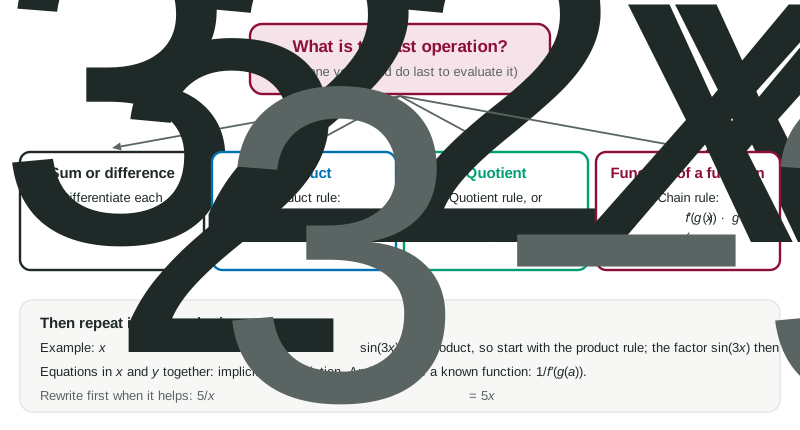
| Expression | Last operation | First rule |
|---|---|---|
| adding and subtracting | term by term | |
| multiplying by | product rule | |
| dividing | quotient rule | |
| cubing | chain rule | |
| squaring | chain rule | |
| taking the log | chain rule |
After the first rule, each piece is a smaller expression. Ask the same question of each piece. Keep going until only basic derivatives remain. Each layer gets exactly one rule.
Worked examples
Worked example 1. Differentiate .
Last operation: a product. Product rule:
The piece is a composition: chain rule, .
So
Worked example 2. Differentiate .
Last operation: cubing. Chain rule: .
The inside is a product: .
So
Worked example 3. Values from a table: , . Find for .
Last operation: multiplying by . Product rule:
The piece is a composition: .
At :
Rewrite first, when it removes a rule
Some quotients are really sums of powers in disguise. Before reaching for the quotient rule, check whether the bottom is a single power of or a constant:
- , so its derivative is . No quotient rule.
, so its derivative is . - , so its derivative is .
Logarithm rules can help too: . But do not rewrite just to rewrite. If the quotient rule is quick, use it.
Beyond formulas
Two more situations name their own method. An equation that mixes and , such as , calls for implicit differentiation. A question about the slope of an inverse, , calls for . And when the functions come as a table or a graph, the rules are the same; you simply read each value at the right input. A corner on a graph (where the function has no derivative) means a rule that needs there cannot be used.
Slips that cost points
- Multiplying derivatives. and .
- Reversing the quotient rule's numerator. It is ; the derivative of the top comes first.
- Missing a layer. Count the layers and check that your answer has one factor or term for each.
- Three-factor products.
: each factor takes a turn being differentiated.