Choosing a Differentiation Rule
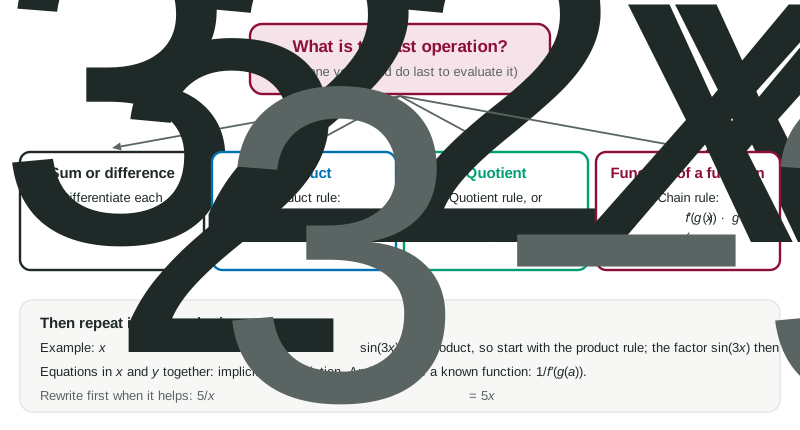
Choose the first rule from the last operation: a sum term by term, a product by the product rule, a quotient by the quotient rule (or a rewrite), a function of a function by the chain rule.
Part 1 · Hook
Why this matters
Part 2 · Before you start
What this builds on
Part 3 · Prerequisite check
Quick check before you start
1. What is ?
Show the answer
Product rule: .
- Correct: :
- :
- :
- :
2. What is ?
Show the answer
Quotient rule: .
- Correct: :
- :
- :
- :
3. What is ?
Show the answer
Chain rule: times the inside derivative 5.
- Correct: :
- :
- :
- :
Part 4 · See it
See it first
Part 5 · Step by step
How it works, step by step
- Ask what you would compute last to evaluate the expressionthat last operation names the first rule: sum, product, quotient or composition
- Apply that ruleit leaves smaller pieces, each needing its own derivative
- Repeat the question on each pieceone rule per layer, until only basic derivatives remain
- Rewrite first when it removes a rule needs only the power rule
Part 6 · Key ideas
Key ideas
- The last operation decides the first rule: is a product; is a composition (a square).
- Inside a product or quotient, any factor may still need the chain rule.
- Equations mixing and call for implicit differentiation; an inverse calls for .
- Rewrite before differentiating when it saves a rule, but do not simplify more than the question asks.
Part 7 · Misconception
A common mistake
The wrong idea: The derivative of a product or a quotient is the product or quotient of the derivatives.
What actually happens: and . Multiplying or dividing the derivatives gives a different, wrong function.
Part 8 · Check yourself
Check yourself
Exam-style questions. Anything you miss goes into your review queue.
Table
Values of , and their derivatives
| 1 | 2 | 3 | 3 | |
|---|---|---|---|---|
| 2 | 5 | 1 | 4 | |
| 3 | 4 | 2 | 6 |
1. Let . Find .
No calculator. Type the exact value (a fraction, π, e or a root is fine).
Show the answer
Product rule:
- Answer: 1
2. Using the table, find the derivative of the quotient at .
No calculator. Type the exact value (a fraction, π, e or a root is fine).
Show the answer
Quotient rule:
- Answer: -7
3. Let . What is ?
Show the answer
The last operation is applying to : chain rule.
- Correct: :
. - : This is ; read at the inside value .
- : This is without the inside derivative .
- : This is : the inside derivative must be read at .
4. Let . Find .
No calculator. Type the exact value (a fraction, π, e or a root is fine).
Show the answer
Product rule first, chain rule inside:
- Answer: 8
5. Find the derivative of .
Type an expression for .
Show the answer
Product first: . The second factor needs the chain rule: . So .
- Answer:
6. What is ?
Show the answer
Three layers: the square, the sine, and . Multiply one derivative for each: .
- : The innermost layer has derivative , which is missing.
- Correct: : One factor per layer: , , .
- : The middle layer, the sine, contributes , which is missing.
- : The derivative of sine is cosine, with no minus sign.
Part 9 · Summary
Summary
Part 10 · Up next
What comes next
Part 11 · Connections