Second and Higher Derivatives
The second derivative f″ is the derivative of f′ : it tells how fast the rate of change is changing.
Part 1 · Hook
Why this matters
Part 2 · Before you start
What this builds on
Part 3 · Prerequisite check
Quick check before you start
1. What is the derivative of ?
Show the answer
Power rule on each term.
- Correct: :
- :
- :
- :
2. For , is
Show the answer
.
- Correct: :
- :
- :
- :
Part 4 · See it
See it first
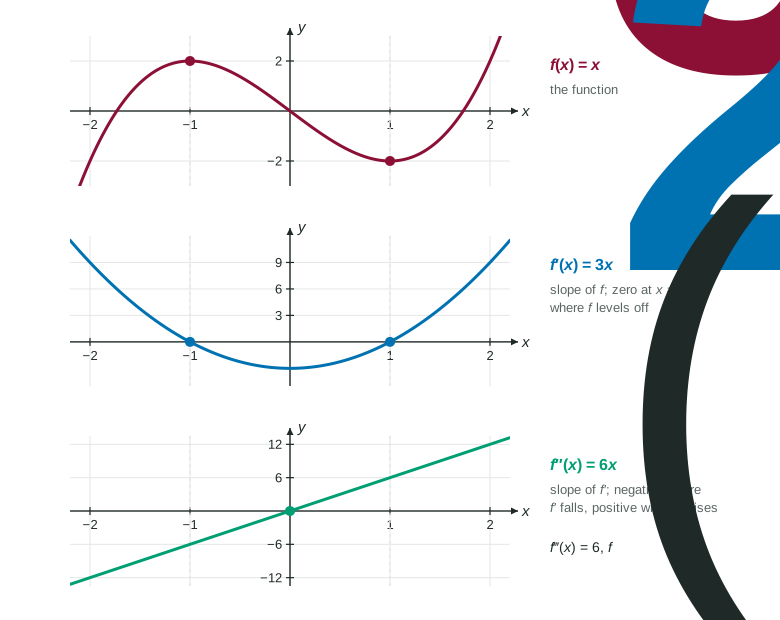
Part 5 · Step by step
How it works, step by step
- is itself a functionit can be differentiated:
- is the slope of the graph of where rises, where falls
- Keep differentiating, , ..., ; for a polynomial of degree ,
- For an implicit curve, differentiate againthen substitute the expression for wherever it appears
Part 6 · Key ideas
Key ideas
- Notation: , , ; higher ones are and .
- Read from a graph of as its slope, not its height.
- If is a product or composition, differentiating again needs the product or chain rule again.
- Implicit second derivative: differentiate (quotient rule, still depends on ), then substitute .
Part 7 · Misconception
A common mistake
The wrong idea: From a graph of , is the height of the graph at .
What actually happens: The height of the graph of is . The second derivative is the slope of that graph at .
Part 8 · Check yourself
Check yourself
Exam-style questions. Anything you miss goes into your review queue.
Graph
The graph of
1. The graph shows , the derivative of . Find .
No calculator. Type the exact value (a fraction, π, e or a root is fine).
Show the answer
is the slope of the graph of . On the graph of is a segment of slope , so .
- Answer: -2
2. On which interval is ?
Show the answer
where the graph of is falling: on , where its slope is .
- Correct: : The graph of falls there, so its slope is negative.
- : There itself is negative; the sign of comes from the slope of .
- : There is positive, but is negative on all of .
- : The graph of rises there, so .
3. What can be said about ?
- It equals , the value of
- It does not exist, because the graph of has a corner at
- It equals 0, because the graph of turns around
- It equals 2, the slope just to the right of
Show the answer
is the derivative of at 2. The one-sided slopes, and , differ, so is not differentiable at 2.
- It equals , the value of : That is the height of the graph of , not its slope.
- Correct: It does not exist, because the graph of has a corner at : The slope of is just left of 2 and just right of it.
- It equals 0, because the graph of turns around: A sharp corner has no single slope, so there is no derivative of there.
- It equals 2, the slope just to the right of : A derivative needs the slopes from both sides to agree; they are and .
4. Let . Find .
No calculator. Type the exact value (a fraction, π, e or a root is fine).
Show the answer
Product rule: . From the graph, and (the slope of the second segment). So .
- Answer: 10
5. Let . Find .
Type an expression for .
Show the answer
and : each derivative brings a factor 3 from the chain rule.
- Answer:
6. Let . Find , the fifth derivative at 0.
No calculator. Type the exact value (a fraction, π, e or a root is fine).
Show the answer
Each derivative multiplies by :
- Answer: -32
Part 9 · Summary
Summary
Part 10 · Up next
What comes next
Part 11 · Connections