The Derivative in Context
In context, a derivative is a rate with units of output per unit of input.
Part 1 · Hook
Why this matters
Part 2 · Before you start
What this builds on
Part 3 · Prerequisite check
Quick check before you start
1. The derivative is
- the slope of the line tangent to the graph of at
- the value of at
- the slope of a secant line over
- the area under up to
Show the answer
The derivative is the instantaneous rate of change, the slope of the tangent line.
- Correct: the slope of the line tangent to the graph of at :
- the value of at :
- the slope of a secant line over :
- the area under up to :
2. From a table, and . What is the average rate of change of on ?
Show the answer
.
- Correct: :
- :
- :
- :
Part 4 · See it
See it first
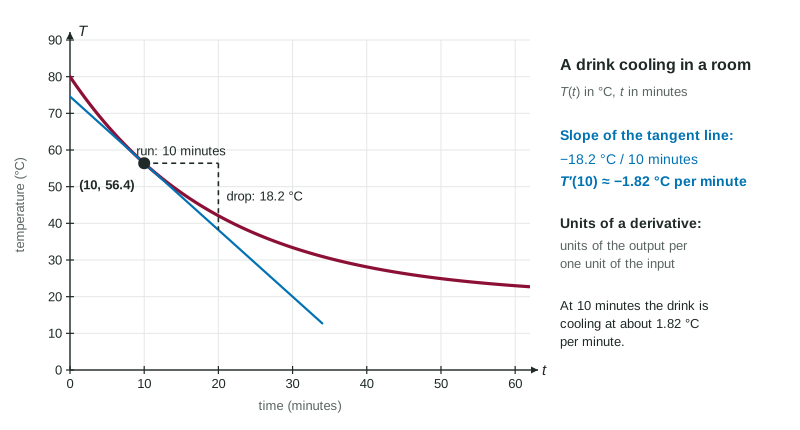
Part 5 · Step by step
How it works, step by step
- is a change in output divided by a change in input, as the input change shrinksits units are output units per input unit
- The sign of the derivativesays whether the quantity is increasing (positive) or decreasing (negative) at that instant
- Its sizesays how fast, in those units
- Put together in one sentenceat this instant, this quantity is increasing (or decreasing) at this many units of output per unit of input
Part 6 · Key ideas
Key ideas
- Units of : units of divided by units of the input (liters per minute, dollars per item).
- Interpret with four parts: the instant, the quantity by name, increasing or decreasing, and the rate with units.
- is an amount; is a rate. Do not mix them in a sentence.
- From a table, estimate with the two closest inputs on either side of , using the table's actual widths.
Part 7 · Misconception
A common mistake
The wrong idea: means the snow grew 1.6 centimeters in 3 hours.
What actually happens: is a rate at the single instant : the depth is increasing at 1.6 centimeters per hour then. A change over an interval is a different quantity, in centimeters.
Part 8 · Check yourself
Check yourself
Exam-style questions. Anything you miss goes into your review queue.
Table
Depth of snow on a deck
| (hours) | |||||
|---|---|---|---|---|---|
| (centimeters) |
1. is differentiable. Use the data in the table to estimate . Include units.
No calculator. Type the exact value (a fraction, π, e or a root is fine), then its unit.
Show the answer
Use the two times that straddle 5.5:
- Answer: 1.1 centimeters per hour
2. What are the units of ?
- centimeters per hour
- centimeters
- hours per centimeter
- centimeters times hours
Show the answer
A derivative is a change in output over a change in input: , centimeters per hour.
- Correct: centimeters per hour: Output units (centimeters) per input unit (hours).
- centimeters: Those are the units of , the depth itself.
- hours per centimeter: The ratio is upside down: the output change goes on top.
- centimeters times hours: A rate divides the output units by the input units.
3. Estimate using the table. Include units.
No calculator. Type the exact value (a fraction, π, e or a root is fine), then its unit.
Show the answer
- Answer: 0.725 centimeters per hour
4. From the table, . Which is the best interpretation?
- In the first 3 hours, the depth of the snow increased by about 1.6 centimeters
- At 3 hours, the depth of the snow is increasing at about 1.6 centimeters per hour
- At 3 hours, the snow on the deck is about 1.6 centimeters deep
- Over the first 3 hours, the snow fell at an average of 1.6 centimeters per hour
Show the answer
An interpretation names the instant, the quantity, whether it increases or decreases, and the units: at hours the depth is increasing at about 1.6 cm per hour.
- In the first 3 hours, the depth of the snow increased by about 1.6 centimeters: That describes a change over an interval, in centimeters; is a rate at .
- Correct: At 3 hours, the depth of the snow is increasing at about 1.6 centimeters per hour: A derivative is a rate at one instant, with units of depth per time.
- At 3 hours, the snow on the deck is about 1.6 centimeters deep: That would be , a depth; the table puts the depth between 15.2 and 20 centimeters then.
- Over the first 3 hours, the snow fell at an average of 1.6 centimeters per hour: is the rate at the instant , not an average from 0 to 3.
5. is the number of liters of water in a tank minutes after noon. What does mean?
- At 12:20 there are 4 liters of water in the tank
- In the first 20 minutes the tank lost 4 liters
- At 12:20 the volume is decreasing at 4 liters per minute
- At 12:20 the amount of water is decreasing at 4 minutes per liter
Show the answer
liters per minute: at minutes the volume is decreasing at 4 liters per minute.
- At 12:20 there are 4 liters of water in the tank: That would be .
- In the first 20 minutes the tank lost 4 liters: That is a change over an interval; is a rate at one instant.
- Correct: At 12:20 the volume is decreasing at 4 liters per minute: A negative rate means the amount is going down.
- At 12:20 the amount of water is decreasing at 4 minutes per liter: The units are upside down: liters per minute.
6. A square has side centimeters and area square centimeters. Find with units.
No calculator. Type the exact value (a fraction, π, e or a root is fine), then its unit.
Show the answer
, so square centimeters per centimeter: near , the area grows about 10 cm² for each extra centimeter of side.
- Answer: 10 square centimeters per centimeter
Part 9 · Summary
Summary
Part 10 · Up next
What comes next
Part 11 · Connections