Straight-Line Motion: Position, Velocity, Acceleration
For a particle on a line, v(t) = x′(t) and a(t) = v′(t) = x″(t) .
Part 1 · Hook
Why this matters
Part 2 · Before you start
What this builds on
Part 3 · Prerequisite check
Quick check before you start
1. If , what is ?
Show the answer
, then .
- Correct: :
- :
- :
- :
2. for a depth in meters and in hours means
- at 4 hours the depth is decreasing at 3 meters per hour
- the depth is 3 meters at 4 hours
- the depth fell 3 meters in 4 hours
- the depth is increasing at 3 meters per hour
Show the answer
A negative derivative is a decreasing quantity, at that rate.
- Correct: at 4 hours the depth is decreasing at 3 meters per hour:
- the depth is 3 meters at 4 hours:
- the depth fell 3 meters in 4 hours:
- the depth is increasing at 3 meters per hour:
Part 4 · See it
See it first
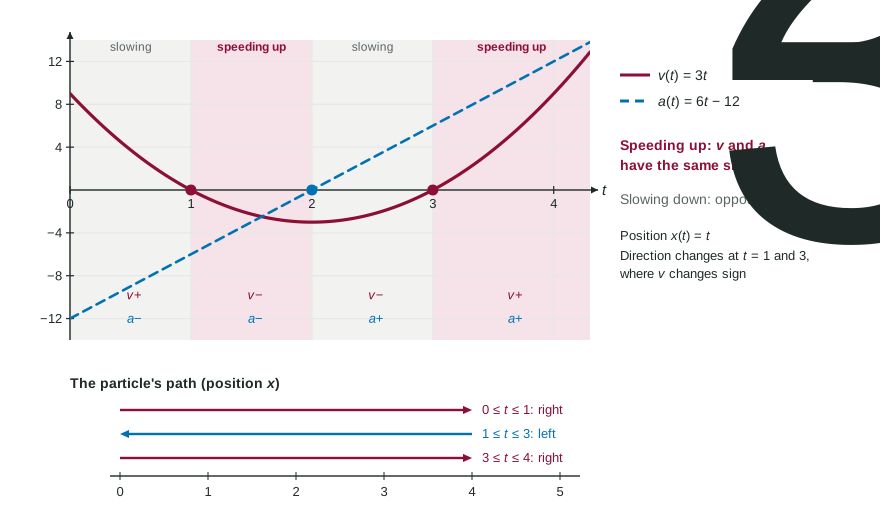
Part 5 · Step by step
How it works, step by step
- Position changes with timeits rate of change is the velocity,
- Velocity changes with timeits rate of change is the acceleration,
- The sign of gives the direction: right (or up) when , left when ; a direction change needs to change sign
- Compare the signs of and same sign: speeding up; opposite signs: slowing down
Part 6 · Key ideas
Key ideas
- Velocity has a sign; speed is and is never negative.
- The particle is at rest when , and changes direction only where changes sign.
- Speeding up when and have the same sign. State both signs in a justification.
- Units: position in meters gives velocity in meters per second and acceleration in meters per second per second.
Part 7 · Misconception
A common mistake
The wrong idea: Negative acceleration means the particle is slowing down.
What actually happens: It depends on the velocity too. With and , the particle moves left faster and faster: it is speeding up. Slowing down needs and with opposite signs.
Part 8 · Check yourself
Check yourself
Exam-style questions. Anything you miss goes into your review queue.
Graph
Position of a particle:
1. A particle moves along the -axis with position meters at time seconds, as graphed. Find its velocity at , with units.
No calculator. Type the exact value (a fraction, π, e or a root is fine), then its unit.
Show the answer
- Answer: -3 meters per second
2. Find the acceleration of the particle at , with units.
No calculator. Type the exact value (a fraction, π, e or a root is fine), then its unit.
Show the answer
, so meters per second per second.
- Answer: 6 meters per second per second
3. At seconds, is the particle speeding up or slowing down?
- Slowing down, because and
- Speeding up, because
- Speeding up, because and are both negative
- Slowing down, because
Show the answer
- Correct: Slowing down, because and : and : opposite signs.
- Speeding up, because : A positive acceleration speeds the particle up only if it is moving in the positive direction.
- Speeding up, because and are both negative: is positive.
- Slowing down, because : The sign of alone gives the direction of motion, not whether speed grows.
4. On which interval is the particle moving to the left?
Show the answer
Moving left means . Since , that is , where the graph of falls.
- : is positive for ; the acceleration is positive on .
- Correct: :
there, and the graph of falls. - : The particle moves right until .
- : there: the position increases.
5. At which times does the particle change direction, and why?
- , because
- and , because there
- and , because changes sign there
- and , because or there
Show the answer
The direction changes where changes sign. changes sign at (positive to negative) and (negative to positive).
- , because : A zero of is where the velocity stops falling; the particle still moves left.
- and , because there: Being at the origin says nothing about the direction of motion.
- Correct: and , because changes sign there: goes from positive to negative at 1 and from negative to positive at 3.
- and , because or there: The right times, but the reason must be about : it changes sign.
6. At , a particle has and . The particle is
- slowing down, because is negative
- slowing down, because is negative
- at rest, because and are both negative
- speeding up, because and share a sign
Show the answer
Speeding up when and share a sign; slowing down when they differ. Here both are negative: speeding up while moving left.
- slowing down, because is negative: A negative acceleration speeds up a particle moving in the negative direction.
- slowing down, because is negative: The sign of alone gives direction only.
- at rest, because and are both negative: At rest means ; here the particle moves left.
- Correct: speeding up, because and share a sign: Both negative: the acceleration points the way the particle moves.
Part 9 · Summary
Summary
Part 10 · Up next
What comes next
Part 11 · Connections