Rates of Change in Other Contexts
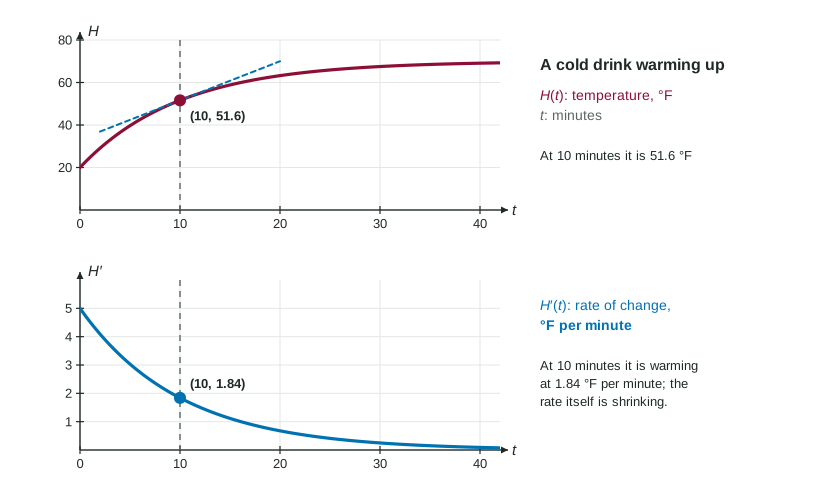
In any context, Q′ is the rate of change of Q in units of Q per input unit, and Q″ is the rate of change of that rate.
Part 1 · Hook
Why this matters
Part 2 · Before you start
What this builds on
Part 3 · Prerequisite check
Quick check before you start
1. The units of , when is in liters and in minutes, are
- liters per minute
- liters
- minutes per liter
- liters times minutes
Show the answer
Output units per input unit.
- Correct: liters per minute:
- liters:
- minutes per liter:
- liters times minutes:
2. For a particle, and . At the particle is
- speeding up
- slowing down
- at rest
- changing direction
Show the answer
and have the same sign.
- Correct: speeding up:
- slowing down:
- at rest:
- changing direction:
Part 4 · See it
See it first
Part 5 · Step by step
How it works, step by step
- Any quantity that depends on an inputhas a rate of change in units of per unit of input
- The sign of says whether the quantity is increasing or decreasing
- is itself a function, so is the rate of change of the ratemeasured in units of Q per input unit per input unit
- The sign of says whether the rate is increasing or decreasing
Part 6 · Key ideas
Key ideas
- An interpretation names the input value, the quantity, increasing or decreasing, and the rate with units.
- When the function is itself a rate (liters per hour), its derivative is a rate of a rate (liters per hour per hour).
- with : decreasing, but more slowly. with : increasing, but more slowly.
- Chained quantities multiply rates, and their units cancel: (°F per foot)(feet per minute) = °F per minute.
Part 7 · Misconception
A common mistake
The wrong idea: If , the temperature is going up.
What actually happens: describes the rate , not the temperature. With and the temperature is still falling, just more slowly.
Part 8 · Check yourself
Check yourself
Exam-style questions. Anything you miss goes into your review queue.
Graph
A bowl of soup cooling:
1. The temperature of a bowl of soup is degrees Celsius, minutes after it is served. Find , with units.
Calculator allowed. Give the answer correct to three decimal places, then its unit.
Show the answer
- Answer: -1.877 degrees Celsius per minute
2. What are the units of ?
- degrees Celsius per minute per minute
- degrees Celsius per minute
- degrees Celsius
- minutes per degree Celsius
Show the answer
Each derivative with respect to divides by minutes once more: is in degrees Celsius per minute per minute.
- Correct: degrees Celsius per minute per minute: is the rate of change of , which is in °C per minute.
- degrees Celsius per minute: Those are the units of .
- degrees Celsius: Those are the units of .
- minutes per degree Celsius: Rates put the output on top: °C per minute, then per minute again.
3. Find , with units.
Calculator allowed. Give the answer correct to three decimal places, then its unit.
Show the answer
- Answer: 0.075 degrees Celsius per minute per minute
4. At , and . What does this say about the soup?
- It is warming, because is positive
- It is cooling, and its rate of cooling is slowing down
- It is cooling faster and faster
- Its temperature is about to stop falling and start rising
Show the answer
means the temperature is decreasing at . means is increasing, toward 0: the soup cools more and more slowly.
- It is warming, because is positive: The sign of , not of , says whether the temperature rises or falls.
- Correct: It is cooling, and its rate of cooling is slowing down: : cooling. : is rising toward 0, so the cooling gets gentler.
- It is cooling faster and faster: Cooling faster would need to become more negative, that is .
- Its temperature is about to stop falling and start rising: is negative for every : the soup keeps cooling, more and more slowly.
5. is the number of gallons of water in a pool hours after filling starts. What are the units of ?
- gallons per hour per hour
- gallons per hour
- gallons squared per hour
- hours per gallon per gallon
Show the answer
: (gallons per hour) per hour.
- Correct: gallons per hour per hour: is in gallons per hour; its rate of change adds another per hour.
- gallons per hour: Those are the units of .
- gallons squared per hour: Differentiating twice divides by hours twice; it does not square the gallons.
- hours per gallon per gallon: Rates put the output on top.
6. The area of an oil slick satisfies and on an interval. What is happening to the slick?
- It is shrinking, but more and more slowly
- It is spreading faster and faster
- It is spreading, but more and more slowly
- It is shrinking faster and faster
Show the answer
The sign of says the area is growing; the sign of says that growth rate is falling.
- It is shrinking, but more and more slowly: A positive means the area is growing.
- It is spreading faster and faster: That would need .
- Correct: It is spreading, but more and more slowly: : area increasing. : the rate of increase is decreasing.
- It is shrinking faster and faster: With the slick is not shrinking.
Part 9 · Summary
Summary
Part 10 · Up next
What comes next
Part 11 · Connections