Geometry for Calculus
Calculus word problems start with a geometric equation.
Part 1 · Hook
Why this matters
Part 2 · Prerequisite check
Quick check before you start
1. Solve for .
Show the answer
Cross-multiply: , so and .
- Correct: :
- :
- :
- :
2. In a right triangle with angle , is
- opposite over adjacent
- adjacent over opposite
- opposite over hypotenuse
- adjacent over hypotenuse
Show the answer
- Correct: opposite over adjacent:
- adjacent over opposite:
- opposite over hypotenuse:
- adjacent over hypotenuse:
Part 3 · See it
See it first
Part 4 · Step by step
How it works, step by step
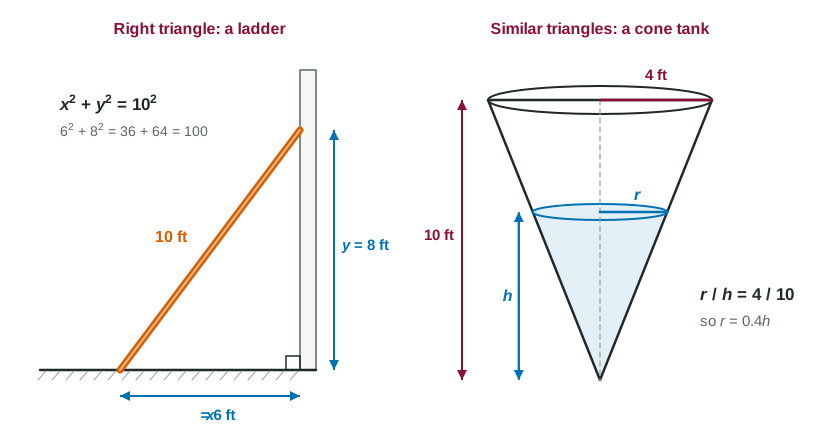
- A right angle in the picture (wall and ground, two roads crossing)the Pythagorean theorem links the sides:
- Two triangles with the same angles (a shadow, water in a cone)similar triangles: corresponding sides are in the same ratio, such as
- Use the ratio to replace one variable by anothera formula like becomes a function of one variable,
Part 5 · Key ideas
Key ideas
- Pythagorean theorem: in a right triangle with legs , and hypotenuse , . The hypotenuse is opposite the right angle.
- Similar triangles have equal angles, so their sides are in proportion: . Look for a small triangle inside a big one.
- Know the area and volume formulas: circle , semicircle , trapezoid , cylinder , cone , sphere .
- Draw the picture, label what changes with letters and what is fixed with numbers, then write one equation.
Part 6 · Misconception
A common mistake
The wrong idea: In the cone problem, the radius of the water is the tank's radius, 4, so .
What actually happens: The water's radius changes with its depth. Similar triangles give ; substitute before doing anything else: .
Part 7 · Check yourself
Check yourself
Exam-style questions. Anything you miss goes into your review queue.
1. A 13-foot ladder leans against a vertical wall. Its foot is 5 feet from the wall. How high up the wall does the top reach?
No calculator. Type the exact value (a fraction, π, e or a root is fine), then its unit.
Show the answer
The ladder, wall and ground form a right triangle with hypotenuse 13: , so and feet.
- Answer: 12 feet
2. A conical tank, point down, is 9 feet deep with a top radius of 6 feet. When the water is feet deep, its surface has radius . Which equation relates and ?
Show the answer
The water forms a smaller cone similar to the tank, so the ratio of radius to depth is the same: .
- Correct: : Similar triangles: .
- : That is depth over radius; the ratio is .
- : Similar shapes scale by a factor; they do not differ by a constant.
- : and are legs of the side-view triangle, not a radius and a slant length of 6.
3. For the tank above (), write the volume of water as a function of the depth alone. Use .
Type an expression for .
Show the answer
Substitute :
- Answer:
4. A person 6 feet tall stands 10 feet from a lamppost 15 feet tall. How long is the person's shadow on the ground?
No calculator. Type the exact value (a fraction, π, e or a root is fine), then its unit.
Show the answer
Two similar right triangles share the angle at the shadow's tip: . Cross-multiply: , so and feet.
- Answer: ≈ 6.667 feet
5. Write the area of an equilateral triangle in terms of its side length .
Type an expression for .
Show the answer
The height splits the base in half: , so . Then
- Answer:
6. A box with a square base of side and height has volume 32 cubic inches. Which expresses in terms of ?
Show the answer
Volume , so .
- Correct: : .
- : The base has area , not .
- : Volume multiplies; it does not subtract.
- : does not give a square root.
7. A balloon rises straight up from a point 50 meters from an observer on level ground. When the balloon is meters high, the angle of elevation from the observer is . Which equation is true?
Show the answer
In the right triangle, is opposite and 50 is adjacent:
- Correct: : Opposite over adjacent.
- : Sine uses the hypotenuse, , not 50.
- : That is adjacent over opposite, which is .
- : Cosine is adjacent over hypotenuse.
Part 8 · Summary
Summary
Part 9 · Up next
What comes next
Part 10 · Connections