Introduction to Related Rates
When quantities linked by an equation change with time, differentiate the equation with respect to t .
Part 1 · Hook
Why this matters
Part 2 · Before you start
What this builds on
Part 3 · Prerequisite check
Quick check before you start
1. If depends on , what is ?
Show the answer
The chain rule, as in implicit differentiation.
- Correct: :
- :
- :
- :
2. If is a differentiable function of , what is ?
Show the answer
The chain rule: outside derivative at , times .
- Correct: :
- :
- :
- :
Part 4 · See it
See it first
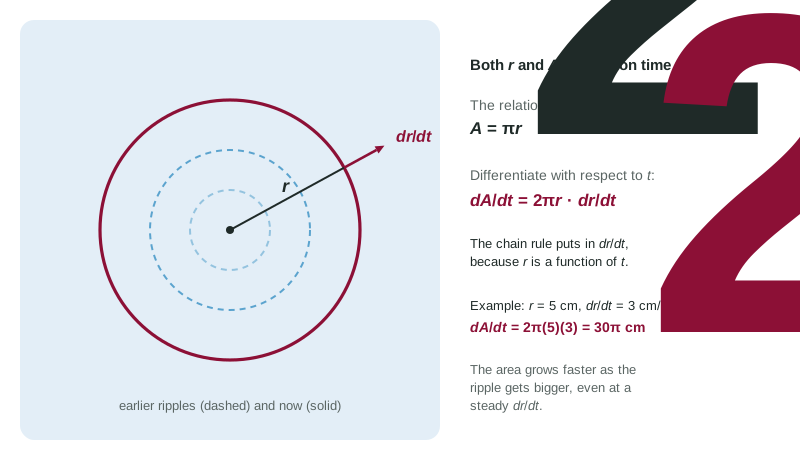
Part 5 · Step by step
How it works, step by step
- Two or more quantities change with time and are linked by an equationeach one is a function of , even if the equation shows no
- Differentiate both sides of the equation with respect to the chain rule attaches a rate to each variable:
- The result is an equation among the ratesknown rates and values give the unknown rate
- Substitute the values of one instant only after differentiatingthe rates are not lost to derivatives of constants
Part 6 · Key ideas
Key ideas
- Related rates: differentiate an equation linking quantities with respect to time .
- Each variable that changes gets its own rate, , , from the chain rule. Constants get none.
- A decreasing quantity has a negative rate: shrinking at 2 cm/s means .
- Products need the product rule:
.
Part 7 · Misconception
A common mistake
The wrong idea: For , .
What actually happens: is . With respect to time, the chain rule adds the factor : .
Part 8 · Check yourself
Check yourself
Exam-style questions. Anything you miss goes into your review queue.
Table
A spherical balloon
| Quantity | Formula or value |
|---|---|
| Volume | |
| Radius | cm, a function of |
| Time | seconds |
1. Air is pumped into the balloon so that cm per second. Differentiate with respect to and write in terms of .
Type an expression for .
Show the answer
- Answer:
2. With cm per second, how fast is the volume increasing when cm? Include units.
No calculator. Type the exact value (a fraction, π, e or a root is fine), then its unit.
Show the answer
- Answer: ≈ 226.195 cubic centimeters per second
3. Now air is pumped in at cubic centimeters per second. How fast is the radius increasing when cm? Include units.
No calculator. Type the exact value (a fraction, π, e or a root is fine), then its unit.
Show the answer
- Answer: ≈ 0.318 centimeters per second
4. Later, air leaks out and the radius shrinks by 0.5 cm every second. Which value goes into the related-rates equation?
Show the answer
A decreasing quantity has a negative derivative: cm per second.
- Correct: : The radius is decreasing, so its rate of change is negative.
- : A shrinking radius has a negative rate of change; the sign is part of the value.
- : 0.5 cm per second is a rate for the radius, not for the volume.
- : A radius is a length; is how fast it changes.
5. A circle's radius grows at cm per second. Write in terms of , where .
Type an expression for .
Show the answer
- Answer:
6. The area of a circular stain grows at a constant rate, cm² per second. As the stain gets larger, what happens to ?
- It increases
- It stays the same
- It becomes negative
- It decreases
Show the answer
, so , which shrinks as grows.
- It increases: Adding the same area each second to a larger circle widens it less.
- It stays the same: A constant does not mean a constant : they are linked by .
- It becomes negative: The radius still grows, so .
- Correct: It decreases: : a larger gives a smaller rate.
Part 9 · Summary
Summary
Part 10 · Up next
What comes next
Part 11 · Connections