Solving Related Rates Problems
To solve a related rates problem: draw and label, write an equation linking the quantities at every instant, differentiate it with respect to time, then substitute the instant's values and solve for the unknown rate.
Part 1 · Hook
Why this matters
Part 2 · Before you start
What this builds on
Part 3 · Prerequisite check
Quick check before you start
1. Differentiating with respect to gives
Show the answer
Each variable depends on ; the constant's derivative is 0.
- Correct: :
- :
- :
- :
2. Similar triangles have legs 3 and 6 and and . Which is true?
Show the answer
Corresponding sides are proportional.
- Correct: :
- :
- :
- :
Part 4 · See it
See it first
Part 5 · Step by step
How it works, step by step
- Draw the situation and name every changing quantityeach named quantity is a function of time ; fixed lengths stay numbers
- Find an equation linking the quantities at every instant (Pythagoras, similar triangles, a volume formula)eliminate any extra variable with a second relation first, such as r = h/2
- Differentiate both sides with respect to the chain rule gives an equation among the rates
- Substitute the values of the instant, with signs for increasing or decreasingsolve for the unknown rate and state it with units
Part 6 · Key ideas
Key ideas
- The five steps: draw and label, relate, differentiate with respect to , substitute, answer with units.
- Constants of the problem (a 10-foot ladder, a 6-foot person) stay numbers; quantities that change get letters.
- Use similar triangles to remove an extra variable before differentiating, so only one unknown rate remains.
- Shrinking or approaching means a negative rate. Report the answer in words too: "the top slides down at 1.5 ft/s".
Part 7 · Misconception
A common mistake
The wrong idea: Substitute the given values first, to make the equation simpler, then differentiate.
What actually happens: The values hold at one instant only. Substituted early they become constants with derivative 0, and the rates disappear. Differentiate the general relation first.
Part 8 · Check yourself
Check yourself
Exam-style questions. Anything you miss goes into your review queue.
Diagram
A ladder sliding down a wall
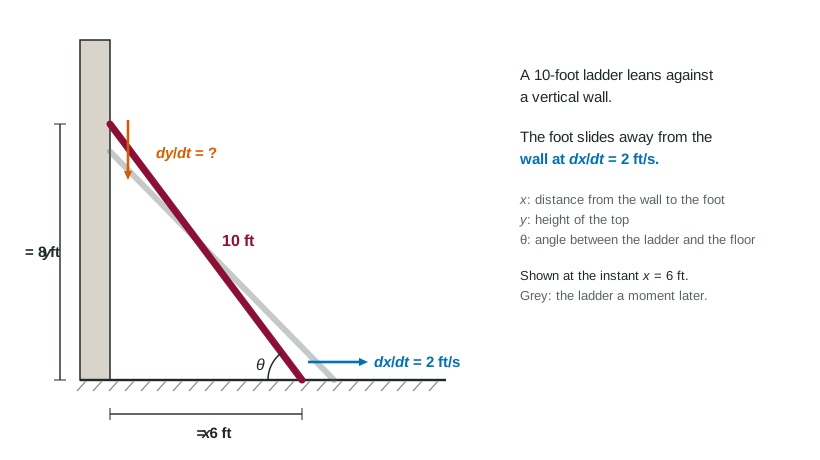
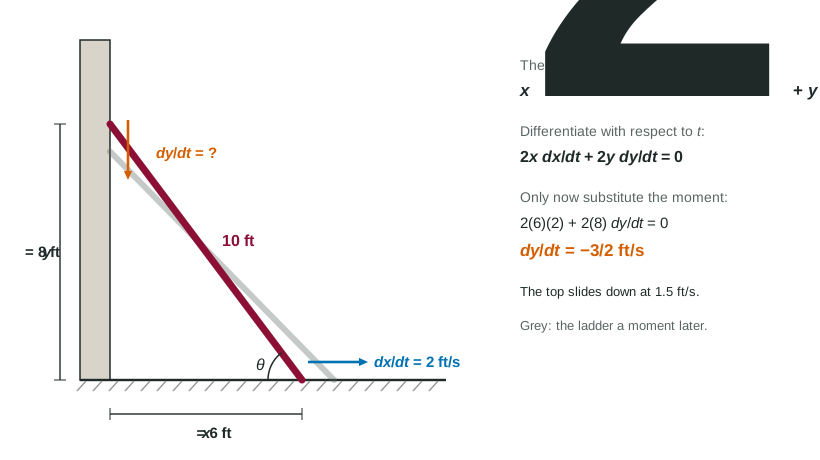
1. The foot of the 10-foot ladder slides away from the wall at 2 feet per second. How fast is the top moving when the foot is 6 feet from the wall? Include units.
No calculator. Type the exact value (a fraction, π, e or a root is fine), then its unit.
Show the answer
gives . At , : , so feet per second. The top slides down at 1.5 ft/s.
- Answer: ≈ -1.500 feet per second
2. How fast is the top of the ladder moving when the foot is 8 feet from the wall? Include units.
No calculator. Type the exact value (a fraction, π, e or a root is fine), then its unit.
Show the answer
At , . Then , so feet per second.
- Answer: ≈ -2.667 feet per second
3. A student writes first and then differentiates. Why does that lose the answer?
- is a constant, so the term with disappears
- is a constant, so
- The equation is false at this instant
- The derivative of 100 should be 10
Show the answer
The relation holds at every instant; holds at one. Differentiate the general relation, then substitute the instant.
- Correct: is a constant, so the term with disappears: The foot's motion is what drives the top; substituting first throws it away.
- is a constant, so : still changes; it is that was frozen.
- The equation is false at this instant: It is true at this instant (); it is just not true at other instants.
- The derivative of 100 should be 10: 100 is a constant, so its derivative is 0.
Diagram
Water filling an inverted cone
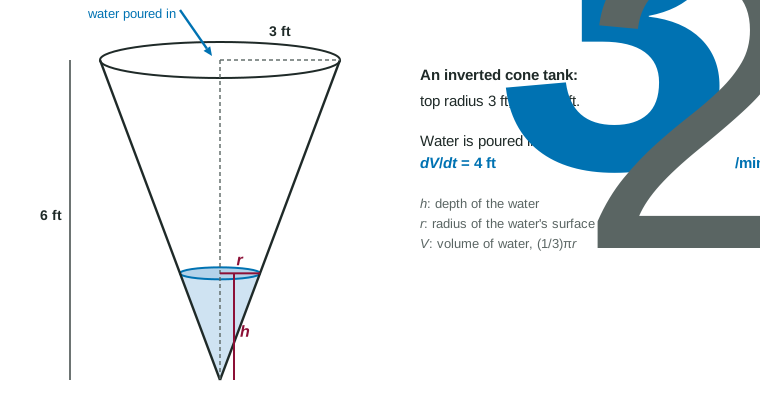
4. Which relation between the water's radius and depth holds at every instant?
Show the answer
The water is a cone similar to the tank: , so at every depth.
- : The ratio is upside down: the depth is twice the radius, not half of it.
- : Similar triangles give a ratio, not a difference.
- Correct: : Similar triangles: .
- : 3 ft is the radius of the full tank; the water's radius changes with .
5. Water is poured in at 4 cubic feet per minute. How fast is the water level rising when the water is 2 feet deep? Include units.
No calculator. Type the exact value (a fraction, π, e or a root is fine), then its unit.
Show the answer
, so . At : , so feet per minute.
- Answer: ≈ 1.273 feet per minute
6. In a related rates problem, which step comes right after writing an equation that links the changing quantities?
- Substitute the values given for that instant first
- Differentiate both sides with respect to time
- Solve the equation for one variable and stop
- Set each rate equal to 0
Show the answer
Draw and label, write the relation, differentiate with respect to , substitute the instant, solve, and answer with units.
- Substitute the values given for that instant first: Substituting first turns changing quantities into constants.
- Correct: Differentiate both sides with respect to time: Then substitute the values of the instant.
- Solve the equation for one variable and stop: The question asks for a rate, which needs a derivative.
- Set each rate equal to 0: Rates are what the problem is about; they are rarely 0.
Part 9 · Summary
Summary
Part 10 · Up next
What comes next
Part 11 · Connections