The last topic showed the key move: differentiate an equation with respect to time, and the chain rule links the rates. A full related rates problem wraps that move in a story. You must turn the story into a picture, the picture into an equation, and the answer back into words. The same five steps handle ladders, tanks, shadows and planes.
The five steps
- Draw and label. Sketch the situation at a general moment. Give a letter to every quantity that changes; write numbers only on lengths that stay fixed.
- Relate. Write an equation that links the quantities at every instant: Pythagoras, similar triangles, an area or volume formula. If it has more changing quantities than you have rates for, use a second relation to remove one.
- Differentiate both sides with respect to .
- Substitute the values at the instant asked about, with signs: shrinking or approaching means a negative rate.
- Solve and answer with units, in a sentence.
The sliding ladder
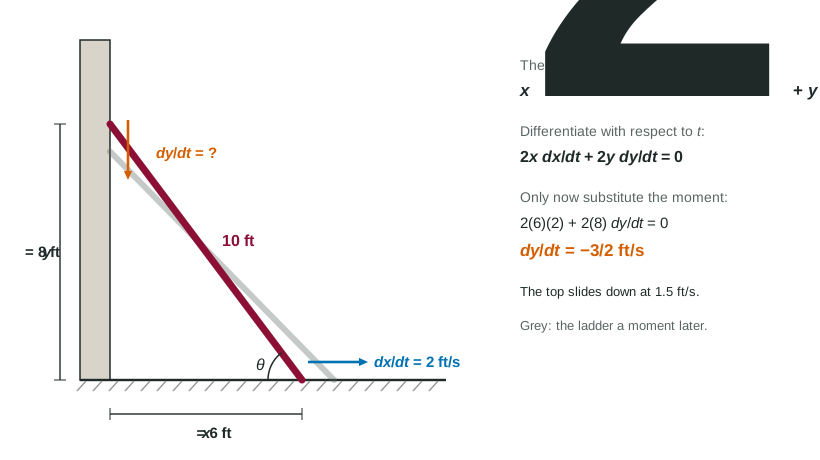
Worked example 1. A 10-foot ladder leans against a wall. Its foot slides away from the wall at 2 feet per second. How fast does the top slide down when the foot is 6 feet from the wall?
Draw: = distance from wall to foot, = height of the top. The ladder's 10 feet never changes, so it stays a number.
Relate: .
Differentiate: .
Substitute: at this instant , so , and : .
Solve: . The top slides down the wall at 1.5 feet per second.
The rates are not equal: the foot moves at 2 ft/s, the top at 1.5 ft/s. And they change with time. When the foot is 8 feet out, and ; the closer the top gets to the floor, the faster it falls.
Angles work too. With the angle between the ladder and the floor, . Differentiating gives . At , , so radian per second: the ladder flattens.
The cone tank: remove a variable first
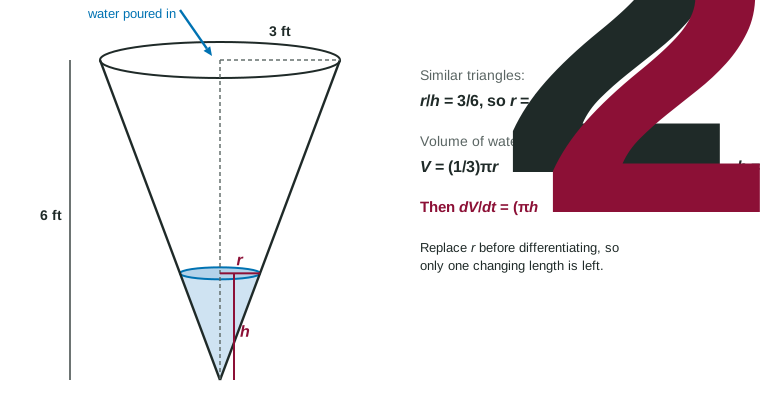
Worked example 2. Water pours into this tank at 4 cubic feet per minute. How fast is the water level rising when the water is 2 feet deep?
Draw: the water is a cone of depth and surface radius , both changing.
Relate: . That has two changing lengths, but we know only . Similar triangles fix the shape: , so at every instant. Substitute it now, because it is always true:
Differentiate: .
Substitute and solve: , so feet per minute.
Notice the difference between the two substitutions. holds at every instant, so it may go in before differentiating. holds at one instant, so it must wait until after.
Shadows
Worked example 3. A 6-foot person walks away from a 15-foot lamppost at 5 ft/s. How fast does the tip of the shadow move?
Let be the distance from the post to the person and the shadow's length. The light ray makes two similar right triangles: , so and .
The tip is at distance from the post. Differentiate:
Slips that cost points
| Slip | Fix |
|---|---|
| Substituting before differentiating | Differentiate the general relation first |
| Keeping two unknown rates | Use similar triangles or a given condition to remove one |
| "Decreasing at 10" entered as | Decreasing means a negative rate |
| Labeling a fixed length with a variable | Constants of the problem stay numbers |
| A bare number | Units and a sentence: "the top slides down at 1.5 ft/s" |