In Unit 1 you met limits like , where both the top and the bottom approach 0. The form tells you nothing by itself: the limit might be 1, or 7, or not exist. Back then you needed algebra tricks or a squeeze. Now that you have derivatives, one rule handles most of these limits, and it comes from the idea you just used for tangent line approximations.
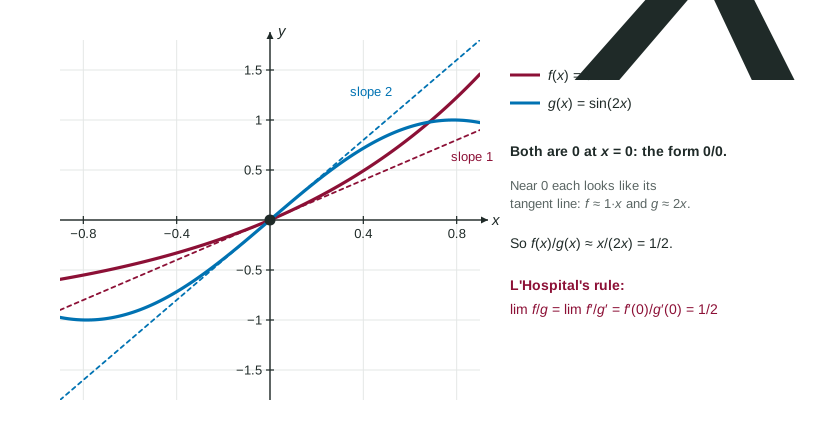
So their quotient is close to . Both functions shrink to 0, but at rates set by their slopes, and the ratio of the slopes is what survives.
Figure 1. Near 0, hugs and hugs . Their quotient approaches , the ratio of the slopes. LevlPrep original diagram.
L'Hospital's rule
If and , or if both limits are infinite, then
provided the limit on the right exists (or is infinite). The same holds for limits as . Three warnings:
Check the form first. The rule needs or . On the exam, show it: write both limits.
Differentiate the top and the bottom separately. This is not the quotient rule.
Never write "". It is a form, not a number. Write " and " instead.
Worked example 1. Find .
Form: and .
By L'Hospital's rule, the limit equals .
Worked example 2. Find .
Form: both limits are 0. First application: .
Check again: and , still . Second application: .
When the form is not indeterminate
Using the rule on a limit that is not or gives wrong answers. For , the form is , so the limit is simply 1. Blindly differentiating gives , which is wrong. A check of the form takes five seconds and saves the point.
From a table of values
Worked example 3. and are differentiable with , , and . Find .