Unit 4 · Topic 4.7 Beta

L'Hospital's Rule

For a limit of the form 0/0 or ∞/∞ , L'Hospital's rule gives lim (f(x))/(g(x)) = lim (f′(x))/(g′(x)) , derivatives taken separately.

Practice 1: Implementing Mathematical ProcessesPractice 3: Justification

Question set for this topic

Part 1 · Hook

Why this matters

Some limits look like 00\frac{0}{0}: both the top and the bottom vanish at the same point. Who wins? Near that point each function behaves like its tangent line, so the race is decided by their slopes. L'Hospital's rule turns that idea into a one-line method, and the exam rewards it when you first show the form.

Part 2 · Before you start

What this builds on

Part 3 · Prerequisite check

Quick check before you start

1. Which limit has an indeterminate form?

  1. limx→0sin⁡xx\lim_{x \to 0}\frac{\sin x}{x}
  2. limx→0x+1x+2\lim_{x \to 0}\frac{x + 1}{x + 2}
  3. limx→1x2x\lim_{x \to 1}\frac{x^2}{x}
  4. limx→21x\lim_{x \to 2}\frac{1}{x}
Show the answer

sin⁡0=0\sin 0 = 0 and the bottom is 0: the form 00\frac{0}{0}.

  • Correct: limx→0sin⁡xx\lim_{x \to 0}\frac{\sin x}{x}:
  • limx→0x+1x+2\lim_{x \to 0}\frac{x + 1}{x + 2}:
  • limx→1x2x\lim_{x \to 1}\frac{x^2}{x}:
  • limx→21x\lim_{x \to 2}\frac{1}{x}:

2. What is ddxe3x\frac{d}{dx}e^{3x}?

  1. 3e3x3e^{3x}
  2. e3xe^{3x}
  3. 3xe3x−13xe^{3x - 1}
  4. e3e^3
Show the answer

The chain rule: e3x⋅3e^{3x} \cdot 3.

  • Correct: 3e3x3e^{3x}:
  • e3xe^{3x}:
  • 3xe3x−13xe^{3x - 1}:
  • e3e^3:

Part 4 · See it

See it first

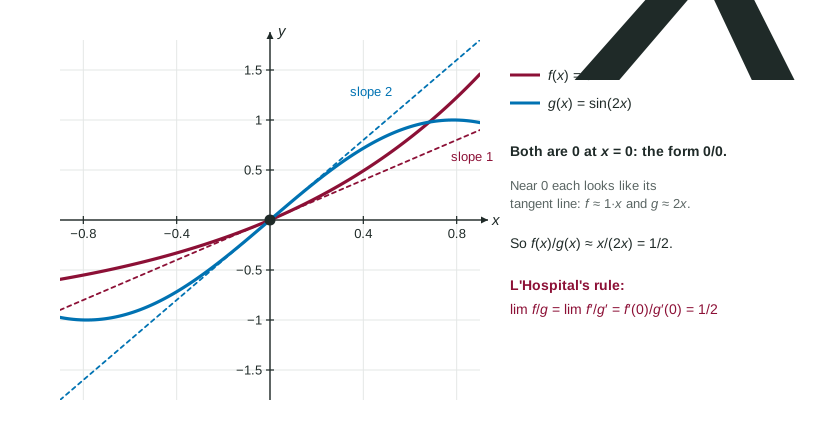
Graphs of f(x) = e^x − 1 (crimson) and g(x) = sin(2x) (blue) near 0, both through the origin, with their dashed tangent lines y = x and y = 2x. Near 0 the quotient f(x)/g(x) is close to x/(2x) = 1/2 = f′(0)/g′(0).
Near 0, ex−1e^x - 1 looks like y=xy = x and sin⁡(2x)\sin(2x) looks like y=2xy = 2x, so their quotient approaches 12\frac{1}{2}, the ratio of the slopes. LevlPrep original diagram.

Part 5 · Step by step

How it works, step by step

  1. limf(x)g(x)\lim\frac{f(x)}{g(x)} has the form 00\frac{0}{0} (or ∞∞\frac{\infty}{\infty})plugging in tells nothing: the answer could be any number, or no limit at all
  2. Near aa, with f(a)=g(a)=0f(a) = g(a) = 0, each function is close to its tangent linef(x)g(x)\frac{f(x)}{g(x)}≈f′(a)(x−a)g′(a)(x−a)\approx \frac{f'(a)(x - a)}{g'(a)(x - a)}=f′(a)g′(a)= \frac{f'(a)}{g'(a)}
  3. L'Hospital's rule makes this exactlimf(x)g(x)\lim\frac{f(x)}{g(x)}=limf′(x)g′(x)= \lim\frac{f'(x)}{g'(x)} when the second limit exists
  4. If the new limit is still indeterminatecheck the form again and apply the rule again

Part 6 · Key ideas

Key ideas

  • First show the form: write limf(x)=0\lim f(x) = 0 and limg(x)=0\lim g(x) = 0 (or both infinite). Without it the rule does not apply.
  • Differentiate the top and the bottom separately. It is not the quotient rule.
  • If the form is not indeterminate, just evaluate: L'Hospital's rule would give a wrong answer.
  • Never write 00\frac{0}{0} as a value with an equals sign; describe the form in words or with two limits.

Part 7 · Misconception

A common mistake

The wrong idea: limx→1x2+1x+1\lim_{x \to 1}\frac{x^2 + 1}{x + 1}=limx→12x1= \lim_{x \to 1}\frac{2x}{1}=2= 2.

What actually happens: The form is 22\frac{2}{2}, not indeterminate, so the rule does not apply. The limit is just 22=1\frac{2}{2} = 1. Always check the form first.

Part 8 · Check yourself

Check yourself

Exam-style questions. Anything you miss goes into your review queue.

Table

Values of ff, gg and their derivatives

Selected values of the twice-differentiable functions f and g and their derivatives
xxf(x)f(x)f′(x)f'(x)g(x)g(x)g′(x)g'(x)
131-24
2050-2
3-1263

1. What is limx→2f(x)g(x)\lim_{x \to 2} \frac{f(x)}{g(x)}?

  1. −52-\frac{5}{2}
  2. 00
  3. −25-\frac{2}{5}
  4. The limit does not exist
Show the answer

ff and gg are differentiable, so continuous: limx→2f(x)=0\lim_{x \to 2} f(x) = 0 and limx→2g(x)=0\lim_{x \to 2} g(x) = 0. By L'Hospital's rule the limit is limx→2f′(x)g′(x)\lim_{x \to 2}\frac{f'(x)}{g'(x)}, and since ff and gg are twice differentiable, f′f' and g′g' are continuous, so this equals f′(2)g′(2)=−52\frac{f'(2)}{g'(2)} = -\frac{5}{2}.

  • Correct: −52-\frac{5}{2}: Both limits are 0, so the limit is f′(2)g′(2)=5−2\frac{f'(2)}{g'(2)} = \frac{5}{-2}.
  • 00: 00\frac{0}{0} is not 0; it is an indeterminate form that needs more work.
  • −25-\frac{2}{5}: The derivatives go in the same places as the functions: f′f' on top.
  • The limit does not exist: A 00\frac{0}{0} form can have a limit; L'Hospital's rule finds it.

2. Find limx→2f(x)x2−4\lim_{x \to 2} \frac{f(x)}{x^2 - 4}.

No calculator. Type the exact value (a fraction, π, e or a root is fine).

Show the answer

Both the top and the bottom approach 0 (form 00\frac{0}{0}). L'Hospital's rule: limx→2f′(x)2x\lim_{x \to 2}\frac{f'(x)}{2x}=54= \frac{5}{4}.

  • Answer: 54\frac{5}{4} ≈ 1.250

3. What is limx→1f(x)g(x)\lim_{x \to 1} \frac{f(x)}{g(x)}?

  1. 14\frac{1}{4}
  2. −32-\frac{3}{2}
  3. −23-\frac{2}{3}
  4. The limit does not exist
Show the answer

Check the form first: f(1)=3f(1) = 3 and g(1)=−2g(1) = -2, so the quotient is continuous at 1 and the limit is 3−2\frac{3}{-2}. L'Hospital's rule does not apply.

  • 14\frac{1}{4}: That is f′(1)g′(1)\frac{f'(1)}{g'(1)}. L'Hospital's rule needs a 00\frac{0}{0} or ∞∞\frac{\infty}{\infty} form, which this is not.
  • Correct: −32-\frac{3}{2}: The form is 3−2\frac{3}{-2}, not indeterminate, so substitute.
  • −23-\frac{2}{3}: That is g(1)f(1)\frac{g(1)}{f(1)}, the quotient upside down.
  • The limit does not exist: Both functions are continuous and g(1)≠0g(1) \ne 0, so the quotient is continuous at 1.

4. To use L'Hospital's rule for limx→2f(x)g(x)\lim_{x \to 2} \frac{f(x)}{g(x)}, what must be shown first?

  1. f′(2)f'(2) and g′(2)g'(2) are both nonzero
  2. f(x)g(x)\frac{f(x)}{g(x)} is differentiable at x=2x = 2
  3. limx→2f(x)=0\lim_{x \to 2} f(x) = 0 and limx→2g(x)=0\lim_{x \to 2} g(x) = 0
  4. f(2)>g(2)f(2) > g(2)
Show the answer

L'Hospital's rule applies to a limit of the form 00\frac{0}{0} or ∞∞\frac{\infty}{\infty}. Write both limits: limx→2f(x)=0\lim_{x \to 2} f(x) = 0 and limx→2g(x)=0\lim_{x \to 2} g(x) = 0.

  • f′(2)f'(2) and g′(2)g'(2) are both nonzero: f′(2)f'(2) may be 0; the rule needs g′g' nonzero near 2, and the indeterminate form.
  • f(x)g(x)\frac{f(x)}{g(x)} is differentiable at x=2x = 2: The quotient is not even defined at 2.
  • Correct: limx→2f(x)=0\lim_{x \to 2} f(x) = 0 and limx→2g(x)=0\lim_{x \to 2} g(x) = 0: The hypothesis: both limits are 0 (or both infinite). Here continuity gives f(2)=g(2)=0f(2) = g(2) = 0.
  • f(2)>g(2)f(2) > g(2): Comparing the values says nothing about the form of the limit.

5. Find limx→0e3x−1x\lim_{x \to 0}\frac{e^{3x} - 1}{x}.

No calculator. Type the exact value (a fraction, π, e or a root is fine).

Show the answer

Form 00\frac{0}{0}. L'Hospital's rule: limx→03e3x1\lim_{x \to 0}\frac{3e^{3x}}{1}=3= 3.

  • Answer: 3

6. Which statement correctly justifies using L'Hospital's rule for limx→0ex−1−xx2\lim_{x \to 0}\frac{e^x - 1 - x}{x^2}?

  1. ex−1−xx2\frac{e^x - 1 - x}{x^2} equals 00\frac{0}{0} at x=0x = 0
  2. limx→0(ex−1−x)\lim_{x \to 0}(e^x - 1 - x)=0= 0 and limx→0x2=0\lim_{x \to 0}x^2 = 0
  3. The derivatives of the top and bottom exist
  4. The function is continuous at x=0x = 0
Show the answer

The rule's hypothesis is a 00\frac{0}{0} (or ∞∞\frac{\infty}{\infty}) form, shown by writing both limits. Avoid writing an equals sign before 00\frac{0}{0}, as if it were a number.

  • ex−1−xx2\frac{e^x - 1 - x}{x^2} equals 00\frac{0}{0} at x=0x = 0: Never write 00\frac{0}{0} as a value; state the two limits.
  • Correct: limx→0(ex−1−x)\lim_{x \to 0}(e^x - 1 - x)=0= 0 and limx→0x2=0\lim_{x \to 0}x^2 = 0: Both limits are shown to be 0: the form 00\frac{0}{0}.
  • The derivatives of the top and bottom exist: Differentiability is needed, but so is the indeterminate form.
  • The function is continuous at x=0x = 0: It is not even defined at 0; the form of the limit is what matters.

Part 9 · Summary

Summary

For a limit of the form 00\frac{0}{0} or ∞∞\frac{\infty}{\infty}, L'Hospital's rule gives limf(x)g(x)\lim\frac{f(x)}{g(x)}=limf′(x)g′(x)= \lim\frac{f'(x)}{g'(x)}, derivatives taken separately. Show both limits first; repeat if the new limit is still indeterminate; and evaluate directly when the form is not indeterminate.

Part 10 · Up next

What comes next

Part 11 · Connections

Connections