The Mean Value Theorem
If f is continuous on [a, b] and differentiable on (a, b) , some c inside has f′(c) equal to the average rate of change: a tangent line parallel to the secant line.
Part 1 · Hook
Why this matters
Part 2 · Before you start
What this builds on
Part 3 · Prerequisite check
Quick check before you start
1. The average rate of change of on is
Show the answer
It is the slope of the secant line through the endpoints: change in output over change in input.
- Correct: :
- :
- :
- :
2. If is differentiable at , then
- is continuous at
- has a corner at
- is not continuous at
Show the answer
Differentiability implies continuity, not the other way round.
- Correct: is continuous at :
- has a corner at :
- :
- is not continuous at :
3. The Intermediate Value Theorem needs which hypothesis on ?
- is continuous on
- is differentiable on
- is increasing
Show the answer
Continuity on the closed interval is the hypothesis of the IVT.
- Correct: is continuous on :
- is differentiable on :
- :
- is increasing:
Part 4 · See it
See it first
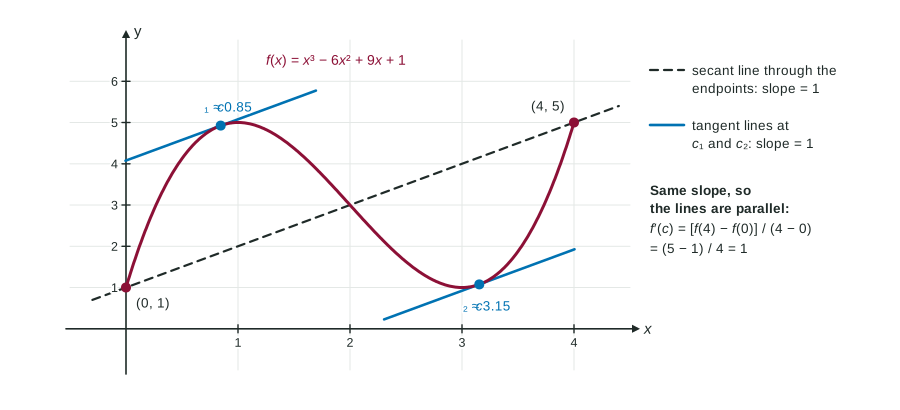
Part 5 · Step by step
How it works, step by step
- is continuous on and differentiable on the graph is one unbroken, smooth curve from to , with a tangent line at each inside point
- Slide a line parallel to the secant line across the curvethe last place it touches the curve is a point where the tangent line is parallel to the secant line
- Parallel lines have equal slopessome in has
- A hypothesis fails (a jump, an asymptote, a corner or cusp inside)the theorem promises nothing, and the conclusion may be false
Part 6 · Key ideas
Key ideas
- Mean Value Theorem: if is continuous on and differentiable on , then
for at least one in . - In words: somewhere inside, the instantaneous rate of change equals the average rate of change.
- " is differentiable" covers both hypotheses, because differentiable implies continuous. Say it.
- The theorem says a exists. It does not say where, and there may be more than one.
- A corner at an endpoint is fine: differentiability is needed only on the open interval.
Part 7 · Misconception
A common mistake
The wrong idea: The Mean Value Theorem works whenever the average rate of change can be computed.
What actually happens: It needs both hypotheses: continuous on and differentiable on . For on the average rate is , but the slope is everywhere it exists. A justification must state the hypotheses before the conclusion.
Part 8 · Check yourself
Check yourself
Exam-style questions. Anything you miss goes into your review queue.
Table
Water level in a reservoir
| (days) | 0 | 3 | 7 | 12 |
|---|---|---|---|---|
| (feet) | 40 | 46 | 38 | 40 |
1. Using the table, which statement is guaranteed for some time with ?
- for a between 3 and 7
Show the answer
- : 35 is below every value in the table. The IVT only promises values between two known values, such as between 38 and 46.
- Correct: : , so the average rate of change on is , and the Mean Value Theorem applies because is differentiable.
- for a between 3 and 7: On the average rate is , not . The sign matters.
- : The table shows no level above 46. A higher level is possible between the readings, but nothing guarantees it.
2. On which interval does the Mean Value Theorem guarantee a time with ?
Show the answer
The Mean Value Theorem gives equal to the average rate of change over an interval. On that rate is feet per day, and is differentiable, so it is continuous there.
- Correct: :
. - : : the right size, the wrong sign.
- : .
- : . The theorem promises the average rate over the interval you choose, and this one is not .
3. The Mean Value Theorem guarantees a time in at which equals what value? Include units.
No calculator. Type the exact value (a fraction, π, e or a root is fine), then its unit.
Show the answer
- Answer: ≈ 0.400 feet per day
4. A student writes: " for some in by the Mean Value Theorem, because ." What does this justification still need to earn the point?
- The value of , found from the table
- A check that on the interval
- That is continuous on and differentiable on
- A second pair of times at which takes equal values, to confirm the first pair
Show the answer
A Mean Value Theorem justification names the theorem and checks both hypotheses: continuous on the closed interval, differentiable on the open one. " is differentiable, so it is also continuous" does both.
- The value of , found from the table: The theorem says a exists; it does not ask you to find it, and the table cannot give it.
- A check that on the interval: The sign of has nothing to do with the theorem's hypotheses.
- Correct: That is continuous on and differentiable on : The theorem's hypotheses must be stated and checked. Here they follow from " is differentiable", which the problem gives.
- A second pair of times at which takes equal values, to confirm the first pair: One interval with equal endpoint values is enough.
5. For on , find the value of guaranteed by the Mean Value Theorem. Give an exact answer.
No calculator. Type the exact value (a fraction, π, e or a root is fine).
Show the answer
Average rate:
- Answer: ≈ 1.732
6. is differentiable everywhere, with and . Which must be true?
- , at the midpoint of the interval
- for some in
- for some in
Show the answer
is differentiable, so it is continuous on and differentiable on . The average rate of change is , so by the Mean Value Theorem for some in .
- : Equal values at the ends say nothing about the value in the middle.
- , at the midpoint of the interval: A flat tangent line is guaranteed somewhere in , not at the midpoint.
- for some in : No value below 3 is known, so the IVT gives no zero.
- Correct: for some in : The average rate on is , and the Mean Value Theorem applies.
Part 9 · Summary
Summary
Part 10 · Up next
What comes next
Part 11 · Connections