Extreme Value Theorem, Global and Local Extrema, Critical Points
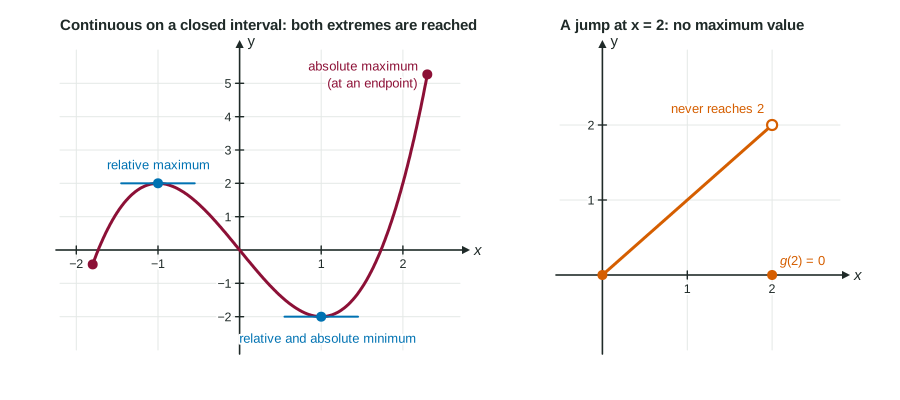
A function continuous on a closed interval reaches an absolute maximum and minimum there (Extreme Value Theorem).
Part 1 · Hook
Why this matters
Part 2 · Before you start
What this builds on
Part 3 · Prerequisite check
Quick check before you start
1. is continuous on when
- it is continuous at each point of and one-sided continuous at and
- it is defined at and
- it is differentiable at each point of
Show the answer
Continuity on a closed interval: no breaks inside, and the one-sided limits at the ends match the endpoint values.
- Correct: it is continuous at each point of and one-sided continuous at and :
- it is defined at and :
- it is differentiable at each point of :
- :
2. For , what is ?
- It does not exist
Show the answer
The graph has a corner at 0: slopes on the left and on the right.
- Correct: It does not exist:
- :
- :
- :
3. The Mean Value Theorem needs
- continuous on and differentiable on
- differentiable on and
- continuous on only
- increasing on
Show the answer
Both hypotheses, every time.
- Correct: continuous on and differentiable on :
- differentiable on and :
- continuous on only:
- increasing on :
Part 4 · See it
See it first
Part 5 · Step by step
How it works, step by step
- is continuous on a closed interval the Extreme Value Theorem guarantees an absolute maximum value and an absolute minimum value on
- An absolute extremum occurs inside the intervalit is also a relative extremum, where the tangent line is flat or does not exist
- So it happens where or does not existthose interior points, the critical points, plus the endpoints, are the only places to look
- A critical point is only a candidatesome critical points ( at 0, a corner on a rising graph) are not extrema at all
Part 6 · Key ideas
Key ideas
- Extreme Value Theorem: if is continuous on , then has at least one absolute maximum value and at least one absolute minimum value on .
- Absolute (global) maximum: for every in the domain or interval. Relative (local) maximum: for every near , on an open interval around . Minimums the same way.
- Critical point: an interior point of the domain where or does not exist.
- Relative extrema happen only at critical points. Absolute extrema on happen at critical points or at endpoints.
- If a hypothesis fails (a jump, an open interval), the theorem promises nothing; extrema may or may not exist.
Part 7 · Misconception
A common mistake
The wrong idea: If , then has a maximum or minimum at .
What actually happens: only makes a critical point, a candidate. For , but the graph rises straight through. A corner can also be a critical point without an extremum. You must check what does around .
Part 8 · Check yourself
Check yourself
Exam-style questions. Anything you miss goes into your review queue.
Graph
The graph of on
1. How many critical points does have in the open interval ?
No calculator. Type the exact value (a fraction, π, e or a root is fine).
Show the answer
and (flat tangent lines), and does not exist (corner). Three critical points: , , .
- Answer: 3
2. Which statement about at is true?
- has a relative maximum at , because the graph has a corner there
- is not a critical point, because is continuous there
- has a relative minimum at , because does not exist
- is a critical point, but is not a relative extremum
Show the answer
A critical point is only a candidate. At , does not exist, but is rising on both sides (slopes near 4 on the left, near 1 on the right), so is neither a relative maximum nor a relative minimum.
- has a relative maximum at , because the graph has a corner there: A corner can be a peak, but this one is not: the graph keeps rising through it.
- is not a critical point, because is continuous there: Continuity does not matter: fails to exist, which makes a critical point.
- has a relative minimum at , because does not exist: An undefined derivative makes a critical point, not an extremum. Values just left of 1 are smaller than , values just right are larger.
- Correct: is a critical point, but is not a relative extremum: does not exist, so it is a critical point; but rises on both sides of , so there is no peak or valley.
3. What is the absolute minimum value of on ?
No calculator. Type the exact value (a fraction, π, e or a root is fine).
Show the answer
The lowest point of the graph is , lower than both endpoint values and . The absolute minimum value is .
- Answer: -2
4. At which values of does have a relative extremum? Select each one.
Show the answer
Relative minimum at (value ) and relative maximum at (value ). The corner at is a critical point without an extremum.
- Correct: : A valley: falls, then rises. Relative minimum.
- : The graph rises through the corner; no peak or valley.
- Correct: : A peak: rises, then falls. Relative maximum.
- : At the graph is falling; nothing special happens.
5. What is the absolute maximum of on , and where does it occur?
- , at
- , at the corner
- , at the right endpoint
- No maximum exists, since is not differentiable at
Show the answer
is continuous on , so the Extreme Value Theorem guarantees an absolute maximum. It is , the highest point of the graph.
- Correct: , at : is the highest point of the whole graph, above both endpoint values.
- , at the corner : is less than .
- , at the right endpoint : An endpoint can hold the maximum, but is not the largest value.
- No maximum exists, since is not differentiable at : The Extreme Value Theorem needs continuity, not differentiability. is continuous on the closed interval.
6. Where does have a critical point?
- At , where
- At , where
- At , where does not exist
- No critical point, since has no solution
Show the answer
is never 0 and is undefined at , which is in the domain of . So is the one critical point (a cusp).
- At , where :
. - At , where : is undefined, not zero: the graph has a cusp.
- Correct: At , where does not exist:
is undefined at , an interior point of the domain. - No critical point, since has no solution: A critical point is also a point where does not exist.
Part 9 · Summary
Summary
Part 10 · Up next
What comes next
Part 11 · Connections