Where a Function Increases or Decreases
The sign of the derivative gives the direction of a function: f′ > 0 on an interval means f is increasing there, f′ < 0 means decreasing.
Part 1 · Hook
Why this matters
Part 2 · Before you start
What this builds on
Part 3 · Prerequisite check
Quick check before you start
1. If , the tangent line to at
- slopes downward
- slopes upward
- is horizontal
- is vertical
Show the answer
A negative slope falls from left to right.
- Correct: slopes downward:
- slopes upward:
- is horizontal:
- is vertical:
2. Where is equal to 0?
Show the answer
, so .
- Correct: :
- :
- :
- :
3. The critical points of are interior points where
- or does not exist
- is not continuous
Show the answer
They split the domain into pieces where keeps one sign.
- Correct: or does not exist:
- :
- :
- is not continuous:
Part 4 · See it
See it first
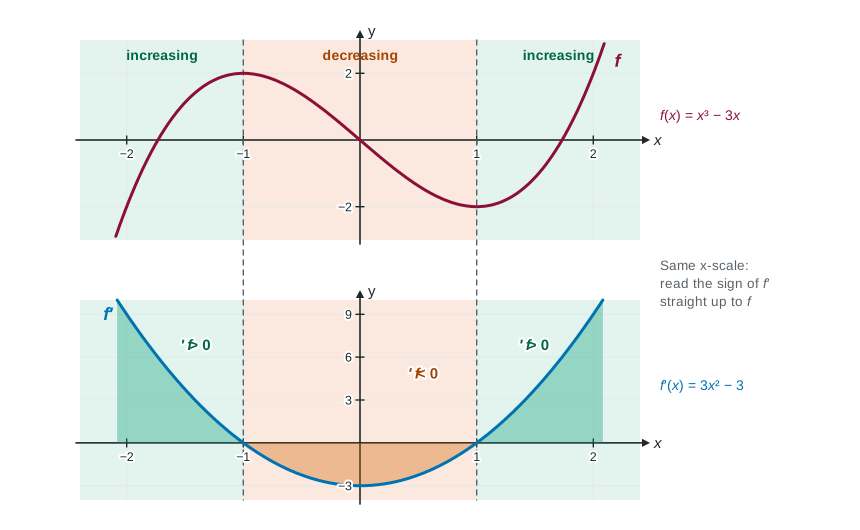
Part 5 · Step by step
How it works, step by step
- at each point of an intervaleach tangent line slopes up, so is increasing on that interval
- at each point of an interval is decreasing on that interval
- can change sign only at a zero or where does not exist (if has no jumps)the critical points split the line into intervals, and one test value per interval gives the sign
- You are given the graph of read the sign (above or below the axis), not whether the graph of goes up or down
Part 6 · Key ideas
Key ideas
- Increasing on an interval: whenever in the interval. If on the interval, is increasing there; if , decreasing.
- Method: find , find where it is 0 or undefined, test the sign of on each interval between those points.
- On a graph of : above the -axis means increasing; below means decreasing.
- Justify with the sign of by name: " for , so is increasing there."
Part 7 · Misconception
A common mistake
The wrong idea: On a graph of , is increasing wherever the graph of is going up.
What actually happens: The direction of comes from the sign of : above the axis, increases, even where the graph of is falling. Whether itself rises or falls tells you about the concavity of , a later topic.
Part 8 · Check yourself
Check yourself
Exam-style questions. Anything you miss goes into your review queue.
Graph
The graph of , the derivative of
1. On which intervals is increasing?
- and
- and
- and , where rises
- , between the outer zeros of
Show the answer
is increasing where : on and on , where the graph of lies above the -axis.
- Correct: and : exactly there: the graph of is above the -axis.
- and : Here : these are where is decreasing.
- and , where rises: That is where is increasing. The sign of , not its direction, tells whether increases.
- , between the outer zeros of : on , so decreases on part of this interval.
2. At , is increasing or decreasing, and why?
- Increasing, because is increasing at
- Increasing, because
- Decreasing, because is less than
- Decreasing, because
Show the answer
, so is decreasing at . The graph of is below the -axis there.
- Increasing, because is increasing at : is rising there, but it is still negative. The sign of decides.
- Increasing, because : Nonzero does not tell the direction; negative means decreasing.
- Decreasing, because is less than : Comparing values of is about whether rises or falls, not about the sign of .
- Correct: Decreasing, because :
.
3. On which of these intervals is increasing at each point? Select each one.
Show the answer
Only lies inside a stretch where . The interval crosses the zero of at .
- Correct: : on , which contains .
- : on .
- : for .
- : on , so decreases on part of .
4. Which is true about the values of ?
- , because
- , because on
- , because
- The graph of gives no way to compare them
Show the answer
for , so is decreasing on and .
- , because : ; and comparing values does not compare values.
- Correct: , because on : is decreasing on and continuous, so it ends lower than it starts.
- , because : Equal slopes at two points say nothing about equal heights.
- The graph of gives no way to compare them: The sign of between them does compare them.
5. Which justification earns credit for " is increasing on "?
- " for ."
- " is increasing on ."
- "The graph goes up on ."
- " and ."
Show the answer
A justification names the function and the condition: on , so is increasing there.
- Correct: " for .": It names and gives its sign on the interval.
- " is increasing on .": False ( rises then falls there), and the direction of is about concavity, not about increasing.
- "The graph goes up on .": Which graph? This is the graph of , and "goes up" names no function.
- " and .": Zeros at the ends do not tell the sign in between.
6. . On which interval is decreasing?
- and
Show the answer
The squared factor is never negative, so exactly when : decreases on .
- : For , both factors give .
- Correct: : , so the sign of is the sign of .
- : For , .
- and : on .
Part 9 · Summary
Summary
Part 10 · Up next
What comes next
Part 11 · Connections