The First Derivative Test
At a critical point, look at the sign of f′ on each side.
Part 1 · Hook
Why this matters
Part 2 · Before you start
What this builds on
Part 3 · Prerequisite check
Quick check before you start
1. If on an interval, then on that interval is
- increasing
- decreasing
- concave up
- constant
Show the answer
A positive derivative means rising tangent lines.
- Correct: increasing:
- decreasing:
- concave up:
- constant:
2. Which points are critical points of ?
- Interior points where or does not exist
- Points where
- The endpoints only
- Points where is largest
Show the answer
Relative extrema can occur only at critical points.
- Correct: Interior points where or does not exist:
- Points where :
- The endpoints only:
- Points where is largest:
Part 4 · See it
See it first
Part 5 · Step by step
How it works, step by step
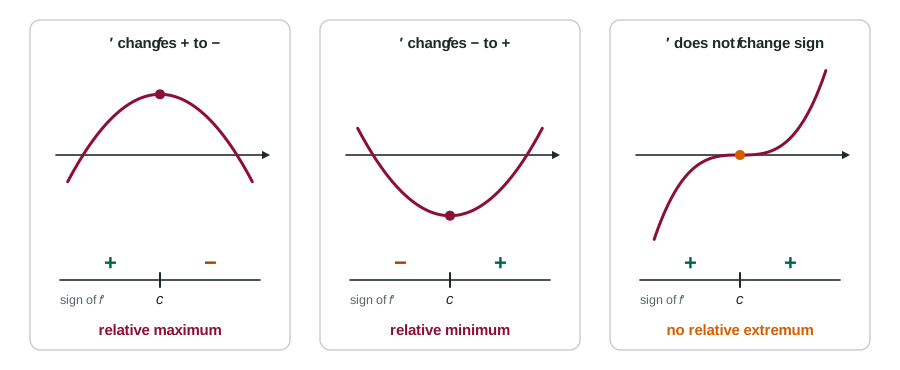
- changes from positive to negative at a critical point (and is continuous at ) rises up to and falls after it, so is a relative maximum
- changes from negative to positive at falls then rises, so is a relative minimum
- has the same sign on both sides of keeps rising (or falling) through : no relative extremum, even if
- You state the resultwrite the sentence: " changes from negative to positive at , so has a relative minimum there"
Part 6 · Key ideas
Key ideas
- First Derivative Test: at a critical point where is continuous, if changes from to , is a relative maximum; from to , a relative minimum; no change, neither.
- It works where does not exist (corners, cusps) as well as where .
- A sign chart of organizes the work, but it is not a justification by itself: write the sentence.
- On a graph of : a relative maximum of is where the graph of crosses the axis going down; a minimum, crossing going up. Touching without crossing gives nothing.
Part 7 · Misconception
A common mistake
The wrong idea: , so has a relative maximum or minimum at .
What actually happens: The scoring guidelines give no credit for "" alone. The point needs a sign change, stated with its direction: " changes from positive to negative at ." For at 0, but there is no extremum.
Part 8 · Check yourself
Check yourself
Exam-style questions. Anything you miss goes into your review queue.
Graph
The graph of , the derivative of
1. At what value of does have a relative maximum?
No calculator. Type the exact value (a fraction, π, e or a root is fine).
Show the answer
changes from positive to negative at , so has a relative maximum there.
- Answer: -3
2. What happens to at ?
- A relative minimum, because
- A relative maximum, because decreases down to 0 just before
- A relative minimum, because has a low point at
- No relative extremum, because does not change sign at
Show the answer
on both sides of (the graph touches the axis there), so is increasing through and has no relative extremum.
- A relative minimum, because : makes 2 a critical point, not an extremum.
- A relative maximum, because decreases down to 0 just before : is positive on both sides; rises through .
- A relative minimum, because has a low point at : A low point of says something about concavity, and never goes negative here.
- Correct: No relative extremum, because does not change sign at : just left and just right of 2: keeps rising.
3. Which justification earns credit for " has a relative minimum at "?
- "."
- " for ."
- " changes from negative to positive at ."
- "The graph crosses the -axis at ."
Show the answer
First Derivative Test: changes from negative to positive at , so has a relative minimum there.
- ".": A zero of alone does not decide: see .
- " for .": Half the story: must also be positive just after 0.
- Correct: " changes from negative to positive at .": It names and the direction of the sign change.
- "The graph crosses the -axis at .": Which graph, and crossing in which direction? Name and the signs.
4. At which values of does have a relative minimum? Select each one.
- , where is lowest
Show the answer
Only at does change from negative to positive.
- : goes from positive to negative there: a relative maximum.
- Correct: : goes from negative to positive.
- : does not change sign.
- , where is lowest: is negative on both sides of ; is still falling.
5. Find the relative maximum value of .
No calculator. Type the exact value (a fraction, π, e or a root is fine).
Show the answer
- Answer: 9
6. Which function has but no relative extremum at ?
Show the answer
For , on both sides of 0, so rises through 0. A zero of without a sign change is not an extremum.
- : changes from negative to positive: a minimum.
- : changes from negative to positive: a minimum.
- Correct: : is positive on both sides of 0: no sign change.
- : changes from positive to negative: a maximum.
Part 9 · Summary
Summary
Part 10 · Up next
What comes next
Part 11 · Connections