The Candidates Test
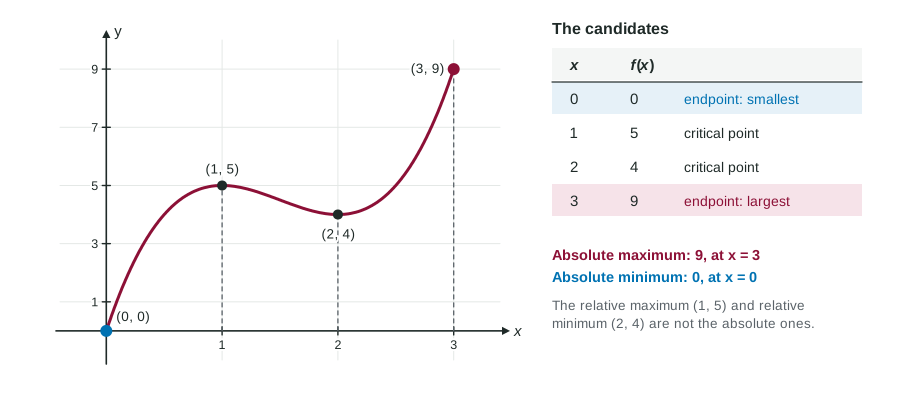
On a closed interval, a continuous function has absolute extrema, and they sit at endpoints or critical points.
Part 1 · Hook
Why this matters
Part 2 · Before you start
What this builds on
Part 3 · Prerequisite check
Quick check before you start
1. The Extreme Value Theorem guarantees an absolute maximum when is
- continuous on a closed interval
- differentiable on an open interval
- increasing
- defined at both endpoints
Show the answer
Continuity on is the hypothesis.
- Correct: continuous on a closed interval:
- differentiable on an open interval:
- increasing:
- defined at both endpoints:
2. changes from positive to negative at . Then is
- a relative maximum
- a relative minimum
- the absolute maximum
- not an extremum
Show the answer
The First Derivative Test gives a relative (local) maximum.
- Correct: a relative maximum:
- a relative minimum:
- the absolute maximum:
- not an extremum:
Part 4 · See it
See it first
Part 5 · Step by step
How it works, step by step
- is continuous on by the Extreme Value Theorem, an absolute maximum and minimum exist
- An absolute extremum is either at an endpoint or insideif inside, it is at a critical point, where is 0 or undefined
- So the endpoints and critical points are the only candidatesevaluate at each one and compare: the largest value is the absolute maximum, the smallest the absolute minimum
- You only showed a sign change of that proves a relative extremum, a local fact, not an absolute one
Part 6 · Key ideas
Key ideas
- Candidates Test (closed interval method): for continuous on , list the endpoints and the critical points in , compute at each, and compare.
- No derivative signs needed: just values. Show the table of candidates and values in your answer.
- The absolute extrema can be at endpoints. A relative maximum can lose to an endpoint.
- On a calculator problem, find critical points with the graph or solver, store them, and evaluate the model at each candidate.
Part 7 · Misconception
A common mistake
The wrong idea: " changes from positive to negative at , so is the absolute maximum."
What actually happens: A sign change is a local argument: it only compares with nearby values. For an absolute extremum on a closed interval, compare the values at the endpoints and every critical point. Chief readers see this lost point every year.
Part 8 · Check yourself
Check yourself
Exam-style questions. Anything you miss goes into your review queue.
Table
Values of and
| 0 | 1 | 3 | 5 | 6 | |
|---|---|---|---|---|---|
| 4 | 7 | -2 | 1 | 5 | |
| 3 | 0 | undefined | 0 | 2 |
1. What is the absolute maximum value of on ?
No calculator. Type the exact value (a fraction, π, e or a root is fine).
Show the answer
Candidates: endpoints and critical points . Values: . The largest is .
- Answer: 7
2. Where does have its absolute minimum on ?
- At , the left endpoint
- At
- At , where
- Nowhere, because is undefined
Show the answer
Of the candidate values , the smallest is , so the absolute minimum is at .
- At , the left endpoint: is not the smallest.
- Correct: At : is the smallest of the five candidate values.
- At , where : is larger than .
- Nowhere, because is undefined: A critical point where is undefined is still a candidate, and here it wins.
3. Which list is the complete set of candidates for the absolute extrema of on ?
- , the critical points
- and , the endpoints
- and , where
Show the answer
On a closed interval, the candidates are the endpoints and the critical points (where is 0 or undefined): .
- Correct: : Both endpoints and every critical point, including where is undefined.
- , the critical points: The endpoints are missing; an absolute extremum can sit at an end.
- and , the endpoints: The critical points are missing.
- and , where : , where is undefined, and both endpoints are missing.
4. Which justification earns credit for "the absolute maximum of on is 7"?
- " changes from positive to negative at , so is the absolute maximum."
- ", so is the absolute maximum on ."
- " is greater than both endpoint values, and ."
- "The candidates give . The largest is 7, at ."
Show the answer
An absolute extremum needs a global argument. The Candidates Test lists every endpoint and critical point with its value and picks the largest.
- " changes from positive to negative at , so is the absolute maximum.": A sign change gives a relative maximum, a local fact. It does not compare with far-away values.
- ", so is the absolute maximum on .": A zero of is only a candidate.
- " is greater than both endpoint values, and .": Close, but the other critical points must be compared too.
- Correct: "The candidates give . The largest is 7, at .": A candidates test: every endpoint and critical point, with values, compared.
5. Find the absolute maximum value of on .
No calculator. Type the exact value (a fraction, π, e or a root is fine).
Show the answer
at ; only is in . Candidates: , , . Maximum: 18.
- Answer: 18
6. Find the absolute maximum value of on . Give an exact answer.
No calculator. Type the exact value (a fraction, π, e or a root is fine).
Show the answer
at . Candidates:
- Answer: ≈ 1.901
Part 9 · Summary
Summary
Part 10 · Up next
What comes next
Part 11 · Connections