Two cars can both be speeding up the road, one gaining speed faster and faster, the other gaining speed more and more slowly. Both position graphs go up, but they bend differently. That bend is concavity. You met it with tangent line approximations; now it becomes a tool for describing a whole graph, and the second derivative is how you measure it.
Concave up and concave down
On an interval, the graph of is concave up if is increasing there: the slopes get larger as you move right, and the graph bends upward like a cup. It is concave down if is decreasing: the slopes get smaller, and the graph bends downward like a cap.
Since is the derivative of , its sign tells whether increases:
- on an interval: increasing, graph concave up.
- on an interval: decreasing, graph concave down.
Concavity is independent of direction. A graph can be increasing and concave down (rising, but leveling off), or decreasing and concave up (falling, but leveling off).
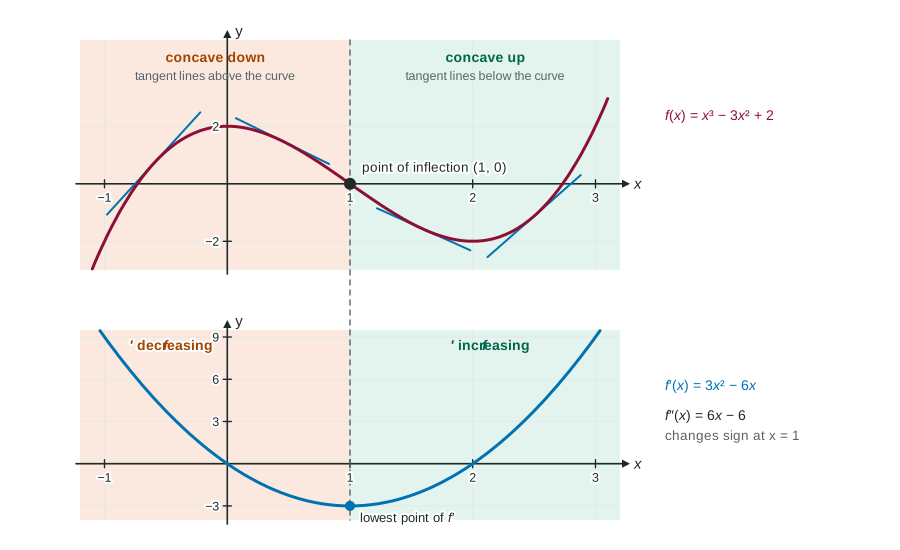
The tangent lines show it too. On a concave-up stretch the graph lies above its tangent lines, so a tangent line approximation there underestimates; on a concave-down stretch it overestimates.
Points of inflection
A point of inflection is a point on the graph where the concavity changes, from up to down or from down to up. For a function with a second derivative, that means changes sign there. Equivalently, changes from increasing to decreasing, or from decreasing to increasing, so has a relative maximum or minimum at that .
To find them:
- Find .
- Find where or does not exist. These are only candidates.
- Check the sign of on each side of each candidate. Keep the ones where the sign changes (and where is defined).
Worked example 1. Find the intervals of concavity and the points of inflection of .
,
Signs of : , , .
Concave up on and ; concave down on . The sign changes at both, so the points of inflection are and .
A zero of is not enough
For , , so . But on both sides of 0: the graph is concave up the whole way, and there is no point of inflection. This is the same trap as " means an extremum": a zero is a candidate, and the sign change is what decides. A justification that says only "" earns nothing.
Concavity from a graph of
This is the most tested version. Given the graph of :
| On the graph of | Tells you about |
|---|---|
| Above or below the -axis (the sign of ) | increasing or decreasing |
| Crossing the axis (a sign change of ) | relative extremum |
| Rising or falling (the slope of , which is ) | concave up or concave down |
| A peak or valley (where turns) | point of inflection |
The common error is to put inflection points at the zeros of . Zeros of are where may have extrema; the turns of are where inflects.
Worked example 2.
is decreasing between its high point and its low point, so is concave down on and concave up elsewhere.
Points of inflection of are at and , where changes from increasing to decreasing and from decreasing to increasing. Justify: " changes from decreasing to increasing at , so the graph of has a point of inflection there."
Concavity in context
If counts people who have heard a rumor, is how fast it spreads. If increases until and decreases after, the spread is fastest at : the graph of has a point of inflection there, changing from concave up to concave down. In words, "increasing at a decreasing rate" means and .