The introduction showed the idea; this page is the full routine, applied to the kinds of problems the exam uses: boxes, cans, cables, shapes inside shapes. The calculus is short. Most mistakes happen in the setup, so the setup gets most of the attention here.
The routine
- Draw the situation and label every changing length or amount with a letter.
- Write the objective function: the quantity to maximize or minimize.
- Write the constraint: the fixed fact that links the variables (a volume, a perimeter, a total length).
- Use the constraint to write the objective in one variable.
- Find the domain from the physical limits.
- Find the critical points in the domain.
- Justify the absolute extremum: candidates on a closed domain, or one critical point that is a relative extremum.
- Answer the question in context, with units.
Keep the objective and the constraint apart. In "an open box with a square base must hold 32 cubic feet; use the least material," the constraint is the volume , and the objective is the material, . Mixing them up is the most common setup error.
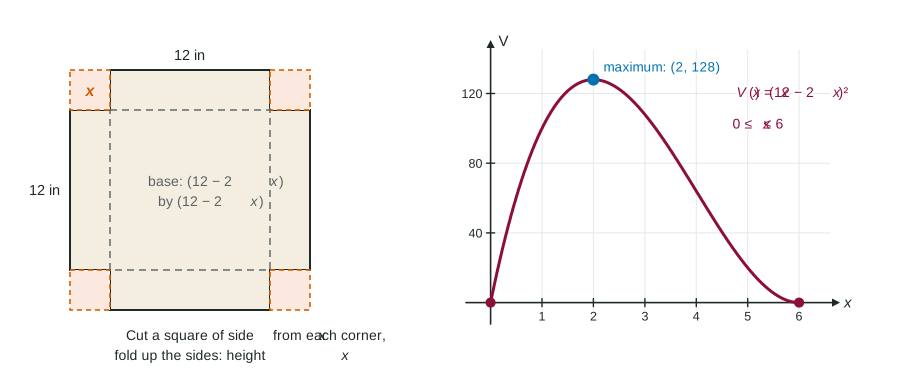
Worked example 1. A 16-inch by 10-inch sheet has a square of side cut from each corner, and the sides are folded up into an open box. Find the largest volume.
Objective: the base loses in each direction, so
Domain: the short side needs , so .
Critical points:
Justify: , , .
Answer: cut 2-inch squares; the box holds 144 cubic inches.
Worked example 2. A closed can must hold 500 cubic centimeters. What radius uses the least metal?
Objective: surface area, two ends plus the side: .
Constraint: , so and , for .
Critical point:
Justify: it is the only critical point for , and , so it is a relative minimum and therefore the absolute minimum.
The domain has no endpoints to compare, which is exactly when the one-critical-point argument is needed.
Calculator optimization
When the critical point has no clean formula, use the calculator to solve , store the result, and evaluate.
Worked example 3. A cable runs from a station on one bank of a river 2 km wide, underwater to a point km downstream on the far bank, then along the bank to a factory 8 km downstream. It costs 5 thousand dollars per km underwater and 3.5 on land, so
Candidates: , , . The cheapest route lands about 1.960 km downstream and costs about 35.141 thousand dollars.
Shapes inside shapes
For a rectangle with its base on the diameter of a semicircle of radius 5, put the top right corner at . The width is , so on . The derivative is zero at , and , larger than . Placing a corner on the curve is what links the variables here; that is the constraint.
Checklist before you write the answer
- Is each critical point inside the domain? Reject the others, and say why.
- Did you justify the extremum, not just find ?
- Did you answer what was asked (the dimensions, the cost, the radius) with units?
- On a calculator problem, did you show the setup, , and give three decimal places?