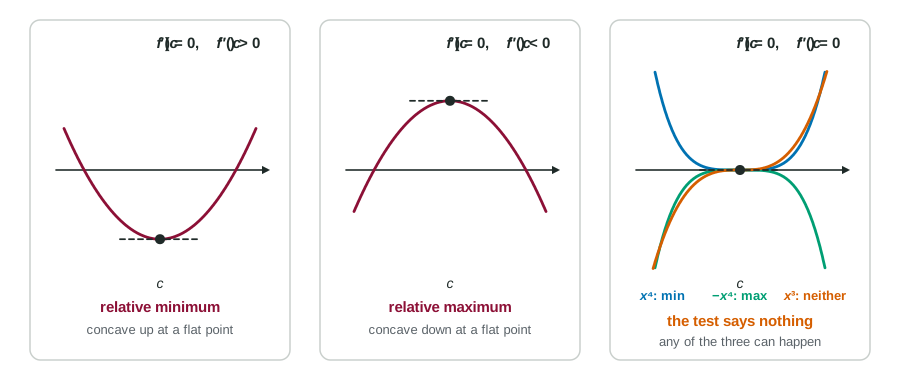
The First Derivative Test needs the sign of on both sides of a critical point. Often there is a quicker way: look at the concavity right at the point. A flat spot at the bottom of a cup is a valley; a flat spot at the top of a cap is a peak. That is the Second Derivative Test.
The test
Suppose and exists.
- If , the graph is concave up at , and has a relative minimum at .
- If , the graph is concave down at , and has a relative maximum at .
- If , the test gives no conclusion.
Why it works: if , then is increasing near . Since , must be negative just before and positive just after. That is the First Derivative Test's condition for a minimum.
Worked example 1. Find and classify the critical points of
.
: relative maximum,
: relative minimum,
The justification needs both facts: " and , so has a relative minimum at ." Saying only "" is not enough: a graph can be concave up at a point where it is still rising.
When the test is silent
If , anything can happen. At , the functions , and all have and , yet the first has a minimum, the second a maximum and the third neither. The test also does not apply where does not exist (a corner or cusp). In those cases, go back to the First Derivative Test.
Worked example 2. . Classify the critical point .
and , so and : the Second Derivative Test gives no conclusion.
First Derivative Test: just left and just right of 0 (the factor is positive, is negative). No sign change: no extremum at .
Tables of and
The test is ideal when you are given a table, because it needs only values at the point:
| Conclusion | ||
|---|---|---|
| positive | relative minimum | |
| negative | relative maximum | |
| no conclusion from this test | ||
| not | anything | not a critical point (if is differentiable): no extremum |
One critical point on an interval
The Second Derivative Test finds relative extrema. But there is a useful case where a relative extremum is also absolute. If a continuous function has exactly one critical point on an interval, and it is a relative minimum (or maximum), then it is the absolute minimum (or maximum) on that interval. The graph cannot turn around again to go lower, because turning around would need another critical point.
Worked example 3. Find the absolute minimum of on .
at , the only critical point in .
, so : a relative minimum.
One critical point, and it is a relative minimum, so is the absolute minimum on , even though the interval has no endpoints to compare with.
This argument is the second way, besides the Candidates Test, to justify an absolute extremum. It is the one you will use most when a later problem asks for the best value on an open interval.