The Second Derivative Test
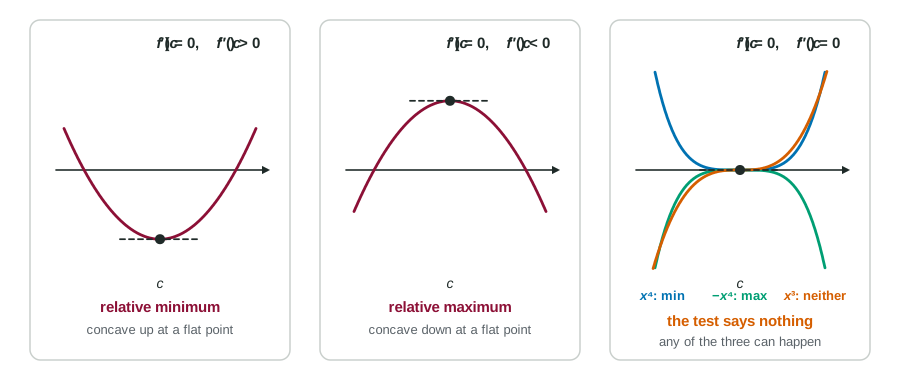
At a critical point where f′(c) = 0 , the sign of f″(c) decides: positive gives a relative minimum, negative a relative maximum, zero gives no conclusion.
Part 1 · Hook
Why this matters
Part 2 · Before you start
What this builds on
Part 3 · Prerequisite check
Quick check before you start
1. If on an interval, the graph of there is
- concave down
- concave up
- decreasing
- increasing
Show the answer
means is decreasing: the graph bends down.
- Correct: concave down:
- concave up:
- decreasing:
- increasing:
2. changes from negative to positive at . Then has
- a relative minimum at
- a relative maximum at
- a point of inflection at
- no extremum at
Show the answer
The First Derivative Test.
- Correct: a relative minimum at :
- a relative maximum at :
- a point of inflection at :
- no extremum at :
Part 4 · See it
See it first
Part 5 · Step by step
How it works, step by step
- and the tangent line at is flat and the graph bends up away from it, so is a relative minimum
- and the graph bends down from a flat point, so is a relative maximum
- and (or does not exist)the test is inconclusive; go back to the First Derivative Test
- A continuous has exactly one critical point on an interval, and it is a relative extremumthat relative extremum is also the absolute extremum on the interval
Part 6 · Key ideas
Key ideas
- Second Derivative Test: if and , has a relative minimum at ; if and , a relative maximum.
- It says nothing when or when does not exist. Then use the First Derivative Test.
- Justify with both facts: " and ."
- One critical point on an interval, and it is a relative minimum (maximum)? Then it is the absolute minimum (maximum) there, even on an open interval.
Part 7 · Misconception
A common mistake
The wrong idea: , so has a relative minimum at .
What actually happens: Concave up alone is not a minimum: at is concave up and rising. The test needs a critical point first, , and then the sign of . And when , the test says nothing at all.
Part 8 · Check yourself
Check yourself
Exam-style questions. Anything you miss goes into your review queue.
Table
Values of and
| -2 | 0 | 1 | 3 | 4 | |
|---|---|---|---|---|---|
| 0 | -2 | 0 | 2 | 0 | |
| -3 | 2 | 4 | -1 | 0 |
1. At which value of in the table does have a relative maximum?
- , where
Show the answer
Second Derivative Test: and , so has a relative maximum at .
- : and : a relative minimum.
- Correct: : and : concave down at a flat point.
- : : the test gives no answer at .
- , where : , so is not a critical point.
2. Which justification earns credit for " has a relative minimum at "?
- " and ."
- "."
- "."
- " and , so changes sign."
Show the answer
The Second Derivative Test needs both: (critical point) and (concave up there), so has a relative minimum at .
- Correct: " and .": Both conditions of the Second Derivative Test.
- ".": Concave up alone is not a minimum; must also have a flat tangent line there.
- ".": A critical point alone is only a candidate.
- " and , so changes sign.": Values of at two separate points do not show a sign change at ; might change sign more than once.
3. What does the Second Derivative Test say about at ?
- A relative maximum, because
- A point of inflection, because and is continuous
- A relative minimum, because
- Nothing, because makes the test inconclusive
Show the answer
The Second Derivative Test needs . Here , so it gives no conclusion; check the sign of on each side instead.
- A relative maximum, because : The test needs strictly.
- A point of inflection, because and is continuous: does not show a sign change of .
- A relative minimum, because : only makes 4 a critical point.
- Correct: Nothing, because makes the test inconclusive: With , the point could be a maximum, a minimum or neither. Use the First Derivative Test.
4. Which describes the graph of at ?
- Increasing and concave up
- Decreasing and concave down
- Increasing and concave down
- A relative maximum, because
Show the answer
, so is increasing; , so it is concave down.
- Increasing and concave up: means concave down.
- Decreasing and concave down: means increasing.
- Correct: Increasing and concave down: and .
- A relative maximum, because : is not a critical point, so the test does not apply.
5. Find the absolute minimum value of on .
No calculator. Type the exact value (a fraction, π, e or a root is fine).
Show the answer
at (the one critical point in ). , so : a relative minimum, and as the only critical point it is the absolute minimum, .
- Answer: 2
6. A company's profit is dollars when it makes units. and . What can you conclude?
- Making 50 units gives a relative maximum of profit
- Making 50 units gives a relative minimum of profit
- Profit is increasing at a decreasing rate at 50 units
- At 50 units, profit is dollars
Show the answer
and : by the Second Derivative Test, has a relative maximum at .
- Correct: Making 50 units gives a relative maximum of profit: A flat point where the graph is concave down: a peak.
- Making 50 units gives a relative minimum of profit: means concave down: a maximum, not a minimum.
- Profit is increasing at a decreasing rate at 50 units: , so profit is not increasing at 50 units.
- At 50 units, profit is dollars: is the value of , not of .
Part 9 · Summary
Summary
Part 10 · Up next
What comes next
Part 11 · Connections