A circle, an oval or a looping curve fails the vertical line test, so it is not the graph of a function . You already know how to find its slope with implicit differentiation. This topic asks what that slope formula tells you about the shape: where the curve is flat, where it stands straight up, and where it has a local high or low point.
The slope formula as a fraction
Differentiate both sides of the curve's equation with respect to , write "" (or the derivative of the right side), and solve. The result usually looks like a fraction in both and :
Worked example 1. Find for .
of both sides:
Collect the terms: , so
Horizontal and vertical tangent lines
A horizontal tangent needs slope 0, so the numerator must be 0 while the denominator is not. A vertical tangent line needs the slope to be undefined because the denominator is 0 while the numerator is not. In both cases the point must actually be on the curve.
| Tangent line | Numerator | Denominator | Also |
|---|---|---|---|
| horizontal | not | point on the curve | |
| vertical | not | point on the curve | |
| no conclusion | the formula gives |
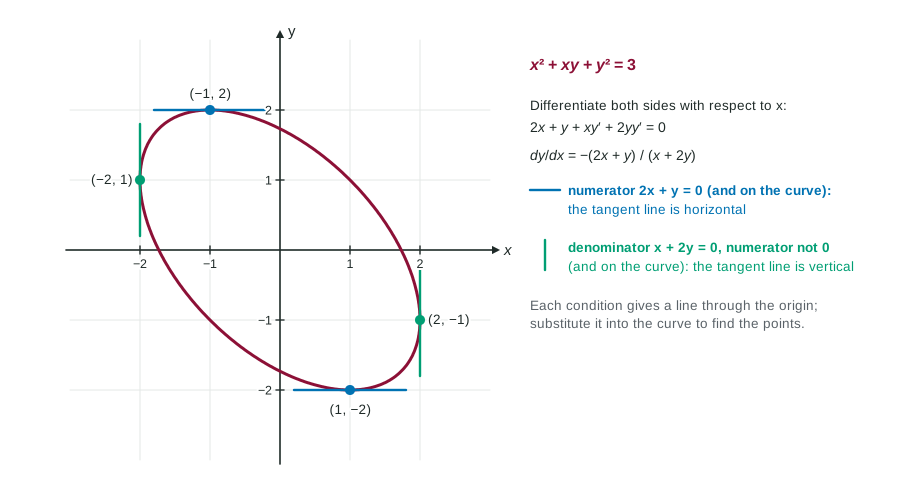
Worked example 2. Find the points of with horizontal and with vertical tangent lines.
Horizontal: , so . Substitute into the curve: , so and . Points and ; the denominator there is and , not 0.
Vertical: , so . Substitute: , so . Points and ; the numerator there is and , not 0.
The substitution step is the one students skip. The point makes the numerator zero, but , so it is not on the curve, and its "slope" means nothing.
When both parts are zero
For the curve , implicit differentiation gives
High and low points of a curve
Near a point with a horizontal tangent, the curve is the graph of a function of , so the Second Derivative Test still works. Find by differentiating the fraction for (quotient rule, treating as a function of ), then substitute the point and the value .
Worked example 3. For , find at .
At , and : .
A horizontal tangent where the curve is concave down: is a local high point of the curve, and in fact its highest point.
What earns the points
- Apply to both sides and keep "" on the right.
- Use the product rule on every -type term and the chain rule on every power of .
- For a vertical tangent, say "the denominator is 0 and the numerator is not," never "."
- Substitute candidate points back into the curve's equation.