Unit 5 · Topic 5.12 Beta

Behavior of Implicit Relations

For an implicit curve, dy/dx = N/D .

Practice 1: Implementing Mathematical ProcessesPractice 3: Justification

Question set for this topic

Part 1 · Hook

Why this matters

A race track is not the graph of a function: it loops back, and at some points it runs straight up the page. Designers still need to know where the track runs exactly east-west or north-south. Implicit differentiation gives the slope at every point of such a curve, and the slope formula shows where it is flat or vertical.

Part 2 · Before you start

What this builds on

Part 3 · Prerequisite check

Quick check before you start

1. Differentiating y2y^2 with respect to xx gives

  1. 2ydydx2y\frac{dy}{dx}
  2. 2y2y
  3. 2x2x
  4. ydydxy\frac{dy}{dx}
Show the answer

Chain rule: yy depends on xx.

  • Correct: 2ydydx2y\frac{dy}{dx}:
  • 2y2y:
  • 2x2x:
  • ydydxy\frac{dy}{dx}:

2. A critical point of a function ff is an interior point where

  1. f′(x)=0f'(x) = 0 or f′(x)f'(x) does not exist
  2. f(x)=0f(x) = 0
  3. f″(x)=0f''(x) = 0
  4. ff is largest
Show the answer

The same idea, for curves, uses dydx\frac{dy}{dx}.

  • Correct: f′(x)=0f'(x) = 0 or f′(x)f'(x) does not exist:
  • f(x)=0f(x) = 0:
  • f″(x)=0f''(x) = 0:
  • ff is largest:

3. If f′(c)=0f'(c) = 0 and f″(c)<0f''(c) < 0, ff has

  1. a relative maximum at cc
  2. a relative minimum at cc
  3. a point of inflection at cc
  4. no conclusion
Show the answer

The Second Derivative Test.

  • Correct: a relative maximum at cc:
  • a relative minimum at cc:
  • a point of inflection at cc:
  • no conclusion:

Part 4 · See it

See it first
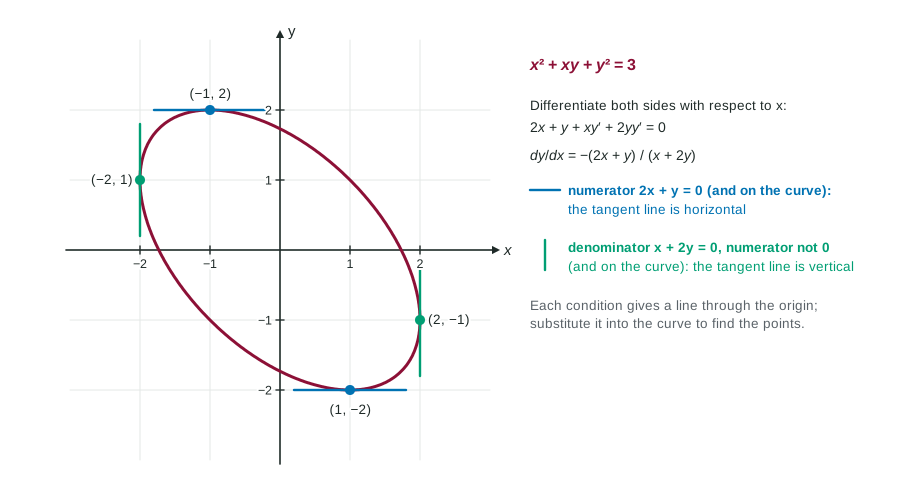
The tilted oval x squared plus xy plus y squared = 3, with dy/dx = -(2x + y)/(x + 2y). Horizontal tangent lines touch it at (-1, 2) and (1, -2), where the numerator 2x + y is zero; vertical tangent lines touch it at (-2, 1) and (2, -1), where the denominator x + 2y is zero and the numerator is not.
On x2+xy+y2=3x^2 + xy + y^2 = 3, the numerator of dydx\frac{dy}{dx} vanishes at the blue points (horizontal tangent lines) and the denominator at the green ones (vertical tangent lines). LevlPrep original diagram.

Part 5 · Step by step

How it works, step by step

  1. Differentiate both sides of the curve's equation with respect to xx, then solvedydx\frac{dy}{dx}=N(x,y)D(x,y)= \frac{N(x, y)}{D(x, y)}, a slope at each point (x,y)(x, y) of the curve
  2. N=0N = 0, D≠0D \ne 0, and the point is on the curvethe tangent line is horizontal there
  3. D=0D = 0, N≠0N \ne 0, and the point is on the curvethe tangent line is vertical there
  4. N=0N = 0 and D=0D = 0 at oncethe formula decides nothing at that point
  5. dydx=0\frac{dy}{dx} = 0 and the sign of d2ydx2\frac{d^2y}{dx^2} is knownthe curve has a local high point (<0< 0) or low point (>0> 0)

Part 6 · Key ideas

Key ideas

  • Horizontal tangent: numerator of dydx\frac{dy}{dx} is 0, denominator is not, point is on the curve. Vertical tangent: denominator 0, numerator not 0, point on the curve.
  • To find the points: set the numerator (or denominator) to 0, solve for one variable, substitute into the curve's equation, then check the other part is not 0.
  • d2ydx2\frac{d^2y}{dx^2}: differentiate dydx\frac{dy}{dx} (quotient rule), then substitute the point and the value of dydx\frac{dy}{dx} there.
  • Write "=0= 0" after differentiating, and apply ddx\frac{d}{dx} to both sides.

Part 7 · Misconception

A common mistake

The wrong idea: The tangent line is vertical where dydx=0\frac{dy}{dx} = 0.

What actually happens: dydx=0\frac{dy}{dx} = 0 means a horizontal tangent. A vertical tangent is where the slope is undefined because the denominator is 0 and the numerator is not. And every candidate point must satisfy the curve's equation; a point that only makes the numerator zero may not be on the curve at all.

Part 8 · Check yourself

Check yourself

Exam-style questions. Anything you miss goes into your review queue.

Graph

The curve x2−xy+y2=12x^2 - xy + y^2 = 12

The graph shows the tilted oval x2−xy+y2=12x^2 - xy + y^2 = 12. Marked points: (2,4)(2, 4), (−2,−4)(-2, -4), (4,2)(4, 2), (−4,−2)(-4, -2) and (−2,2)(-2, 2).
−5−4−3−2−112345−5−4−3−2−112345xy(2, 4)(4, 2)(-2, 2)

1. Differentiate the oval's equation implicitly and solve: find dydx\frac{dy}{dx} in terms of xx and yy.

Type an expression for dydx=\frac{dy}{dx} =.

Show the answer

ddx\frac{d}{dx} of both sides: 2x−(y+xdydx)+2ydydx2x - \left(y + x\frac{dy}{dx}\right) + 2y\frac{dy}{dx}=0= 0. So dydx(2y−x)=y−2x\frac{dy}{dx}(2y - x) = y - 2x and dydx\frac{dy}{dx}=y−2x2y−x= \frac{y - 2x}{2y - x}.

  • Answer: dydx=\frac{dy}{dx} = y−2x2y−x\frac{y - 2x}{2y - x}

2. At which points is the line tangent to the curve horizontal?

  1. (2,4)(2, 4) and (−2,−4)(-2, -4)
  2. (4,2)(4, 2) and (−4,−2)(-4, -2)
  3. (0,23)(0, 2\sqrt{3}) and (0,−23)(0, -2\sqrt{3})
  4. (−2,2)(-2, 2) and (2,−2)(2, -2)
Show the answer

Horizontal: numerator y−2x=0y - 2x = 0 with the point on the curve and the denominator not 0. Substituting y=2xy = 2x: 3x2=123x^2 = 12, so (2,4)(2, 4) and (−2,−4)(-2, -4); the denominator there is 66 and −6-6.

  • Correct: (2,4)(2, 4) and (−2,−4)(-2, -4): y=2xy = 2x makes the numerator 0; on the curve, x2−2x2+4x2=12x^2 - 2x^2 + 4x^2 = 12 gives x=±2x = \pm 2.
  • (4,2)(4, 2) and (−4,−2)(-4, -2): There the denominator 2y−x2y - x is 0: vertical tangent lines.
  • (0,23)(0, 2\sqrt{3}) and (0,−23)(0, -2\sqrt{3}): At (0,23)(0, 2\sqrt{3}), dydx\frac{dy}{dx}=2343= \frac{2\sqrt{3}}{4\sqrt{3}}=12= \frac{1}{2}.
  • (−2,2)(-2, 2) and (2,−2)(2, -2): At (−2,2)(-2, 2), dydx=1\frac{dy}{dx} = 1.

3. At which points is the line tangent to the curve vertical?

  1. (2,4)(2, 4) and (−2,−4)(-2, -4)
  2. (23,0)(2\sqrt{3}, 0) and (−23,0)(-2\sqrt{3}, 0)
  3. (0,0)(0, 0), where both parts are 0
  4. (4,2)(4, 2) and (−4,−2)(-4, -2)
Show the answer

Vertical: denominator 2y−x=02y - x = 0, numerator not 0, point on the curve. x=2yx = 2y gives 4y2−2y2+y2=124y^2 - 2y^2 + y^2 = 12, so y=±2y = \pm 2: (4,2)(4, 2) and (−4,−2)(-4, -2).

  • (2,4)(2, 4) and (−2,−4)(-2, -4): There the numerator is 0: horizontal tangent lines.
  • (23,0)(2\sqrt{3}, 0) and (−23,0)(-2\sqrt{3}, 0): At (23,0)(2\sqrt{3}, 0), dydx\frac{dy}{dx}=−43−23= \frac{-4\sqrt{3}}{-2\sqrt{3}}=2= 2.
  • (0,0)(0, 0), where both parts are 0: (0,0)(0, 0) is not on the curve: 0≠120 \ne 12.
  • Correct: (4,2)(4, 2) and (−4,−2)(-4, -2): x=2yx = 2y makes the denominator 0; on the curve, 3y2=123y^2 = 12 gives y=±2y = \pm 2; the numerator is −6-6 and 66, not 0.

4. Write an equation for the line tangent to the curve at (−2,2)(-2, 2). Enter the right side.

Type an expression for y=y =.

Show the answer

dydx\frac{dy}{dx} at (−2,2)(-2, 2): 2−2(−2)2(2)−(−2)\frac{2 - 2(-2)}{2(2) - (-2)}=66= \frac{6}{6}=1= 1. Tangent line: y−2=1(x+2)y - 2 = 1(x + 2), so y=x+4y = x + 4.

  • Answer: y=y = x+4x + 4

5. At the highest point (2,4)(2, 4) of the oval, find d2ydx2\frac{d^2y}{dx^2}, which tells how the curve bends there.

No calculator. Type the exact value (a fraction, π, e or a root is fine).

Show the answer

Quotient rule: d2ydx2\frac{d^2y}{dx^2}=(dydx−2)(2y−x)−(y−2x)(2dydx−1)(2y−x)2= \frac{\left(\frac{dy}{dx} - 2\right)(2y - x) - (y - 2x)\left(2\frac{dy}{dx} - 1\right)}{(2y - x)^2}. At (2,4)(2, 4), dydx=0\frac{dy}{dx} = 0: (−2)(6)−036=−13\frac{(-2)(6) - 0}{36} = -\frac{1}{3}. Concave down at a horizontal tangent: (2,4)(2, 4) is the highest point.

  • Answer: −13\frac{-1}{3} ≈ -0.333

6. For a curve with dydx\frac{dy}{dx}=N(x,y)D(x,y)= \frac{N(x, y)}{D(x, y)}, which statement earns credit for "the tangent line is vertical at PP"?

  1. "dydx=0\frac{dy}{dx} = 0 at PP."
  2. "D=0D = 0 and N≠0N \ne 0 at PP, and PP is on the curve."
  3. "D=0D = 0 at PP."
  4. "N=0N = 0 and D≠0D \ne 0 at PP, and the point PP is on the curve."
Show the answer

Vertical tangent: the denominator is 0, the numerator is not, and the point lies on the curve. Chief readers see "dydx=0\frac{dy}{dx} = 0" used for vertical tangents every year; it is the condition for horizontal ones.

  • "dydx=0\frac{dy}{dx} = 0 at PP.": That is a horizontal tangent.
  • Correct: "D=0D = 0 and N≠0N \ne 0 at PP, and PP is on the curve.": All three conditions.
  • "D=0D = 0 at PP.": If N=0N = 0 too, nothing is decided; and PP must be on the curve.
  • "N=0N = 0 and D≠0D \ne 0 at PP, and the point PP is on the curve.": That is a horizontal tangent.

Part 9 · Summary

Summary

For an implicit curve, dydx=ND\frac{dy}{dx} = \frac{N}{D}. Horizontal tangents: N=0N = 0, D≠0D \ne 0, on the curve. Vertical tangents: D=0D = 0, N≠0N \ne 0, on the curve. Both zero: no conclusion. At a horizontal tangent, the sign of d2ydx2\frac{d^2y}{dx^2} tells whether the curve has a local high or low point.

Part 10 · Up next

What comes next

Part 11 · Connections

Connections