The First Derivative Test finds peaks and valleys, but only compared with their neighbors. Many real questions want more: the hottest moment of the whole day, the lowest level the reservoir reaches all month. That is an absolute extremum, and on a closed interval there is a short, reliable way to find it without any sign analysis at all.
Why a short list is enough
Put together what you already know. If is continuous on :
- The Extreme Value Theorem says an absolute maximum and an absolute minimum exist.
- Each one is either at an endpoint, or inside the interval.
- If it is inside, it is also a relative extremum, so it is at a critical point.
So the absolute extrema are among a short list of candidates: the two endpoints and the critical points in between. Evaluate at each candidate, and the largest value is the absolute maximum; the smallest is the absolute minimum.
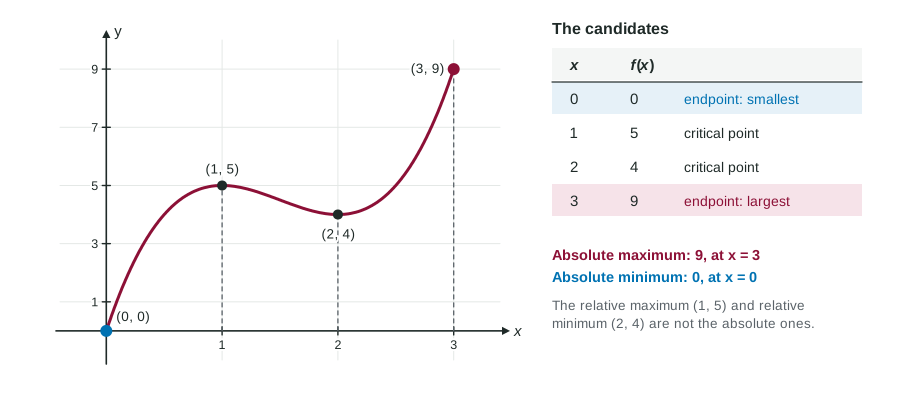
The Candidates Test, step by step
The Candidates Test (also called the closed interval method) for continuous on :
- Find .
- Find the critical points in the open interval : where or does not exist. Throw away any outside the interval.
- Make a table of and for the endpoints and each critical point.
- The largest in the table is the absolute maximum value; the smallest is the absolute minimum value.
Worked example 1. Find the absolute extrema of on .
Absolute maximum: , at . Absolute minimum: , at . Both are at endpoints; the relative maximum and relative minimum are not the absolute ones.
No signs of are needed, and nothing has to be said about which critical points are peaks. The comparison does all the work.
Exact answers without a calculator
Worked example 2. Find the absolute minimum of on .
when : and .
Candidates: ;
Absolute minimum: , at . Keep it exact; the decimals are only for comparing.
With a calculator
On a calculator question the critical points may not have a formula. Graph or use the solver to find its zeros, store each one, and evaluate at the stored values. Then compare with the endpoints.
Worked example 3. A reservoir holds
Candidates: , , , .
The least volume is about thousand gallons, at days. The endpoint value was close: only the comparison shows which is smaller.
Local versus global: the point readers take away
A justification like " changes from negative to positive at , so this is the absolute minimum" earns no credit. A sign change is a local fact: it compares with nearby values only. An endpoint, or another critical point far away, could be lower. For an absolute extremum you need a global argument. On a closed interval, the Candidates Test is the simplest one: show the table of candidates and values, then name the largest or smallest.
| Question asks for | Tool | Justification |
|---|---|---|
| A relative extremum | First Derivative Test | " changes from to at " |
| An absolute extremum on | Candidates Test | A table of endpoints and critical points with their values |