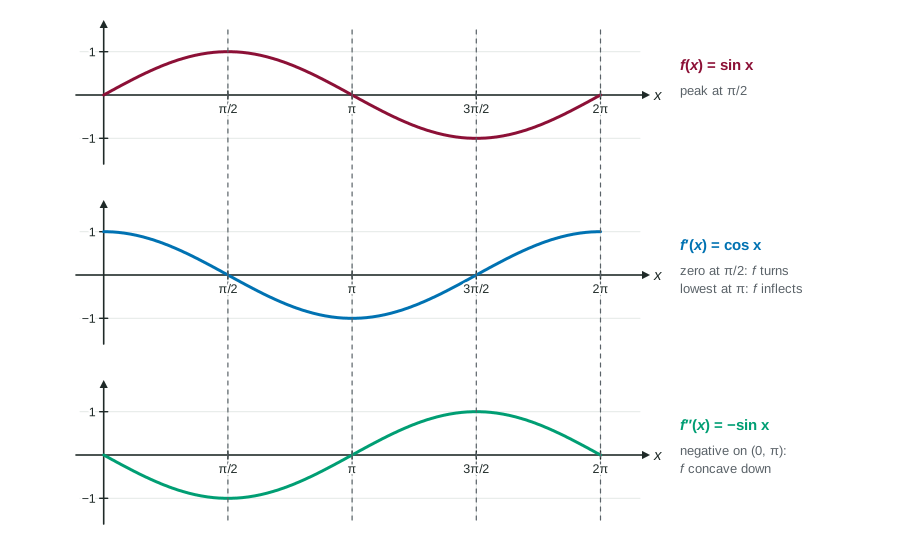
This topic pulls Unit 5 together. You are given one of , or , as a graph, a table or a formula, and asked about the others: where rises, where it peaks, how it bends, whether a tangent line over- or underestimates. Every year one free-response question is built this way around a graph of . The skill is graphical analysis: reading the right feature of the right function and saying so by name.
One story told three ways
| Behavior of | Read from | Read from |
|---|---|---|
| increasing | (not enough) | |
| relative maximum | changes from to | and |
| concave up | increasing | |
| point of inflection | changes from increasing to decreasing, or back | changes sign |
Always ask which function the given information is about. "Positive" means something different for , and .
Working from a graph of
Worked example 1. The graph of on has a high point at , a low point at , and crosses the axis at , and . Also .
Relative maximum of : at , because changes from positive to negative there.
Concave up: on and , because is increasing there.
Inflection points: at and , because changes from increasing to decreasing at 0 and from decreasing to increasing at 2.
At : , so is decreasing there, and it has a point of inflection.
Tangent line at : point , slope , so .
Notice the pattern in every justification: it names and says what does. "The graph changes direction at 1" names nothing and earns nothing.
Working from a table
A table gives exact values at a few points. Use the tests that need only those values, and the theorems that connect them.
Worked example 2. is twice differentiable and is continuous.
At : and , so by the Second Derivative Test has a relative minimum.
Inflection in : is continuous, and , so changes from positive to negative somewhere in : the graph has a point of inflection there.
Approximating : gives . Because and is continuous, is concave down near 4, the graph lies below the tangent line, and is an overestimate.
Working from words
Contexts describe derivatives in words. Translate before you calculate:
- "Increasing at a decreasing rate": and .
- "Decreasing, but more and more slowly": and .
- "The rate of change is greatest": has a maximum, which is where changes from positive to negative, an inflection point of .
- For motion, position : velocity and acceleration . With and , the object moves forward and slows down.
A global fact from
Sometimes the sign of holds everywhere, and that gives a global answer. If for all and , then is decreasing on the whole line: positive before 2 and negative after. So rises to and falls after, and is the absolute maximum, not just a relative one.
The two classic swaps
- Zeros versus turns. On a graph of , zeros (where it crosses the axis) are candidates for extrema of ; turns (its peaks and valleys) are inflection points of .
- Sign versus direction. The sign of gives the direction of ; the direction of gives the concavity of . "f is increasing because is increasing" mixes them up.