Connecting f, f' and f''
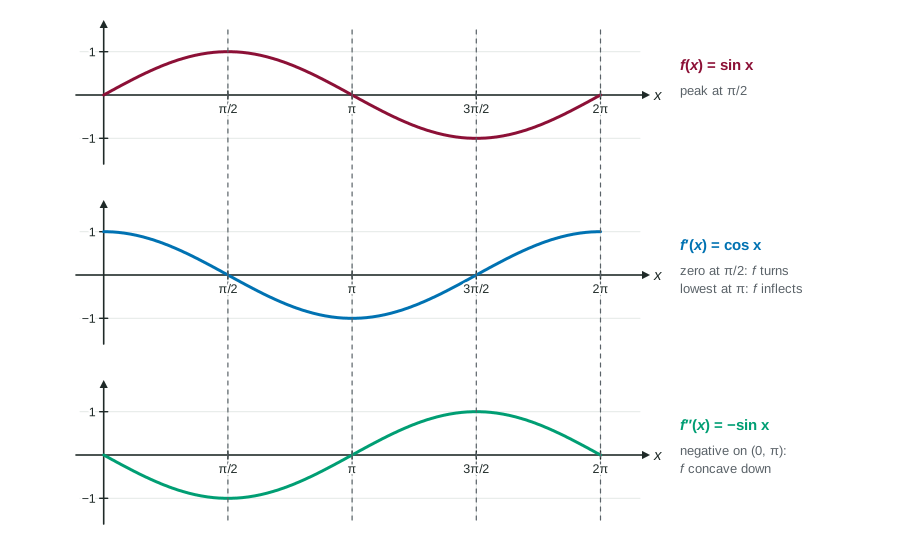
The three graphs carry one story.
Part 1 · Hook
Why this matters
Part 2 · Before you start
What this builds on
Part 3 · Prerequisite check
Quick check before you start
1. Where the graph of has a high point, the graph of has
- a point of inflection
- a relative maximum
- a relative minimum
- a corner
Show the answer
turns, so changes sign: the concavity of changes.
- Correct: a point of inflection:
- a relative maximum:
- a relative minimum:
- a corner:
2. and mean has
- a relative minimum at
- a relative maximum at
- a point of inflection at
- no conclusion
Show the answer
The Second Derivative Test.
- Correct: a relative minimum at :
- a relative maximum at :
- a point of inflection at :
- no conclusion:
3. The line tangent to at is
Show the answer
Point , slope .
- Correct: :
- :
- :
- :
Part 4 · See it
See it first
Part 5 · Step by step
How it works, step by step
- The sign of tells whether is increasing or decreasing; a sign change of is a relative extremum of
- The sign of , or whether is rising or fallingtells the concavity of ; a sign change of is a point of inflection of
- and give the tangent line, and the sign of near says whether it overestimates or underestimates
- A justification on the examnames the function whose sign or direction you read: " changes from positive to negative", " is decreasing"
Part 6 · Key ideas
Key ideas
- Graphical analysis: given any one of , , (graph, table or formula), read the features of the others.
- From a graph of : sign of (above or below the axis) gives increasing or decreasing; direction of (rising or falling) gives concavity.
- From a table: and the sign of give the Second Derivative Test; a continuous that changes from positive to negative between two inputs gives a point of inflection between them.
- Words: "increasing at a decreasing rate" means and .
Part 7 · Misconception
A common mistake
The wrong idea: On a graph of , the points of inflection of are where the graph of crosses the -axis.
What actually happens: Crossings of are where has extrema. Inflection points of are where turns (its peaks and valleys), because that is where changes sign. Chief readers see this swap every year.
Part 8 · Check yourself
Check yourself
Exam-style questions. Anything you miss goes into your review queue.
Graph
The graph of
1. At which value of does have a relative maximum?
- , where is highest
- , where is lowest
- , where
Show the answer
crosses the axis going down at (positive before, negative after), so has a relative maximum there.
- Correct: : changes from positive to negative at .
- , where is highest: A high point of is an inflection point of .
- , where is lowest: A low point of is an inflection point of .
- , where : changes from negative to positive there: a relative minimum.
2. On which intervals is the graph of concave up?
- and
- and
- and
Show the answer
is concave up where is increasing: from up to its high point at 0, and after its low point at 2.
- : is decreasing there: concave down.
- and : There : is increasing. That is direction, not concavity.
- and : There : is decreasing.
- Correct: and : is increasing there.
3. Use the graph and the formula to find the slope of the graph of at , which is .
No calculator. Type the exact value (a fraction, π, e or a root is fine).
Show the answer
, so : the graph of is falling at , and is concave down there.
- Answer: -3
4. Which is true of the graph of at ?
- It has a relative minimum
- It is decreasing and has a point of inflection
- It is increasing and concave up
- It has a point of inflection and a relative minimum
Show the answer
- It has a relative minimum: : not a critical point.
- Correct: It is decreasing and has a point of inflection: , and changes from decreasing to increasing at 2.
- It is increasing and concave up: means decreasing.
- It has a point of inflection and a relative minimum: A relative minimum would need to change sign at 2.
5. Write an equation for the line tangent to the graph of at . Enter the right side.
Type an expression for .
Show the answer
Point , slope :
- Answer:
6. On , and . Which describes there?
- Increasing, at an increasing rate
- Decreasing, at a decreasing rate
- Decreasing, and concave down
- Increasing, at a decreasing rate
Show the answer
means increases; means decreases, so the increase slows down: concave down.
- Increasing, at an increasing rate: That would need .
- Decreasing, at a decreasing rate: means increasing.
- Decreasing, and concave down: means increasing.
- Correct: Increasing, at a decreasing rate: : increasing. : the rate is falling.
Part 9 · Summary
Summary
Part 10 · Up next
What comes next
Part 11 · Connections